Oil Change vs Tune Up: Maintenance Comparison 2026
This analysis compares oil changes and tune-ups to help you choose the right service. Learn what each entails, when to schedule them, and how to plan combined maintenance for better engine health in 2026.


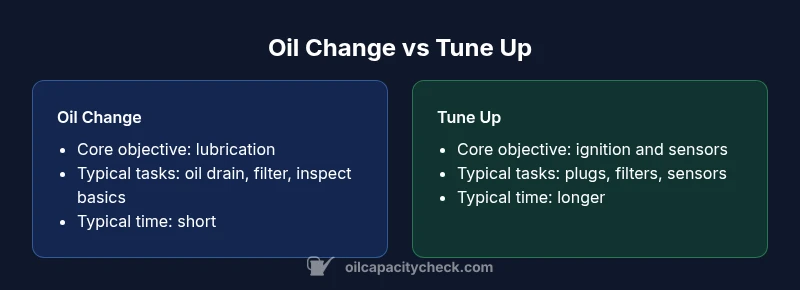
Oil change vs tune up: the difference is purpose. An oil change is routine lubrication to protect the engine, while a tune-up targets ignition, sensors, and related systems to restore efficiency. For most drivers, regular oil changes are the baseline, and a tune-up is warranted when performance symptoms appear. This quick comparison helps you decide which service to schedule first.
Understanding the difference between oil change and tune-up
At first glance, the phrases oil change and tune-up seem similar, but they address different needs. An oil change primarily preserves the engine’s lubrication, reducing wear and preventing overheating. A tune-up focuses on the combustion system, including spark plugs, ignition timing, filters, and sensors, to optimize performance and fuel efficiency. According to Oil Capacity Check, most vehicle owners should treat oil changes as a foundational service and consider a tune-up when signs of performance degradation appear. This page explains how each service works, what it includes, and how to decide which is appropriate given your vehicle’s condition and maintenance history. Understanding these distinctions helps you build a maintenance plan that minimizes risk and cost over the life of your engine.
How engine oil keeps your engine healthy
Engine oil forms a protective film between metal parts, reducing friction, cooling hot surfaces, and helping to remove contaminants. When oil breaks down or is contaminated, viscosity changes and the lubrication layer thins, increasing wear. An oil change replaces old oil and the oil filter, restoring proper filtration and flow. The choice of oil type—conventional, synthetic, or synthetic blend—depends on engine design, climate, and driving style. Oil Capacity Check emphasizes following the vehicle’s owner manual to select the right viscosity and capacity. Regular oil changes also provide an opportunity to inspect belts, hoses, and the underside for leaks or signs of wear, all of which contribute to long-term reliability.
What a tune-up typically covers in modern engines
A tune-up today often centers on restoring ignition and fuel delivery efficiency. Common steps include inspecting and possibly replacing spark plugs, checking ignition coils, cleaning or replacing air and fuel filters, and testing sensors and actuators. Some tune-ups also involve inspecting belts, hoses, PCV valves, and vacuum lines. In newer vehicles, many maintenance tasks blend with diagnostic checks rather than a classic, one-time tune-up. Oil Capacity Check notes that the term tune-up has evolved; many modern cars require scheduled maintenance rather than routine tune-ups, unless a symptom or warning light indicates an underlying issue.
The scope difference: lubrication versus ignition and sensors
Lubrication maintenance and ignition system maintenance address different failure modes. Oil changes prevent metal-on-metal wear and overheating, protecting engine longevity. Tune-ups address inconsistent combustion, misfires, poor fuel economy, and rough running. If you drive a vehicle with a modern engine, you may not need a traditional tune-up as frequently, but periodic checks of spark plugs, coils, air/fuel mixtures, and sensors remain important. Oil Capacity Check highlights that both services benefit from timely inspection; skipping either can lead to accelerated wear or undiagnosed problems that become costly to repair.
Frequency, timing, and cost considerations
Oil changes are typically scheduled at manufacturer-recommended intervals and are among the most affordable routine services. Tune-ups, when needed, can be more expensive and time-consuming because they may involve labor for diagnostics and component replacement. Your exact cost depends on vehicle make, model, and the number of parts replaced. Oil Capacity Check advises using manufacturer intervals as a baseline and treating tune-ups as symptom-driven rather than routine. This approach helps you balance maintenance quality with cost efficiency over the vehicle’s lifetime.
Decision guide: when to choose oil change over tune-up
If the vehicle has no running symptoms and the oil life indicator or service interval is near, start with an oil change. If you notice rough idling, misfires, reduced acceleration, unusual exhaust, or a check engine light, a tune-up or deeper diagnostic may be warranted. For older vehicles with ambiguous symptoms, a combined service visit can be efficient, but plan the scope carefully to avoid unnecessary work. Oil Capacity Check emphasizes documenting service history to ensure you do not duplicate work on a single visit and to keep maintenance aligned with the car’s needs.
Planning combined services for convenience and risk reduction
Combining an oil change with a tune-up can save time and ensure multiple systems are evaluated in a single visit. Before scheduling, prepare a clear list of symptoms and a maintenance timeline, and confirm what each shop includes in its tune-up package. Some shops bundle ignition checks with air filter replacements and belt inspections, while others separate these tasks. Consider coordinating with a single trusted technician who can interpret diagnostic codes and align service with manufacturer recommendations. Oil Capacity Check notes that a well-planned visit may reduce the total downtime and risk of patchwork repairs later on.
Practical steps to prepare for an oil change or tune-up
Before a service, make a simple checklist: verify oil type and capacity from the owner’s manual, confirm tire condition and fluid levels, clear the workspace for any additional diagnostics, and bring a current maintenance log. On the day of service, arrive early if you expect a detailed tune-up, and ask the technician to explain any recommended replacements beyond the standard oil and filter. After service, inspect the receipt to verify oil grade, filter specification, and any parts that were replaced. This proactive approach helps you stay informed and keeps future maintenance predictable.
Real-world scenarios and decision paths
Consider a daily commuter with a high-mileage vehicle. An oil change every few thousand miles is likely to occur more often than a tune-up. If that same vehicle begins to misfire at highway speed, a tune-up becomes more relevant, possibly alongside diagnostics. In a modern car with a robust onboard diagnostic system, a check engine light signals the need for professional evaluation, which may include a tune-up or targeted repair. Oil Capacity Check emphasizes tailoring your plan to the car’s age, maintenance history, and driving conditions to avoid over-maintaining or missing critical issues.
Maintenance strategy and lifecycle thinking
Treat oil changes as the baseline, universal maintenance that supports engine longevity. Treat tune-ups as a higher-probability intervention when the symptoms point toward ignition or sensor concerns. Effective maintenance merges these services into a coherent lifecycle plan that accounts for climate, driving patterns, and manufacturer guidance. Regular documentation helps you avoid redundant work and ensures you stay within the vehicle’s recommended maintenance window. Oil Capacity Check's framework encourages proactive planning and evidence-based decisions rather than reactive repairs.
Comparison
| Feature | oil change | tune up |
|---|---|---|
| Core objective | Replace aging oil and filter to protect lubrication | Restore ignition efficiency and sensor/valve function |
| Main tasks performed | Drain old oil, replace filter, inspect basics | Check/replace spark plugs, inspect ignition coils, air/fuel filters, belts, sensors |
| Typical time to complete | Short visit, usually under an hour | Longer if diagnostic or parts replacement is needed |
| Cost context | Lower upfront cost and routine maintenance | Higher cost when additional parts/services are included |
| Best for | Everyday lubrication maintenance | Vehicles with ignition or efficiency issues |
| Impact on engine health | Reduces wear by maintaining lubrication | Can improve performance and emissions when issues exist |
| Frequency recommendation | Follow manufacturer intervals; often every few thousand miles | Tune-ups are less frequent in modern engines unless symptoms arise |
| Warranty and coverage context | Maintenance must align with warranty requirements | Not a guaranteed fix for specific engine problems |
What's Good
- Oil changes are quick, accessible, and affordable
- Oil changes protect engine parts and reduce risk of damage
- A tune-up can improve overall efficiency when signs are present
- Regular checks during an oil change can catch other wear early
Cons
- Oil changes do not fix ignition or sensor problems by themselves
- Tune-ups may be unnecessary for modern engines without symptoms
- A tune-up can be more time-consuming and expensive than an oil change
Oil change wins as the essential baseline; tune-ups are conditional.
Choose routine oil changes to protect the engine. Opt for a tune-up when there are performance symptoms or diagnostic cues indicating ignition or sensor issues; consider combining services for efficiency.
People Also Ask
What is the difference between an oil change and a tune-up?
An oil change replaces engine oil and the filter to protect lubrication and remove contaminants. A tune-up targets ignition, filters, and sensors to restore combustion efficiency and performance. In modern engines, tune-ups are symptom-driven rather than routine.
An oil change keeps the engine lubricated; a tune-up focuses on ignition and sensors to improve performance. For most drivers, start with an oil change unless there are noticeable performance issues.
How often should I get an oil change vs a tune-up?
Oil changes follow the manufacturer’s interval, often several thousand miles depending on oil type and driving. Tune-ups are less frequent and typically driven by symptoms or a diagnostic check. Always refer to the owner's manual for recommended schedules.
Oil changes happen on a regular schedule; tune-ups happen when you notice problems or diagnostics indicate a need.
Are tune-ups still needed for modern cars?
Many modern vehicles require fewer traditional tune-ups due to advanced ignition and fuel systems. Regular diagnostics and scheduled maintenance still matter, but the emphasis is on preventive checks rather than routine tune-ups.
Modern cars often need diagnostics and targeted maintenance rather than classic tune-ups, unless a problem is detected.
Can an oil change fix misfires or a rough idle?
An oil change alone typically won’t fix ignition misfires or rough idle. If symptoms persist after a fresh oil change, a tune-up or further diagnostics may be necessary to address ignition or fuel delivery issues.
No, oil alone usually won’t fix misfires; you’ll likely need diagnostics or a tune-up if symptoms continue.
What are signs I need a tune-up?
Look for rough idling, reduced fuel efficiency, engine misfires, delayed acceleration, or warning lights related to ignition or emissions. If you notice these, schedule a diagnostic first, then determine if a tune-up is needed.
If your car runs roughly or uses more fuel, it may be time for a tune-up or diagnostic check.
Should I combine an oil change with a tune-up?
Yes, combining services can save time and ensure multiple systems are checked. Confirm the scope with your shop to avoid paying for unnecessary work while ensuring essential checks are completed.
Combining services can be efficient, but confirm what’s included before you proceed.
What should I bring to a maintenance visit?
Bring your owner's manual, a recent maintenance log, and a list of any symptoms or warning lights. It helps the technician tailor the service and avoid unnecessary parts replacement.
Bring the maintenance log and note any symptoms to help the technician plan.
How do I know if a shop’s tune-up package is comprehensive?
Ask for a breakdown of tasks included, parts replaced, and diagnostic steps. A thorough tune-up should cover ignition, filters, fluids, belts, sensors, and a diagnostic check.
Get a clear task list and diagnostic plan from the shop before agreeing to a tune-up.
The Essentials
- Start with oil changes as the baseline maintenance
- Use tune-ups to address specific performance symptoms
- Coordinate services to minimize downtime and cost
- Follow manufacturer guidance for intervals and parts