Oil Change or Service: A Practical Comparison
A clear, objective comparison of oil change vs. vehicle service, covering scope, timing, costs, and decision factors to help car owners make informed maintenance choices.


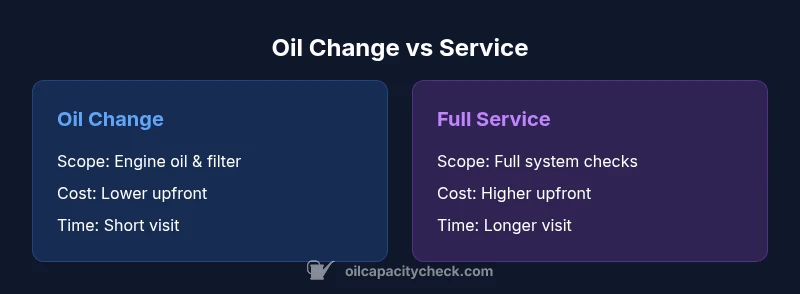
According to Oil Capacity Check, deciding between an oil change or service hinges on your car’s age, mileage, and maintenance history. An oil change replaces the engine oil and filter, while a service visit spans broader checks like fluids, belts, brakes, and air filters. Understanding these differences helps you plan maintenance and budget effectively.
What exactly is being done during an oil change vs a service?
An oil change is the most targeted maintenance task for engines: it drains old oil, replaces the oil filter, and tops off fluids as needed. It ensures proper lubrication, cooling, and contaminant removal for the next operating period. By contrast, a vehicle service is a broader maintenance event that may include an oil change plus inspection of the cooling system, transmission fluid, brake components, belts and hoses, air and cabin filters, tire condition, lights, wipers, and diagnostic checks. In practice, a service assesses overall health and readiness to handle upcoming driving demands, whereas an oil change focuses on oil-life and filtration. For DIYers, knowing the scope helps you budget, plan, and communicate with a shop.
From a maintenance perspective, the two tasks are complementary. An oil change without addressable issues can keep an engine running smoothly, but neglecting ancillary systems during a service can miss developing problems. The distinction matters most when you consider vehicle age, driving conditions, and the manufacturer’s recommendations. Oil Capacity Check highlights that many cars today rely on scheduled services to catch wear items early, preventing costly failures later. The practical goal is to maintain the engine’s lubrication while keeping the rest of the car’s systems aligned with performance expectations.
For owners who are careful with records, the oil change is a fast, routine visit, while a service is a more comprehensive check-up that can identify bugs before they become breakdowns. The exact content of a service varies by make, model, and driving climate, but the core idea is consistency: regular checks and timely interventions.
How to read your owner's manual and follow the manufacturer’s maintenance schedule
Your vehicle’s manual is the primary source of official intervals for oil changes and servicing. Manufacturers publish miles- or time-based recommendations, often with two levels: a basic oil change and a more comprehensive service plan. When you compare the two, you’ll see that the oil-change interval is usually shorter and more frequent, while service intervals are longer and depend on overall vehicle condition and operating environment. Oil Capacity Check recommends aligning your plan with the OEM schedule; deviations should be intentional and well-justified by vehicle use, fuel quality, climate, and maintenance history. Keeping a maintenance log helps you track when to perform each task and ensures you don’t miss critical checks during life’s busy periods.
How this decision affects long-term maintenance costs and reliability
Choosing between an oil change and a full service isn’t merely about the immediate price; it’s about value over time. An oil change protects the engine internals and can prevent catastrophic failures caused by oil neglect. A service adds preventive care for ancillary components, potentially reducing repair costs in the future. A cost-focused view often shows lower initial cost for an oil change, but higher cumulative risk if other systems are neglected. Oil Capacity Check Analysis, 2026, emphasizes that a balanced plan—regular oil changes plus periodic services—tends to offer the best long-term reliability per dollar spent, especially on higher-mileage or turbocharged engines. The key is to tailor the approach to your vehicle’s design and your driving profile, not to adopt a one-size-fits-all rule.
Practical examples: what to do for common driving scenarios
For a city commuter with short trips, an oil change between 5,000 to 7,500 miles might be reasonable if the engine is well-tuned and climate is mild. For an older SUV with higher mileage and occasional towing, a service interval that includes inspections of cooling, transmission, and brakes can prevent edge-case failures. If you drive in dusty or coastal environments, more frequent filter changes and air-quality checks during a service become important. In moderate climates with steady highway use, you may be able to stretch intervals a bit, but any trip extended by extreme temperatures or heavy loads should trigger a service sooner rather than later. The goal is to keep the engine lubricated while ensuring other critical systems are evaluated for wear and tear.
Communicating with your mechanic: clearly defining scope and expectations
When you’re discussing maintenance with a technician, be explicit about your goals. If you’re scheduling an oil change, specify the grade of oil, viscosity, and whether you want a filter change included. For a service, outline which checks you want—brake fluid, coolant level, air filters, serpentine belts, and battery health, for example. Provide your vehicle’s mileage, recent driving patterns, and any symptoms you’ve noticed such as unusual noises, reduced fuel economy, or warning lights. Clear communication helps the shop deliver the right service without unnecessary add-ons and ensures you leave with a detailed inspection report and an itemized bill. Oil Capacity Check recommends recording service dates and mileage so you and your mechanic stay aligned over the car’s lifetime.
Comparison
| Feature | Oil Change | Full Service |
|---|---|---|
| Scope | Engine oil and filter replacement only | Broader maintenance checks (fluids, brakes, belts, filters, tires) |
| Frequency guidance | Typically at manufacturer oil-change interval | Based on overall health, environment, and manufacturer service interval |
| Cost perception | Lower upfront cost | Higher upfront cost but broader coverage |
| Time commitment | Short visit (around 30-60 minutes) | Longer visit (often 1-3 hours) |
| Best for | Short-term maintenance, budget-conscious owners | Older vehicles or setups needing comprehensive checks |
What's Good
- Keeps engine lubrication optimal and reduces wear
- Oil changes are quick and predictable
- Regular oil-life management can prevent major failures
- Service intervals catch wear items early
- Maintains overall vehicle health with inspections
Cons
- Oil-change-only visits miss non-oil wear items
- Full services cost more and take longer
- Inconsistent service quality can occur across shops
- Over-reliance on shop-based checks may reduce DIY learning
A balanced approach generally offers the best long-term value
Opt for regular oil changes on schedule, paired with periodic full services based on OEM recommendations and driving conditions. This combo protects the engine and the rest of the vehicle, reducing unexpected failures and optimizing resale value.
People Also Ask
What is the difference between an oil change and a service?
An oil change replaces the engine oil and filter to maintain lubrication. A service is a broader maintenance event that includes checks of fluids, belts, brakes, cooling system, filters, and diagnostics. The choice depends on vehicle age, mileage, and driving conditions.
Oil changes focus on oil and filter, while a service covers many other systems—the difference is scope and aim.
How often should I get an oil change vs a full service?
Most manufacturers publish intervals, often measured in miles or time. An oil change is performed at the recommended oil-change interval, while a full service occurs at longer, condition-based intervals. Always align with the owner’s manual and your driving environment.
Follow the manufacturer’s schedule; oil changes are more frequent, full services are scheduled less often based on vehicle health.
Is it worth paying for synthetic oil for every oil change?
Synthetic oil can offer better protection and longer intervals in some engines, but the cost is higher. The decision should consider your engine type, climate, and any manufacturer recommendations. A service may justify higher oil quality if the vehicle operates under demanding conditions.
Synthetic oil can be beneficial in some cases, but check what your car’s manufacturer recommends.
What does a typical full service check include?
A typical full service includes oil change (if scheduled), filter changes, brake inspection, fluid top-offs, belt checks, air and cabin filter changes, tire checks, and diagnostic scans for warning lights. Exact items vary by model and age.
A full service covers more than oil; it’s a health check for the whole vehicle.
Can I perform an oil change at home, and should I?
DIY oil changes are feasible with basic tools and a safe setup. However, waste disposal, proper oil grade, and filter selection matter. If you’re unsure, a quick-lube or dealership service can ensure proper procedure and documentation.
Yes, you can DIY if you have the tools and follow safety and disposal guidelines.
How do I know if my car needs a service now or just an oil change?
If you notice warning lights, unusual noises, or a general decline in performance, schedule a service. If the vehicle is running smoothly and oil life is low, an oil change is appropriate. Use the maintenance log to guide decisions.
If in doubt, a service visit can clarify whether additional checks are needed.
The Essentials
- Prioritize oil changes on time to protect engine lubrication
- Schedule periodic full services to catch wear in non-oil systems
- Follow OEM intervals and tailor to climate and driving style
- Keep a maintenance log for mileage and dates
- Communicate clearly with your mechanic to align scope and cost