Difference Between Oil Change and Top Up: A Practical Guide
Understand the difference between an oil change and topping up oil, when to use each, and practical steps for checking levels and maintaining engine health.


TL;DR: An oil change replaces old oil and the filter with fresh oil, while topping up adds oil to reach the correct level without draining or replacing the filter. The change delivers a full engine refresh and better protection, whereas topping up helps prevent low-oil risk between full services. Use a top-up for small level dips and an oil change for routine maintenance intervals.
What is an oil change?
The difference between oil change and top up is foundational to engine maintenance. An oil change is a full-service procedure where the old oil is drained, the oil filter is replaced, and the engine is refilled with fresh oil of the correct viscosity. This process removes contaminants, reduces sludge buildup, and helps maintain proper lubrication under load. A complete oil change also often includes a quick inspection of key components such as the drain plug, gasket condition, and overall oil level after refilling. For most vehicles, an oil change is recommended at manufacturer intervals or when the oil shows signs of degradation. In this context, the phrase difference between oil change and top up highlights that the former is a comprehensive refresh, while the latter is a targeted adjustment of quantity only.
What does topping up oil mean?
Topping up oil is the act of adding a small amount of new oil to bring the level back to the recommended range without draining old oil or replacing the filter. This approach is useful when a dipstick shows the level slightly below the minimum mark or after a brief oil consumption event. Top-ups do not address oil contamination, filter wear, or dilution of additives, and they do not replace the long-term protection a full change provides. The difference between oil change and top up becomes clear here: topping up maintains quantity, not quality or cleanliness of the oil system.
Key differences at a glance
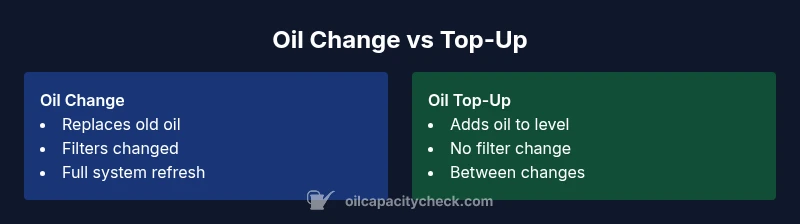
- What it includes: Oil change = drain old oil, replace filter, refill with fresh oil; Top up = add oil to reach proper level.
- Coverage: Oil change targets cleanliness, filtration, and lubrication; Top up addresses level only.
- Frequency: Oil changes occur at set maintenance intervals; Top ups occur as-needed between changes.
- Long-term impact: Oil change reduces sludge and wear; Top up maintains level to prevent immediate low-oil risk but does not clean the system.
- Cost and downtime: Oil changes are more time-intensive and typically cost more; Top ups are quicker and cheaper, but only a temporary fix.
When to choose an oil change vs top-up
Knowing the difference between oil change and top up helps you decide what to do in different scenarios. If the oil appears dark, gritty, or has a burnt smell, or if the filter has not been replaced in a long period, an oil change is warranted. If your vehicle uses oil more quickly than expected and the dipstick shows a dip below the recommended range, topping up a small amount can temporarily restore the level. Always follow the manufacturer’s guidance; if you’re unsure, start with a top-up to bring the level to the correct range and plan for a full change at the next service.
Additionally, some manufacturers require filters to be changed with every certain interval of oil changes, making the decision less about the oil itself and more about the service schedule. Always consider your driving style, climate, and oil consumption history when weighing oil change vs top-up.
How to check oil level accurately
To determine whether you need an oil change or a top-up, you must measure the oil level correctly. Park on level ground, wait for the engine to cool, wipe the dipstick clean, reinsert fully, and pull it again to read the level. Use the marks on the dipstick to see if the oil sits between the minimum and maximum. If it’s near or below the minimum, a top-up is reasonable; if it’s consistently low, or if the oil appears degraded, plan for a full change. Always use the recommended oil viscosity for your vehicle and ensure the oil is free from contaminants.
Practical considerations: filters, grade, and quantity
When you perform an oil change, replacing the filter is typically essential, as it traps contaminants and helps protect the engine. The oil grade (viscosity) should match the manufacturer’s specification to ensure optimal lubrication under operating temperatures. For topping up, you must know the exact grade and required quantity to avoid overfill, which can cause foaming and reduced lubrication. Both actions should consider the age and condition of the engine; older engines may benefit more from regular changes to reduce buildup, while newer engines with good maintenance might be fine with true-to-spec top-ups between changes.
Environmental and waste considerations
Oil disposal is an environmental responsibility. An oil change generates used oil that must be recycled or disposed of at an approved facility. Reputable shops handle disposal and proper filtering. Top-ups produce less waste, but if you top up repeatedly without a full change when needed, you may still accumulate contaminants in the oil. Responsible maintenance pairs top-ups with periodic changes to minimize environmental impact while protecting engine health.
Cost considerations and value
The costs associated with an oil change and a top-up vary widely by region, shop, and vehicle. Generally, an oil change is more expensive due to labor, filter replacement, and disposal, while topping up is cheaper and quicker. If you drive a high-mileage vehicle or have consumption issues, frequent top-ups can become inconvenient and might delay addressing underlying problems. Consider the long-term value: a single oil change can prevent more costly engine issues down the line, whereas a top-up keeps you within spec between full services.
DIY steps for a safe oil change
If you have some mechanical experience, a proper oil change can be performed at home with the right tools. Gather: a new filter, the correct amount and viscosity of oil, a drain pan, wrenches, a funnel, and safety gear. Drain the old oil, replace the filter, torque the drain plug correctly, pour in fresh oil to the specified level, and check for leaks. After refilling, run the engine for a minute, turn it off, wait, then recheck the level and top up if necessary. Dispose of used oil responsibly and never mix types unless the manufacturer allows it. Remember, the difference between oil change and top up is not just procedure; it’s the scope and impact on engine health.
Common mistakes and how to avoid them
- Mixing oil grades beyond manufacturer guidance can reduce lubrication efficiency.
- Failing to replace the filter during an oil change can allow contaminants to circulate.
- Overfilling oil can cause foaming and pressure issues; always measure accurately.
- Skipping leaks or seal checks after an oil change may mask problems that worsen over time.
- Relying solely on top-ups for ongoing consumption without planning full changes can lead to undetected wear.
Practical maintenance plan and quick reference guide
Create a simple maintenance rhythm that aligns with manufacturer recommendations and your driving conditions. Schedule a full oil change at regular intervals, and use top-ups only to correct short-term dips between services. Keep a log of oil changes, filter replacements, and oil consumption so you can adjust the plan as needed. A consistent routine helps you avoid the pitfalls of waiting too long for changes or overusing top-ups, balancing cost, performance, and engine health.
Comparison
| Feature | Oil Change | Oil Top-Up |
|---|---|---|
| What it includes | Drain old oil, replace filter, refill with fresh oil | Add oil to bring level to the correct range without draining or replacing filter |
| Process | Complete service: drain, filter swap, refill, inspect | Check level, add specified grade until target range is reached |
| Best for | Full engine refresh, reduce wear, address contamination | Minor dip in oil level between full services |
| Frequency/Timing | Per manufacturer schedule or service interval | As needed between full services |
| Cost range | Moderate to higher depending on parts and labor | Low to moderate depending on amount of oil added and service provider |
| Environmental impact | More waste oil from drain; disposal included | Less waste due to no draining; still dispose of added oil if applicable |
| Maintenance effect | Improves engine cleanliness, protective filtration, and lubrication | Maintains proper oil level to prevent low-oil risk, not a full clean |
What's Good
- Thorough engine refresh and filtration
- Prevents sludge buildup and wear when used as scheduled
- Higher long-term value for high-mileage engines
- Clear maintenance signal and potential resale benefits
Cons
- Higher upfront cost and more downtime
- Requires proper disposal and handling of used oil
- Incorrect oil type or overuse can cause issues if not aligned with specs
Oil change is the preferred option for a full engine refresh; top-up is best for maintaining level between changes.
Choose an oil change when the goal is to restore cleanliness and filtration; opt for topping up to address a temporary dip between full services. Align both with the vehicle’s owner's manual and driving conditions for optimal engine health.
People Also Ask
What is the main difference between oil change and top up?
The main difference is scope: an oil change replaces old oil and the filter, addressing contamination and filtration; topping up only adds oil to restore level without cleaning or replacing filters. This distinction guides when each service should be used.
Oil changes remove degraded oil and replace the filter, while top ups merely restore the level. Use top ups for small dips and oil changes for a full engine refresh.
When should I top up oil instead of changing it?
Top ups are appropriate for small, temporary dips in oil level between scheduled changes. If the oil looks clean and within spec, topping up can maintain level; if the oil is dirty or the engine shows signs of wear, plan a full change.
Top up if the level is low but the oil appears healthy; otherwise schedule a full change.
Can topping up oil replace an oil change?
No. A top-up cannot replace a full oil change. It cannot remove contaminants or replace the filter, and it does not address additive depletion or oil degradation.
Topping up isn’t a substitute for a full oil change.
How do I know which oil viscosity to use?
Always use the viscosity grade recommended by the vehicle manufacturer. Using the wrong grade can affect lubrication, fuel efficiency, and engine protection.
Check the owner’s manual or consult a trusted mechanic for the exact grade.
What are signs I need an oil change soon?
Dark, gritty, or burnt-smelling oil, a high engine temperature, increased engine noise, or a maintenance light may indicate it’s time for an oil change. If you routinely drive in harsh conditions, consider more frequent changes.
If the oil looks dirty or smells burnt, plan for a change soon.
Does topping up oil require a filter change?
Not typically. Topping up does not require changing the oil filter, which is a core part of a full oil change. If it’s time for a service, you may replace the filter as part of the change.
Top ups usually skip the filter change; reserve it for full changes.
The Essentials
- Choose oil change for a full engine refresh and long-term protection
- Use top-up to fix small oil level dips between full changes
- Always follow manufacturer viscosity specs and filter replacement rules
- Check oil level regularly and plan changes at set intervals
- Dispose of used oil responsibly to protect the environment