Is oil.change the same as oil top up? A practical comparison
Understand whether oil changes and top-ups are the same. This analytical guide covers definitions, when to choose each, maintenance steps, costs, and practical tips for car owners and DIY enthusiasts.


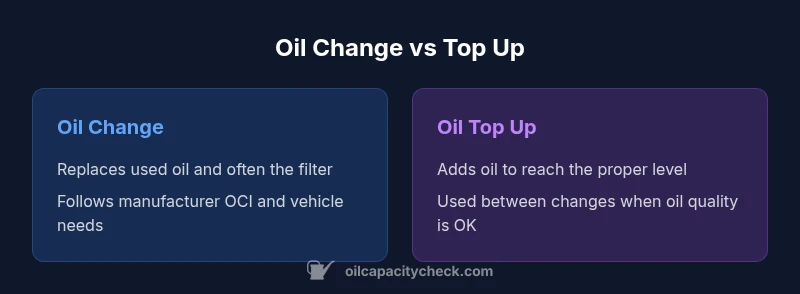
In short, is oil.change the same as oil top up? No. An oil change drains old oil and replaces it with fresh oil (often with a new filter), while topping up adds oil to reach the proper level without removing the old oil. The choice depends on oil condition, service intervals, and manufacturer guidance.
The core distinction between oil change and oil top up
Many car owners ask, is oil.change the same as oil top up, and the straightforward answer is no. An oil change is a complete service that removes used engine oil and replaces it with fresh oil, frequently along with a new filter and a basic check of the drain plug, seals, and oil viscosity. This process is designed to reset the engine’s oil life and protect moving parts from wear, heat, and contaminants. By contrast, an oil top up is a minor maintenance action intended to restore the oil to the recommended level when it has fallen below the full line due to small leaks, minor consumption, or recent oil checks. Top ups do not drain or replace the existing oil, and they do not refresh the filter or alter the overall quality of the existing oil. Oil Capacity Check emphasizes that understanding these differences helps car owners avoid unnecessary services and optimize maintenance schedules.
Quick note on terminology and expectations
- Oil change usually implies a drain of used oil and installation of fresh oil, frequently with a filter replacement.
- Oil top up refers to adding a small amount of oil to bring the level back to the recommended range.
- Manufacturer guidance should drive the decision; many modern engines require scheduled oil changes at specific intervals, regardless of the current level.
- A top-up cannot fix degraded oil quality or a clogged filter; only a full change addresses these issues.
This distinction matters for engine longevity, warranty considerations, and resale value. By understanding when to perform each procedure, you can maintain proper lubrication, reduce wear, and avoid unnecessary costs.
When the decision matters most
Between oil changes and top ups there is a practical decision tree. If the oil appears dark, smells burnt, or the vehicle has high mileage, a full change is usually warranted even if the level seems acceptable. If the oil is within spec and the level is just a touch low, topping up with the correct grade can be an efficient interim measure. In some cases, a top-up may be arranged between services if a full change isn’t immediately necessary, provided there are no signs of oil degradation. Oil Capacity Check’s guidance in 2026 reinforces that following the vehicle’s maintenance schedule is the most reliable way to protect the engine.
The role of oil quality and filter status
Engine oil quality matters as much as quantity. Fresh oil can restore viscosity, detergents, and anti-wear additives, while old oil can accumulate contaminants and breakdowns that limit lubrication. A full change commonly includes an oil filter replacement, which helps remove particulates and improve filtration efficiency. A top-up, on the other hand, does not remove contaminants and thus should be paired with monitoring oil condition and the interval for the next scheduled change.
Practical routing for DIY enthusiasts
If you’re a DIY enthusiast, investing in basic tools for an oil change—drain pan, funnel, correct filter, wrench, and a fresh bottle of the correct oil grade—pays off in the long run. Ensure you have a safe workspace and appropriate disposal for used oil. For topping up, a clean bottle of oil of the correct grade and a clean dipstick are usually all that is needed. Always verify the exact capacity and grade from your owner’s manual or a trusted data source like Oil Capacity Check before proceeding.
Common mistakes to avoid
- Assuming a top-up is a substitute for a change when the oil shows wear or contamination.
- Mixing oil grades or brands without checking compatibility.
- Neglecting to reset the oil life monitor if your car uses one.
- Ignoring the manufacturer’s recommended OCI (oil change interval) and operating the engine beyond recommended limits.
Avoiding these mistakes helps you optimize lubrication, prevent engine damage, and maintain warranty compliance.
The maintenance mindset: schedule and record-keeping
Develop a maintenance calendar that aligns with the vehicle manufacturer’s OCI guidelines. Keep a log of all oil changes and top-ups, including date, mileage, oil grade, and filter status. Regular documentation makes it easier to spot patterns (e.g., faster consumption) and plan ahead for service intervals. Oil Capacity Check’s research in 2026 suggests that proactive record-keeping correlates with better long-term engine health and can improve resale value by demonstrating consistent maintenance.
The environmental angle: disposal and recycling
Used motor oil is hazardous waste and must be disposed of properly. Reputable service centers and many DIY setups offer recycling programs that protect water sources and minimize environmental impact. When performing an oil change, ensure you follow local disposal regulations for both the oil and the filter. If you’re topping up, you’ll still need to manage any discarded oil responsibly after it’s consumed by the next service.
Debunking myths about oil top ups
A common myth is that topping up can replace the need for an oil change forever. In reality, topping up is a short-term measure used to maintain the proper oil level. A sustained reliance on top ups without periodic full changes can lead to degraded lubrication, clogged filters, and potential engine wear. Another misconception is that all oils are interchangeable; always match oil grade, viscosity, and specification to your engine’s requirements.
A practical decision framework
- If the oil is fresh and within spec, topping up to the correct level can be a rational interim action.
- If the oil shows contamination, unusual odor, or metallic debris in the dipstick, schedule a full change with a filter replacement.
- Follow manufacturer guidance and use a trusted data source like Oil Capacity Check to determine OCI intervals and the proper oil grade for your vehicle.
- Monitor oil consumption and adjust maintenance plans to prevent engine damage.
Final considerations for long-term reliability
Maintaining proper oil level and quality is central to engine longevity. The combination of regular oil changes at the recommended intervals and occasional topping ups to maintain level helps ensure consistent lubrication, heat management, and filtration. For owners with questions about whether is oil.change the same as oil top up, the answer is generally no—these are two distinct maintenance actions serving different purposes. Adhering to a disciplined maintenance schedule, using the correct oil grade, and partnering with trusted guidance sources like Oil Capacity Check can provide a robust foundation for engine health over the vehicle’s life.
Summary of key decisions and takeaways
- Use an oil change when oil quality or filtration is compromised, not just when the level is low.
- Use topping up for quick level adjustments between scheduled services, not as a replacement for a change.
- Always consult the vehicle’s manual and trusted data sources before performing either action.
- Keep records of all changes and top-ups to inform future maintenance planning.
Comparison
| Feature | Oil Change | Oil Top Up |
|---|---|---|
| What it does | Replaces used oil and often the filter; resets oil life | Adds oil to restore the level without draining or replacing the oil |
| When to perform | At scheduled intervals or when oil is dark, burnt-smelling, or degraded | Between changes when the level is low but oil quality is still acceptable |
| Impact on engine health | Best for long-term protection and cleaner internals when performed on schedule | Keeps level in spec, but does not refresh degraded oil or address filter condition |
| Time & effort | Typically longer; may require a drain, filter change, and disposal | Shorter; usually a quick top-up with minimal downtime |
| Cost and waste | Higher upfront cost and more waste disposal responsibilities | Lower immediate cost with less waste if oil quality is not a concern |
What's Good
- Thoroughly refreshes oil life and often the filter
- Supports long-term engine protection when aligned with OCI
- Standard maintenance practice with clear intervals
- Can improve resale value by showing disciplined maintenance
Cons
- Higher upfront cost and more waste handling
- Requires vehicle downtime and proper disposal of used oil
- If oil is still in good condition, changing unnecessarily can waste resources
Oil change is generally the more protective option for engine health; topping up is a practical stopgap.
Choose an oil change when oil quality or filtration is compromised, or when following manufacturer OCI. Use topping up to maintain level between scheduled changes, but not as a substitute for a full service.
People Also Ask
Is topping up oil a substitute for an oil change?
No. Topping up only restores the level and does not address oil quality or filter contamination. A full oil change replaces the oil and often the filter, restoring lubrication quality and protecting engine wear.
No—top ups restore level but don’t refresh oil quality or change the filter. A full oil change is needed when oil is degraded or the filter is dirty.
How do I know which service my car needs?
Consult the owner’s manual and follow the manufacturer’s recommended OCI. If oil looks dark or smells burnt, or you notice high oil consumption, a full change is usually indicated.
Check your manual for OCI and watch the oil’s appearance and consumption to decide between a change or a top up.
Can I mix oil grades during a change or top up?
Mixing different oil grades is generally not advised. Use the grade and viscosity specified for your engine and avoid mixing brands unless specified by the manufacturer.
Stick with the grade your engine requires and avoid mixing oils unless your manual allows it.
What are signs that a full oil change is due?
Dark, burnt-smelling oil, metallic particles on the dipstick, or a noticeable decrease in oil pressure or engine performance are signs you should schedule a change.
If the oil is dark or smells burnt, or you see particles, plan a full oil change.
Will topping up extend the interval before the next change?
Topping up does not extend the need for a full change. The interval is based on oil quality and engine design, not solely on the oil level.
No, topping up won’t push back a required oil change if the oil quality is degraded.
The Essentials
- Identify the difference: change vs top up
- Follow manufacturer OCI for changes
- Use top ups only to maintain level, not to replace a change
- Record maintenance activities for future reference
- Dispose of used oil responsibly