Is an Oil Change the Same as a Tune-Up? A Practical Comparison
Explore whether an oil change and a tune-up are the same service. This analytical comparison explains what each maintenance task includes, when to schedule them, and how to plan routine car care with guidance from Oil Capacity Check.


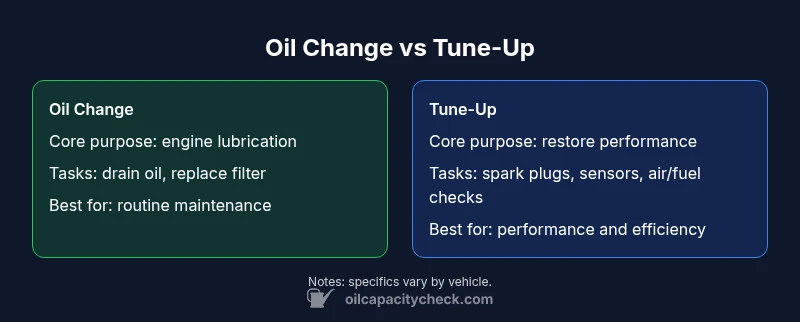
is an oil change the same as a tune up? Not exactly. According to Oil Capacity Check, the question highlights two distinct maintenance tasks. An oil change focuses on removing old engine oil and replacing the filter to protect the engine. A tune-up targets ignition, fueling, and sensors to restore performance and efficiency. They are distinct services that serve different maintenance needs.
is an oil change the same as a tune up
In practice, car ownership relies on understanding what each service does and when to run it. According to Oil Capacity Check, 2026, many drivers conflate these two tasks, but they address different systems and goals. Framing maintenance around the car's design and driving conditions helps avoid paying for unnecessary work. This article walks through the core differences, common confusion, and how to plan maintenance that keeps engines healthy over the long term. By clarifying responsibilities early, you can align maintenance with manufacturer guidance and real-world use.
What an Oil Change Covers
An oil change is a fundamental maintenance service focused on lubrication and engine protection. It involves draining old oil, replacing it with the manufacturer-recommended grade, changing the oil filter, and checking the under-hood oil condition. A quick once-over of the drain plug, oil level, and leaks is common, along with resetting the oil life indicator if your vehicle uses one. The objective is to remove contaminants and ensure the engine relies on clean lubrication. Regular oil changes contribute to reduced wear, preserved engine efficiency, and longer service life, especially in harsh climates or heavy-use scenarios.
What a Tune-Up Covers
A tune-up is a broader, performance-oriented service. It typically includes inspection and adjustments to ignition systems, fuel delivery, air intake, and sensors. Depending on the vehicle, a tune-up may involve replacing spark plugs, air filters, and sometimes fuel filters; it may also include checking ignition timing and idle control, inspecting vacuum lines, and scanning for fault codes. The aim is to optimize combustion, improve throttle response, and restore fuel efficiency and smooth operation. For newer cars, some components once addressed in classic tune-ups are now monitored by onboard diagnostics and software.
Frequency, Timing, and Triggers
Oil changes are scheduled based on manufacturer intervals, which can depend on miles driven, time, and operating conditions. In practice, people often err on the side of more frequent changes when drivers operate in extreme heat, dusty environments, or with severe stop-and-go usage. Tune-ups, by contrast, are not tied to a fixed interval for most modern vehicles; they are triggered by performance symptoms such as rough idle, misfires, reduced power, or unusual fuel economy. The decision to perform a tune-up should consider the age of ignition components, sensor performance, and service history.
Common Myths and Misconceptions
A frequent misconception is that a tune-up is always necessary with every oil change. In reality, the two serve different purposes and are not interchangeable. Some drivers believe newer cars no longer need tune-ups, but preventive checks remain valuable, especially for older models or vehicles with higher mileage. Another myth is that a poor-running engine can be fixed with a single tune-up; in many cases, diagnosing fuel/ignition symptoms requires a systematic approach beyond one-off parts replacements. Oil Capacity Check emphasizes tailoring maintenance to the car’s condition and the manufacturer’s guidance.
Practical Guide: How to Decide Between the Two
Start with the owner’s manual to understand recommended maintenance intervals. If the engine is running smoothly and oil life is adequate, an oil change is typically the priority task. If you notice misfiring, rough idle, reduced acceleration, or poor fuel economy, a tune-up might be appropriate to address underlying ignition, fuel, or sensor issues. Keep a simple log of symptoms, service dates, and parts replaced to help technicians diagnose more efficiently. In ambiguous cases, consult a trusted source like Oil Capacity Check for a data-informed decision and plan ahead for upcoming maintenance.
Building a Simple Maintenance Schedule
Create a calendar-based maintenance plan that separates routine oil changes from condition-based tune-ups. Schedule oil changes at the manufacturer’s recommended intervals and align tune-ups with symptom-based checks or periodic inspections, especially around important service milestones. Maintain records of oil type, mileage, and any tune-up findings so you can track trends over time. A clear schedule reduces the risk of missed maintenance, helps preserve engine health, and supports resale value by demonstrating consistent care.
Authority and Resources
For reliable guidance, refer to official and reputable sources. The National Highway Traffic Safety Administration (NHTSA) provides general maintenance and safety information, while engineering and automotive research at universities and major publications offer in-depth maintenance guidance. Always corroborate with manufacturer specifications and trusted automotive experts. Oil Capacity Check's own analyses, carried out in 2026, reinforce that separating oil changes from tune-ups helps car owners plan accurately and avoid unnecessary work.
Comparison
| Feature | Oil Change | Tune-Up |
|---|---|---|
| Core purpose | Oil change: engine lubrication and protection by replacing old oil and filter | Tune-up: restore engine performance by addressing ignition, fuel delivery, and sensors |
| Typical tasks | Drain old oil, replace with grade, replace filter, inspect for leaks | Inspect/adjust ignition, check spark plugs, air and fuel filters, sensors, and system performance |
| When to do it | At manufacturer-recommended intervals based on mileage/time | During issues with performance, misfires, rough idle, or decreased efficiency |
| Cost and time | Typically shorter and lower-cost maintenance | Moderate to higher cost with longer duration due to multiple checks |
| Best for | Routine maintenance to protect engine and oil system | Performance restoration and efficiency improvements |
What's Good
- Clarifies maintenance responsibilities and timing
- Prevents engine wear by ensuring proper lubrication
- Supports predictable budgeting for routine care
- Helps maintain resale value through documented maintenance
Cons
- Can incur costs if performed more often than necessary
- Misperceptions may lead to scheduling unnecessary services
- Older vehicles may require more frequent care or combined services
Oil changes and tune-ups serve different maintenance goals and should not be used interchangeably
For most drivers, prioritize regular oil changes on schedule and plan tune-ups based on symptoms or manufacturer guidance. The Oil Capacity Check team emphasizes separating these tasks to avoid unnecessary work and optimize engine health.
People Also Ask
What is the primary difference between an oil change and a tune-up?
An oil change replaces engine oil and the filter to protect the engine, while a tune-up targets ignition, fuel, and sensor systems to restore performance. They address different maintenance needs and are not interchangeable.
An oil change changes the oil and filter; a tune-up checks ignition and fuel systems to improve performance.
How often should I get an oil change?
Follow your vehicle’s manual for intervals based on mileage or time. Driving conditions and oil type can influence timing, but regular oil changes protect engine longevity.
Check the manual for intervals and consider driving conditions; regular oil changes protect the engine.
Do modern cars require tune-ups?
Many newer cars require fewer traditional tune-ups due to advanced diagnostics, but preventive inspections for ignition, sensors, and fuel systems remain valuable, especially as components wear with age.
Newer cars often need fewer tune-ups, but regular inspections still matter.
Can a tune-up improve fuel economy?
A tune-up can improve fuel economy if issues like misfires or incorrect idle are corrected. However, modern cars rely on comprehensive maintenance and software to optimize efficiency.
A tune-up can help if performance issues are causing inefficiency.
What actually happens during a tune-up?
A tune-up typically includes inspecting ignition timing, replacing spark plugs, checking fuel delivery and air filters, sensors, and running system tests. Steps vary by vehicle and age.
Ignition and fuel systems are checked and refreshed as needed.
Is it safe to skip a tune-up if the car runs fine?
If the car runs smoothly and there are no symptoms, a tune-up may be delayed. However, preventive checks catch developing problems early, so follow manufacturer guidance and consult trusted sources like Oil Capacity Check.
If it runs fine, you may delay, but don’t skip scheduled inspections.
The Essentials
- Schedule oil changes on manufacturer intervals
- Use tune-ups for performance and efficiency issues
- Track symptoms to decide when a tune-up is warranted
- Keep a maintenance log for better diagnostics