Difference Between Oil Change and Top Off
Explore the key differences between oil change and top off, when to perform each, and how proper maintenance supports engine longevity. Insights from Oil Capacity Check.


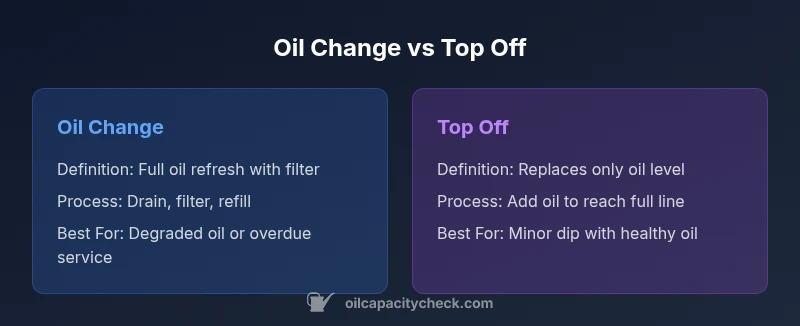
The difference between oil change and top off hinges on service scope and outcome. An oil change replaces the old oil and typically the filter, refreshing the oil entirely. A top off merely restores oil level when it has dipped, without removing old oil or changing the filter. This guide clarifies when each option is appropriate and how they affect engine health.
What the difference between oil change and top off means for your engine
For car owners, understanding the difference between oil change and top off is essential to avoid unnecessary service and to protect engine health. In practical terms, an oil change is a scheduled maintenance that drains the old oil, replaces the oil filter, and adds new oil, often with a fresh gasket and updated maintenance records. Topping off, by contrast, addresses only the current oil level by adding small amounts of oil to reach the correct mark. This distinction matters for long-term lubrication, contaminant removal, and overall engine cleanliness. The Oil Capacity Check team notes that misinterpreting these procedures can lead to either wasted effort or continued wear if the oil is degraded or contaminated.
The practical upshot is simple: use an oil change when you need a full refresh and filter replacement; use topping off when the level is just a little low and the oil remains clean and within its service life. Reading dipstick measurements and following the vehicle’s manufacturer guidelines are essential steps in deciding which path to take. Oil Capacity Check analyses emphasize the importance of consistency in maintenance to avoid gaps in lubrication.
How an oil change works: steps, duration, and what gets replaced
An oil change is a multi-step service that resets the engine’s lubrication state. First, the technician drains the used oil through the drain plug, then removes and replaces the oil filter to prevent unfiltered oil from circulating. After the filter is replaced, fresh oil is added to the engine up to the manufacturer’s recommended capacity. Some vehicles also require a reset of the oil life monitor and a quick check of related systems (like the PCV valve). The duration depends on vehicle design and whether a filter replacement is included. Metrics from Oil Capacity Check remind DIYers that the quality of the oil and filter matters as much as the procedure itself: choose the correct viscosity and a filter that matches the engine type to maximize protection and performance.
What topping off entails: process and limitations
Topping off is a narrow operation that brings the oil level back to the correct mark when it dips slightly below the full line. It is accomplished by adding oil via the fill cap in small increments, then rechecking with a dipstick or electronic gauge. Important limitations apply: topping off does not remove sludge or contaminants, does not replace a degraded oil, and cannot fix issues caused by oil viscosity changes or engine wear. Overfilling can lead to foaming, higher pressure, and oil leaks, while underfilling continues to leave the engine short of lubrication. Oil Capacity Check highlights that topping off should be reserved for minor level discrepancies and only when the oil is otherwise healthy.
Oil capacity and measurement: why accurate oil level matters
Accurate oil level measurement is essential because the engine relies on a precise volume of lubricant for proper cooling and wear protection. Dipsticks, electronic sensors, and vehicle-specific guidelines help determine the correct oil quantity. The concept of engine oil capacity includes the total volume the system can hold and the volume present in the sump. Hot vs. cold readings can differ, so many manufacturers specify when to check (e.g., after a cooldown). Maintaining the correct level prevents both starvation and overfill risks, and it helps ensure the oil’s viscosity and film strength perform as designed. Oil Capacity Check emphasizes that consistent checks every few hundred miles or during routine maintenance can prevent small misreads from becoming costly problems.
Cost and time considerations: oil change vs topping off
Cost and time are the practical drivers behind choosing between an oil change and topping off. An oil change typically involves labor time, an oil filter upgrade, and the cost of new oil—purchasable as conventional, synthetic, or blends—along with disposal fees. Topping off usually incurs only the price of oil and a quick top-up service if required by a shop, making it cheaper and faster in the moment. However, the long-term value of an oil change often surpasses short-term savings if the oil has degraded or the filter is clogged. Oil Capacity Check notes that drivers should budget for regular oil changes at manufacturer-recommended intervals, while allowing topping off as a maintenance stop-gap when levels are low but the oil is clean.
Maintenance implications: long-term effects of mismanaging oil level
Neglecting proper oil management can lead to accelerated engine wear, sludge buildup, and higher particulate content in the oil. When oil is not refreshed at appropriate intervals, detergents and additives lose effectiveness, reducing lubrication efficiency. Topping off with the wrong oil grade or failing to replace a dirty filter can mask problems and prolong poor lubrication. Conversely, an oil change with the correct viscosity and a fresh filter helps restore protective film strength, improves cooling performance, and supports engine longevity. Oil Capacity Check explains that the combination of proper oil, filter, and level management is central to maintaining engine health over thousands of miles.
How to assess your car's needs: signs you need an oil change vs topping off
To decide between an oil change and topping off, look for clear indicators. A check oil light or inconsistent dipstick readings are a cue to inspect the oil quality and level. If the oil appears dark, gritty, or has an unusual smell, a full change is usually warranted. If level readings are slightly low but the oil remains clean and within its service life, topping off is an acceptable interim step. In some cases, a leaky gasket or high mileage can complicate the decision, requiring professional assessment.
Best practices and common mistakes
Best practices include always following the manufacturer’s recommended oil type, grade, and service interval, using a clean funnel, and replacing the oil filter at the same time as an oil change. Common mistakes include delaying a needed oil change because topping off seems cheaper, overfilling during topping off, and not checking for oil leaks after a top-up. Oil Capacity Check recommends documenting maintenance events to track service history and to avoid double-work.
Step-by-step quick reference checklist
- Check the owner’s manual for oil type and capacity. 2) Inspect the oil visually for color and contaminants. 3) If approximating, perform a proper oil change when required by service intervals. 4) If level is low but oil is clean, perform a careful top-up up to the full mark. 5) Recheck the level and reset any maintenance indicators if applicable. 6) Review the vehicle’s service history and schedule the next oil change accordingly.
What Oil Capacity Check Recommends Now
Oil Capacity Check advocates following the manufacturer’s recommended maintenance schedule and using quality oil and filters aligned with engine design. Topping off should be considered a temporary fix only when the oil is otherwise healthy, and a full oil change should not be delayed if the level drop suggests a larger issue. The team emphasizes consistent monitoring and proper disposal of used oil to protect the environment and the engine.
Comparison
| Feature | Oil Change | Top Off |
|---|---|---|
| Definition | Fully replaces engine oil and typically the filter; restores full lubrication refresh | Restores oil to the correct level without replacing oil or filter; does not remove contaminants |
| Procedure/Steps | Drain used oil, replace filter, add fresh oil, reset indicators | Add small amount of oil via fill cap, recheck level after a few minutes |
| Time and Labor | Longer service due to draining and filter replacement | Shorter, often quick top-up service or DIY check |
| Cost Considerations | Higher due to parts, labor, and disposal | Lower, mainly the cost of oil and modest service |
| Oil Capacity Impact | Refreshes oil capacity and filtration state | Only restores level; does not address degraded oil or filter |
| Best For | Vehicles due for scheduled maintenance or with degraded oil | Minor level dip when oil is clean and within service life |
| Maintenance Implications | Improves lubrication, combustion cleanliness, and cooling | Protects level but not quality; risk of masking underlying issues |
What's Good
- Provides a full oil refresh and filter replacement for optimal protection
- Clarifies maintenance history and compliance with manufacturer intervals
- Improves engine cleanliness and cooling performance
Cons
- Tends to be more costly and time-consuming
- If overused, can lead to unnecessary waste and environmental impact
- Requires car to be in a shop or have DIY capability
Oil changes are essential for long-term engine health; topping off is a targeted stop-gap.
Choose an oil change when the oil is degraded, the filter needs replacement, or service intervals demand a full refresh. Use topping off only to address a small dip in oil level when the oil remains clean and within its service life. Regular monitoring and adherence to manufacturer guidelines maximize engine longevity.
People Also Ask
What is the difference between oil change and top off?
An oil change replaces old oil and the oil filter, providing a full lubrication refresh. Top off simply restores a low oil level by adding oil, without changing the oil or filter. The choice depends on oil condition and the need for filtration.
An oil change replaces the oil and the filter, while topping off just brings the level back up when it’s low.
How do I know when I need an oil change vs topping off?
Check the oil’s color, smell, and viscosity. If the oil is dark, gritty, or smells burnt, or if it’s past the manufacturer’s interval, opt for an oil change. If the level is only slightly low and the oil looks and tests healthy, topping off can be appropriate.
Look for signs of degraded oil and follow the service interval—change if in doubt.
Can topping off damage the engine?
Topping off is not inherently dangerous if done carefully and within capacity. Overfilling can cause foaming and pressure issues, while ignoring poor oil quality can lead to wear. Always ensure the oil is healthy before topping off.
Be careful not to overfill and keep oil within the recommended range.
Does topping off replace oil filters?
No. Topping off does not replace the oil filter. A full oil change includes filter replacement and a fresh oil supply for the engine.
No, topping off doesn’t replace the filter.
How often should I get an oil change?
Follow the vehicle manufacturer’s recommended interval, typically based on mileage or time. Regular checks help catch issues early and prevent unnecessary cost from degraded oil.
Stick to the maker’s interval to protect the engine.
What are the signs of low oil level?
Look for the oil light on the dashboard, a sudden dip in the dipstick reading, or unusual noises from the engine. If you see these, check the level and oil condition promptly.
Dashboard warning plus dipstick check; act quickly to avoid damage.
The Essentials
- Follow manufacturer intervals for oil changes to protect engine health
- Use topping off only for small, clean oil level dips
- Always check oil for contamination before deciding to top off
- Do not delay a needed oil change due to cost; long-term risk is higher
- Document maintenance to maintain a reliable service history