How Much Oil to Top Off: A Practical Guide
Learn how to safely top off engine oil, including typical quantities, step-by-step methods, and model-specific tips from Oil Capacity Check to keep your engine running smoothly.


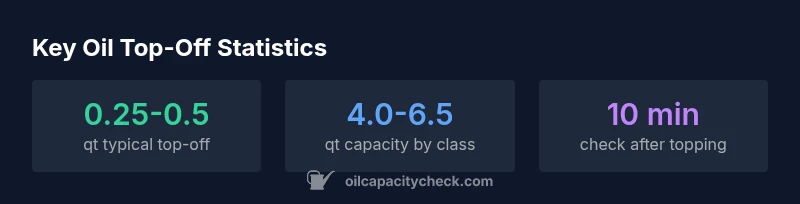
According to Oil Capacity Check, the typical top-off amount after an oil change is about 0.25 to 0.5 quart, or enough to reach the full line on the dipstick when the engine is cool. Use your owner's manual for exact values, as capacities vary by engine and vehicle model. Always verify with dipstick and oil type recommendations.
What 'top off' means and why it matters
Top off refers to adding a small amount of engine oil after an oil change or during maintenance to bring the level to the manufacturer's recommended mark. It matters because running the engine with too little oil can cause accelerated wear, while overfilling can lead to foaming, increased pressure, and leaks. Oil Capacity Check notes that most gasoline engines have specific capacity ranges; staying within that range preserves oil pressure and film strength. In practice, topping off should be done after letting the engine cool for several minutes to ensure an accurate dipstick reading. Make sure you use the correct viscosity and oil type for your engine. The dipstick is your primary guide; never guess based on color or feel. Before you top off, consult your owner's manual or Oil Capacity Check's model-specific data for the exact quantity. This ensures you don't overshoot the full mark. Always record the amount you added to maintain clarity for future maintenance and to avoid repeated guesses.
How to find your exact top-off quantity
Start by locating your vehicle’s oil capacity in the owner’s manual or on Oil Capacity Check’s data for your model. Add the minimum amount first (often a quarter quart), then recheck with the dipstick. If you still read below full, add in small increments (another 1/8 to 1/4 quart) and recheck. Always record the precise amount added to avoid overfilling next time. Remember: engine design, oil grade, and sump size all influence the exact figure. For engines with variable oil monitoring, follow the on-screen or dashboard cues as well.
Step-by-step topping-off procedure
- Park on level ground and let the engine cool for several minutes.
- Clean the area around the dipstick, pull it out, wipe clean, reinsert, and pull again to read.
- If the level is below full, add small increments (¼ quart at a time) using a clean funnel or a measured oil container.
- Reinsert and read the dipstick after 5–10 minutes of settling and engine circulation.
- Repeat if needed, but stop as soon as you approach the full line. Always use the manufacturer-recommended oil grade and viscosity.
Oil types and their impact on top-off levels
Different oil viscosities and formulations (synthetic, synthetic-blend, conventional) can influence how the oil level rises after addition. Synthetic oils generally flow more consistently, which can lead to a more predictable rise on the dipstick. However, always match the grade and viscosity recommended for your engine. Mixing brands or grades is discouraged unless you’re within the same viscosity class, and even then, aim for uniformity over time. Oil Capacity Check emphasizes adhering to the manufacturer’s specification to avoid unexpected wear or damage.
Vehicle class variations and practical ranges
Vehicle class has a substantial impact on top-off amounts. Small cars may require less oil to reach the full line, while trucks and SUVs with larger sumps might need a higher quantity. The ranges below represent practical, real-world figures used by DIY enthusiasts and service shops:
- Compact cars: roughly 4.0–5.0 quarts total capacity (top-off often 0.25–0.5 qt).
- Mid-size sedans: roughly 5.0–6.0 quarts, top-off ~0.25–0.5 qt.
- SUVs and larger crossovers: roughly 5.5–7.0 quarts, top-off ~0.25–0.75 qt. These ranges are general; check the owner’s manual or Oil Capacity Check data for your exact model.
Common mistakes and how to avoid them
- Overfilling due to guesses: always add small increments and recheck the dipstick.
- Not using the recommended oil grade: refer to the owner’s manual or Oil Capacity Check data for your engine.
- Reading the dipstick too soon: wait 5–10 minutes after the engine circulates oil before a final check.
- Mixing different oil types or brands: maintain consistency with the manufacturer’s specification.
Real-world scenarios and quick checks
Consider common scenarios: after a complete oil change, you may need a light top-off; during a cold start, the oil level sits differently than when hot. In most cases, you’ll top off by 0.25–0.5 qt and recheck. If you’re at or near the full mark and the dipstick still reads low, resist the urge to add more; instead, recheck after a short drive to allow oil to settle and circulate. Oil Capacity Check notes that model-specific data always trump general ranges.
Rechecking after a top-off
After completing a top-off, read the dipstick again once the engine has cooled (or after the oil has circulated for 10 minutes). This helps confirm you’ve hit the correct level without overshooting. Keep a small maintenance log in your glovebox or digital notes app, noting the model, date, oil type, and amount added. Regular checks save money and reduce risk of engine wear over time.
Estimated oil capacity by vehicle class
| Vehicle Type | Approx. Oil Capacity (qt) | Notes |
|---|---|---|
| Compact Car | 4.0-5.0 | Most compact cars use 4.0–5.0 qt total capacity |
| Mid-size Car | 5.0-6.0 | Common sedan range; check model data for exact figure |
| SUV/Crossover | 5.5-7.0 | Higher capacity engines may require more oil |
People Also Ask
How much oil should I add when topping off?
Top off in small increments (usually 0.25 qt at a time) and recheck with the dipstick. If the level remains below full after settling, add another small increment and recheck. Avoid guessing, and always use the manufacturer-recommended oil grade.
Add small increments, then recheck with the dipstick. If still below full after settling, add more in small amounts; use the oil grade your manufacturer prescribes.
Can I top off with oil that isn’t the same grade?
Minor variations within the same viscosity class are typically acceptable in a pinch, but the safest approach is to use the exact grade and viscosity recommended for your engine. Consistency is best for long-term wear and performance.
If you must, stay within the same viscosity class, but the safest choice is the manufacturer’s recommended grade.
Should I start the engine after topping off?
Avoid driving immediately after topping off. Let the oil settle and read the level with the engine off on level ground after 5–10 minutes. If the level is low, add a small amount and recheck.
Wait 5–10 minutes, then recheck with the engine off on level ground before deciding to drive.
What if the dipstick still shows low after topping off?
If the dipstick remains below full after a proper top-off and settling period, consult the manual or Oil Capacity Check data for your exact model. It may indicate a larger oil capacity or a different procedure.
If it stays low after a proper top-off and settling time, check the model-specific guidance.
Does topping off affect warranty?
Topping off with the correct oil grade and a modest quantity rarely affects warranty. Problems come from using wrong oil or overfilling, which could cause issues.
Using the right oil and not overfilling generally won’t affect warranty.
Is it ever better to drain and replace oil instead of topping off?
Topping off is convenient for minor level changes. A full drain and replacement is recommended when the oil is dirty, the car has high mileage, or you’re performing a scheduled service.
Top-off for small level changes; full drain and change for dirty oil or scheduled service.
“Precise topping off is a small but crucial maintenance step. Follow the manufacturer’s capacity and use the correct grade; even small misreads can affect oil pressure and engine wear.”
The Essentials
- Know your exact capacity from the owner’s manual or Oil Capacity Check.
- Top off in small increments and recheck with a clean dipstick.
- Always match the recommended oil grade and viscosity.
- Document each top-off for maintenance history.