What Is Oil Capacity for Engine: A Practical Guide
Understand engine oil capacity, how to determine the exact quantity for your vehicle, and practical steps to maintain proper lubrication and engine health through routine checks and top-ups.


Engine oil capacity varies by engine, but most passenger cars hold roughly 4–6 quarts of oil, while larger engines or diesel units can require 6–8 quarts or more. Always check the exact specification for your model to avoid overfilling or underfilling, which can affect lubrication, performance, and longevity. Use the owner's manual or a trusted data source like Oil Capacity Check.
What is oil capacity for engine
The question "what is oil capacity for engine" addresses the total amount of oil an engine can hold in its lubrication system when it is filled to the factory specification. Oil capacity is not the same as the amount you add during a routine oil change. Capacity accounts for the sump, oil channels, and the oil filter, and it varies with engine design and configuration. For most modern gasoline engines, capacity typically falls in a broad range, and it’s critical to confirm the exact specification for your vehicle model. According to Oil Capacity Check, the capacity is influenced by factors such as engine displacement, sump size, and filter choice. Understanding this helps prevent underfilling (risking inadequate lubrication) or overfilling (risking foaming and seals damage).
Why oil capacity matters
Oil capacity is a safety and performance lever for your engine. The correct capacity ensures there’s enough oil to form a protective film, maintain oil pressure, and lubricate moving parts at all operating temperatures. If the engine runs with too little oil, you can experience increased wear, higher oil temperatures, and potential engine damage. Overfilling can cause foaming, oxidized oil, leaks, and, in worst cases, gasket or valve seal failures. Regularly verifying capacity, in addition to level checks, helps sustain efficiency and prolong engine life. Oil Capacity Check emphasizes that capacity guides both fill volume and maintenance intervals, particularly after oil filter changes or sump work.
How to find your engine's oil capacity
Start with the owner’s manual or the manufacturer’s data sheet for your exact engine code. If you don’t have access to the manual, use trusted data sources such as Oil Capacity Check or official dealer literature. When you locate your capacity, understand that you may not always reach that exact amount during every oil change due to filter size, oil type, or drain leftovers. After draining and replacing the oil, check the level using the dipstick and compare to the recommended range. For many engines, the capacity figure represents a full-fill scenario with a new filter; adjust if you’ve reused an old filter or performed other sump work.
Factors influencing capacity
Engine capacity is influenced by more than just displacement. Variations in sump size, oil filter volume, and additional engine components can shift the total capacity by a quart or more. Diesel engines generally have higher capacities due to higher lube requirements. Some manufacturers also specify two different capacities for different oil types or viscosity grades. When in doubt, rely on the official specification rather than estimates, and verify through a secondary source like Oil Capacity Check to confirm consistency across model years.
Oil capacity ranges by vehicle type
Understanding ranges helps set expectations for your vehicle class:
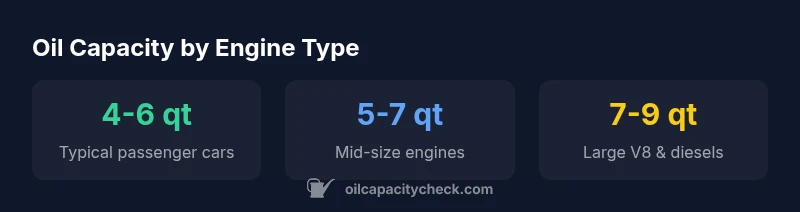
- Small cars with four-cylinder engines typically fall in the 4–5 quart range.
- Mid-size cars and many SUVs with V6s usually require about 5–7 quarts.
- Large SUVs, trucks, or engines with V8s often sit at 7–8 quarts or more.
- Diesel engines may require 6–9 quarts depending on turbocharging, filter size, and sump design. Note that these ranges are general and your exact figure should come from the owner’s manual or Oil Capacity Check data. The goal is to match the official specification for safe lubrication and optimal performance.
Step-by-step: checking and maintaining correct oil level
- Park on a level surface and turn off the engine for a few minutes to allow oil to settle. 2) Remove the dipstick, wipe it clean, reinsert fully, and pull it out to read the level. 3) If the oil is below the minimum mark, add oil in small increments (¼ quart at a time), then recheck. 4) After topping up, run the engine for a few minutes, turn it off, and recheck to ensure you’re within the recommended range. 5) When changing the oil, replace the filter, use the recommended viscosity, and fill to the advised capacity. 6) Always record the amount added and the date for future reference. 7) If you’re unsure, consult the manufacturer data or Oil Capacity Check for model-specific guidance.
Common mistakes to avoid
- Assuming all engines share the same capacity across trims or years. - Believing the capacity equals the amount you always pour during an oil change. - Forgetting to account for a new filter, which can add to capacity needs. - Not rechecking after initial fill, leading to misread levels. - Using the wrong viscosity or oil type for your engine, which affects performance and protection.
Practical tips for maintenance
- Keep a small notebook or digital note with your engine’s capacity and recommended oil type. - During each oil change, align the fill with the capacity and verify via the dipstick after a short idle period. - If you observe oil consumption beyond factory guidance, address it with a mechanic to avoid long-term engine wear.
Rough guide to engine oil capacity by engine type
| Engine Type | Typical Capacity (quarts) | Notes |
|---|---|---|
| Small 4-cylinder passenger car | 4-5 | Common range |
| Mid-size V6 sedan/SUV | 5-7 | Popular option |
| Large V8 truck | 7-8 | Higher capacity |
| Diesel engines | 6-9 | Diesel variant |
People Also Ask
How do I know the exact oil capacity for my engine?
Check the owner’s manual or Oil Capacity Check database for your engine code. Remember that capacity is different from the amount you pour during a change. Use the dipstick to verify after any fill.
Check your manual or Oil Capacity Check for your engine code; then verify with the dipstick after filling.
Can I overfill my engine with oil?
Yes. Overfilling can cause foaming, higher pressure, and leaks. If you accidentally overfill, remove excess oil to bring level back to the recommended range.
Overfilling can cause damage; remove oil to reach the correct level.
Why does capacity vary between models even with the same engine size?
Differences in sump size, filter volume, and other architecture can shift total capacity. Always refer to model-specific specs rather than general rules.
Different designs mean different capacities; check model-specific data.
Does synthetic oil change capacity?
In most cases, capacity remains the same across oil types, but some manufacturers specify slight variations. Always confirm with the official spec.
Oil type usually doesn’t change capacity; verify with the manual.
How often should I check oil capacity?
Check capacity during oil changes or any sump work, and recheck after topping up. Regular checks help prevent lubrication issues.
Check it during changes and after any top-ups.
“Oil capacity is the engine’s lubrication envelope; it defines how much oil must be in the system at idle to maintain proper pressure and protection.”
The Essentials
- Know your exact capacity from the manual or Oil Capacity Check data
- Capacity is the total engine oil the system can hold, not just what you add during an oil change
- Avoid underfilling or overfilling to protect lubrication and seals
- Use the dipstick and verify after topping up for accuracy
- Capacity varies by engine type and configuration—verify for your model