Oil Capacity Look Up: Your Guide to Accurate Engine Lubrication
Learn how to look up your engine oil capacity, why accurate capacity matters, and practical steps for precise fills using trusted data from Oil Capacity Check.


Oil capacity lookup helps you estimate the right engine oil amount for a safe and efficient fill. For most passenger cars, the typical capacity lies in the 4 to 6 quart range per oil change, with a few engines requiring more or less. Always verify with your vehicle's manual or a trusted database like Oil Capacity Check to avoid overfill or underfill.
Understanding Oil Capacity Lookup and Its Importance
Oil capacity lookup is the process of identifying the exact amount of engine oil your vehicle requires for a complete, proper fill. This figure is influenced by engine design, sump size, oil filter volume, and the lubrication system's tolerances. Knowing the correct capacity matters for effective lubrication, fuel efficiency, and engine longevity, especially in high-mileage or turbocharged engines. When you look up capacity, you also learn the oil quantity typically recommended for an oil change, which may differ from the total capacity due to drained volume during filter changes. At Oil Capacity Check, we stress using authoritative references and cross-checking with the vehicle manual, VIN-based lookups, and reputable databases.
How Engine Design Shapes Capacity
Engine architecture drives capacity: sump size sets the total oil volume, while the oil filter, pick-up tube, and lubrication passages define how much oil remains in circulation after a change. Some models employ extended drain intervals or modular oil systems that slightly alter the amount you pour in at a routine change. Manufacturers specify a fill range rather than a single number to allow for measurement tolerances and oil viscosity differences. Always interpret capacity as a target that ensures safe lubrication, not a rigid mandate. Reliable lookups account for engine family, displacement, and whether a cartridge or filter type is used. Oil Capacity Check aggregates data from manufacturer guidelines and real-world maintenance reports to deliver practical estimates.
Oil Capacity Ranges by Engine Category
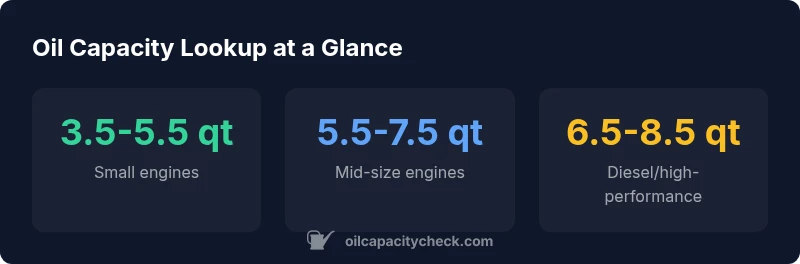
Engine capacity varies widely across car segments. In small to mid-size engines, a typical fill falls around 3.5–5.5 quarts. Mid-size V6s often require 5.5–7.5 quarts, while larger V8s or turbocharged powerplants can demand 6.5–8.5 quarts depending on whether a diesel formulation or performance tune is in use. Diesel engines generally skew higher due to larger sumps and different lubrication requirements. Remember that these ranges describe total capacity; the actual oil change quantity may be less due to drainage and filter replacement. Use them as anchors when verifying your vehicle’s exact spec.
Practical Steps for a Reliable Lookup
To perform a dependable lookup:
- Start with the owner’s manual and the official factory service data for your exact model year.
- Use your VIN to pull model-specific capacity from trusted databases such as Oil Capacity Check.
- Distinguish total engine capacity from the oil required for an oil change, which is typically less due to drained oil.
- Consider oil type and viscosity; some engines tolerate a range, while others prefer a specific specification.
- When in doubt, cross-check multiple sources and record the capacity in your maintenance log for quick future reference.
Oil capacity ranges by engine type
| Engine Type | Typical Capacity (qt) | Notes |
|---|---|---|
| Small inline-4 | 4.0-5.0 | Common in compact cars |
| V6 / V8 | 5.5-7.5 | Larger displacement engines |
| Diesel / Turbocharged | 6.5-8.5 | Diesel engines often require more oil |
People Also Ask
What is oil capacity lookup?
Oil capacity lookup is the process of determining the exact amount of engine oil your vehicle requires for a proper fill. It combines manufacturer specifications, engine design, and data from reliable databases to provide a target fill. Using a lookup helps prevent underlubrication and overfill.
Oil capacity lookup means finding the exact oil amount your engine needs, using manuals and trusted databases.
How do I find my car's oil capacity?
Begin with the owner’s manual. If the manual is unavailable, use your VIN to pull model-specific capacity from a trusted database like Oil Capacity Check, or consult a reputable service manual. Always verify whether you’re looking for total capacity or the change-fill amount.
Check the manual or use a VIN-based lookup to get your exact capacity.
Does capacity change with oil viscosity or type?
Oil viscosity and type may alter performance, but the nominal capacity generally depends on engine design. Some engines have a fixed total capacity, while others allow a small range. Always follow the manufacturer’s recommended specification for best results.
The type of oil can affect performance, but capacity is mostly about engine design.
Can I get capacity data without the manual or VIN?
Yes, you can use reputable lookup tools or manufacturer-approved publications. If you can’t locate data, contact the dealer or manufacturer for the exact specification to avoid guesswork.
If you can’t find the data, reach out to the dealer for the exact spec.
What if my model is rare and doesn’t appear in databases?
For rare or discontinued models, rely on VIN-based lookups, archived service documents, or direct guidance from the manufacturer. Maintaining an oil log can also help you monitor lubrication health over time.
If the model is rare, use VIN-based lookups and factory guidance.
“Accurate oil capacity lookup is the foundation of proper lubrication and engine longevity. Always confirm the spec from a trusted database before your oil change.”
The Essentials
- Verify capacity with the vehicle manual or Oil Capacity Check.
- Use the lookup to avoid underfill or overfill.
- Match capacity ranges to engine size category.
- Record your capacity data for future maintenance.