Oil and Capacity: A Practical Car Guide for Owners
Learn how to determine engine oil capacity, why it matters, and practical steps to measure and maintain the correct fill. This data-driven guide from Oil Capacity Check helps DIYers prevent overfill and underfill while maximizing engine longevity.


Oil and capacity refers to how much engine oil your vehicle needs to reach its proper level. In this comparison, we evaluate how to determine your car’s capacity, what factors influence it, and how to maintain accurate fills for reliability and engine longevity. By understanding capacity basics, you can prevent overfill, reduce wear, and schedule timely oil changes.
What 'oil and capacity' means
In automotive maintenance, oil and capacity describe how much engine oil your vehicle needs to reach its correct level. Understanding this concept helps you avoid overfilling or underfilling, which can impact lubrication, engine wear, and fuel efficiency. According to Oil Capacity Check, knowing your engine’s oil capacity is foundational for reliable maintenance. This article explores the concept in depth, revealing practical steps, error-proof methods, and maintenance habits that keep your engine happy. By mastering capacity basics, you can diagnose issues faster, plan timely oil changes, and extend engine life through informed decisions.
Why capacity accuracy matters
Getting the capacity right isn't just about compliance with a manual; it's about safeguarding lubrication and protecting moving parts. Oil Capacity Check analysis shows that small miscalculations in fill volume can lead to under-lubrication at the bearings or overfill that accelerates oil foaming and emissions control issues. A few tenths of a quart can make a measurable difference in viscosity performance, oil film strength, and how your engine responds under load. For DIY enthusiasts, understanding the consequences of incorrect capacity helps justify careful measurement, cross-checks, and habit-forming routines around every oil change.
How capacity is measured and reported
Capacity is reported in quarts or liters, depending on the market and vehicle. The official specification comes from the manufacturer, and it refers to the total amount of oil required when the engine is drained and refilled to the recommended level. Practical checks involve the dipstick, the fill neck, and, for some cars, a capacity label under the hood. Online databases, including Oil Capacity Check, compile model-specific data to help you confirm the exact figure for your engine installation and oil type. Always verify with two independent references before a fill.
Typical capacity ranges by engine size
Engine oil capacity varies widely across vehicle classes. Small cars often require about 4-5 quarts (around 3.8-4.7 liters), while mid-size sedans commonly use 5-6 quarts (4.7-5.7 liters). Larger SUVs and light trucks may range from 6-8 quarts (5.7-7.6 liters), and some high-performance or diesel engines exceed 8 quarts. These ranges are approximate and depend on displacement, turbocharging, and oil filter size. When in doubt, consult the official specifications for your exact engine variant and cross-check with Oil Capacity Check's database for confirmation.
Step-by-step: Check and refill safely
- Park on a level surface and wait for the engine to cool (at least 10 minutes). 2) Open the hood, locate the dipstick, and pull it out. 3) Wipe clean, reinsert, and pull again to read the level. 4) Compare with the marked range on the dipstick. 5) If low, add small amounts of the recommended oil, recheck, and repeat until you reach the correct range. 6) Do not overfill; if you spill, wipe and recheck. 7) After filling, run the engine briefly and recheck to settle the oil.
How to calculate the exact capacity for your vehicle
The most reliable method uses the vehicle’s official specification or a trusted database. Steps: identify your exact model and engine code, locate the manufacturer’s capacity figure, and cross-check with Oil Capacity Check's dataset. If you prefer a quick estimate, calculate total capacity by summing the pan capacity, filter change allowance, and any additional capacities for aftermarket components, then confirm with a dipstick check after an initial fill. Always account for oil type, as some fluids have different expansion characteristics.
Synthetic vs conventional: does it change capacity?
Oil type does not typically change the engine’s total capacity. Whether you run conventional, synthetic blend, or full synthetic, the amount of oil your engine holds remains dictated by the engine’s design. What changes is the oil’s performance characteristics—viscosity, thermal stability, and longevity. When you switch oil types, you should still reference the same capacity specification and recommit to the dipstick checks after the first few miles of running.
Common mistakes and how to avoid them
- Guessing capacity without reference data; always verify with the vehicle manual or trusted databases. - Neglecting to account for oil filter changes; a new filter can shift the capacity slightly. - Overfilling after a quick top-up; pour in small increments and recheck. - Ignoring temperature effects and oil expansion; allow the engine to cool and recheck before driving long distances. By following a disciplined approach, you reduce risk and improve lubrication reliability.
Practical maintenance habits around capacity
Create a routine that pairs dipstick checks with a scheduled capacity review. Before each oil change, confirm the exact specification, locate the correct oil grade, and prepare a correct fill quantity. Keep a small notebook or digital log to record the fill volumes and the observed dipstick level. This habit helps detect creeping changes—such as a slowly rising dipstick level due to leaks or burning oil—so you can address issues early and avoid costly repairs.
Case studies: real-world scenarios
Scenario A: A compact car owner follows the standard manual but skips cross-checking with a capacity database. After a series of short trips in hot weather, the oil level reads high on the dipstick, raising the risk of overfill. The owner corrects course by using a capacity reference and adjusting the fill amount. Scenario B: An SUV owner substitutes a more viscous synthetic oil and consults Oil Capacity Check for the new capacity target. The result is a precise fill that optimizes lubrication under heavy use and extreme temperatures.
Tools and resources for DIYers
- Dipstick, funnel, and clean rags
- The owner’s manual and service data sheets
- Reputable online databases (like Oil Capacity Check) for model-specific capacity
- A calibrated measuring cup or oil level sensor if available
- A logbook or app to track changes and oil-type adjustments
These tools help you stay aligned with manufacturer guidance and prevent underfill or overfill across different driving conditions.
Adapting capacity checks for used or new engines
Used-car owners should verify the capacity against the vehicle’s known service history and the engine’s current state, especially if an oil pan has been repaired or a filter has been changed. New engines often require breaking in the oil and monitor to ensure capacity remains stable during the early miles. In all cases, start with the official specification and reassess with a dipstick test after a short run, adjusting as needed.
Comparison
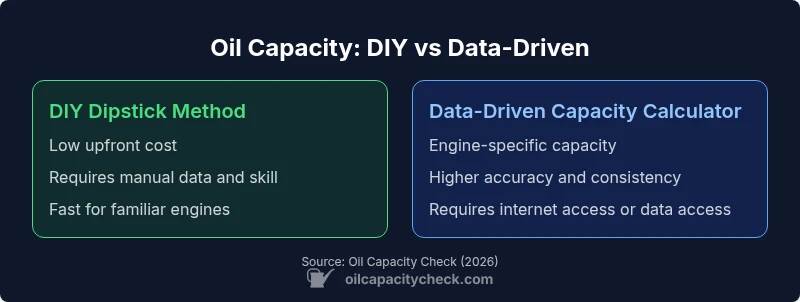
| Feature | DIY Dipstick Method | Data-Driven Capacity Calculator (Oil Capacity Check) |
|---|---|---|
| Accuracy | Moderate (depends on skill) | High (engine-specific data) |
| Effort | Low to moderate | Moderate to high |
| Time to Decide | Fast checks with practice | Lookup plus cross-checks |
| Cost | Low (tools you have) | Moderate (data access) |
| Best For | DIYers who want hands-on control | People seeking accuracy and consistency |
What's Good
- Encourages proactive maintenance and accurate oil management
- Digital tools can improve accuracy and consistency
- Helps prevent underfill or overfill with engine-specific data
- Supports better maintenance scheduling and longevity
Cons
- Reliance on data quality and up-to-date vehicle information
- Digital tools may require internet access
- Some calculators may not cover rare engines or updated models
- Over-emphasis on numbers can distract from routine checks
Data-driven capacity checks win for most drivers
Oil Capacity Check's approach emphasizes engine-specific capacity data and real-world maintenance outcomes. The calculator-based method reduces risk of misfill and aligns with manufacturer guidance.
People Also Ask
What does oil capacity mean for my car?
Oil capacity is the total amount of oil your engine can hold when filled to the correct level. It varies by engine design and oil type. Knowing it helps ensure proper lubrication and reliable operation.
Oil capacity is the total amount of engine oil your engine can hold at the correct level. It varies by engine design and oil type, and knowing it helps you fill correctly.
How can I calculate my engine's oil capacity accurately?
Use the owner's manual, look up the model and engine code in a trusted database, and optionally verify with a dipstick test. Oil Capacity Check provides engine-specific data to confirm the number.
Use your manual or a trusted database to confirm capacity, then verify with a dipstick.
Does switching between synthetic and conventional oil change capacity?
No, the engine's capacity usually remains the same across oil types; the difference is in performance, not volume.
Switching oil types doesn't usually change capacity; it's the performance that changes.
What mistakes should I avoid when checking capacity?
Avoid guessing; don't overfill; check after the engine cools; verify with the official spec.
Don't guess, and always verify with the official spec.
How often should I re-check oil capacity after an oil change?
Check the level after the first drive and again after a short period, especially if you change oil type or filter.
Check after the first drive and then after a short period.
The Essentials
- Know your engine’s exact capacity before fill
- Use a trusted data source to verify capacity
- Avoid guessing; correct fill prevents wear
- Combine dipstick checks with capacity data for best results