Oil Capacity Chart: A Practical Guide for DIY Oil Fill
Learn how an oil capacity chart helps car owners estimate oil fill, compare engine sizes, and plan maintenance with confidence. Practical tips, vehicle-type ranges, and best practices for accurate oil checks.


An oil capacity chart maps typical engine oil capacities by vehicle type and engine size, expressed in quarts or liters, giving you a practical fill target for maintenance. It’s a quick reference to avoid under- or overfilling and to plan oil changes. According to Oil Capacity Check, use the chart alongside the manufacturer spec for accuracy.
What an Oil Capacity Chart Really Is
An oil capacity chart is a practical reference that translates engine size and vehicle type into estimated oil fill volumes, usually shown in quarts or liters. It serves as a helpful guide, not a rigid rule, because exact capacities can vary by model, engine variant, and even by the oil filter installed. Oil Capacity Check emphasizes that the chart should be used alongside the manufacturer’s official specification. For DIY enthusiasts, the chart is a quick way to sanity-check how much oil you should plan to add during an oil change, especially when you’re using a non-standard or aftermarket filter. By understanding the typical ranges, you can avoid underfilling, which risks lubrication gaps, or overfilling, which can cause foaming and pressure issues.
In practice, the chart is most reliable when you know your engine family, confirm whether your vehicle uses synthetic or conventional oil, and then cross-check with your vehicle’s handbook. This integration of data points helps you move beyond guesswork and toward precise maintenance planning. The Oil Capacity Check team notes that consistency matters: always align your fill with the latest official specification for your exact engine and trim.
How to Read and Interpret the Oil Capacity Chart
Most consumer charts present capacities in quarts (with liters shown for metric vehicles). To read them, start by identifying your engine family or vehicle type, then locate the corresponding capacity range. Keep in mind that many charts show a range because real-world engines can vary by displacement, oil filter, and accessory options. When topping off after an oil change, plan for a small buffer (for example, 0.25–0.5 quarts) to account for measurement variance and filter fill. Always verify the cited figure against your owner’s manual or official service bulletin for your exact model. Oil Capacity Check recommends cross-referencing multiple sources to capture regional differences and optional equipment.
If you’re working with a newer vehicle or a performance variant, the chart can still guide you, but rely on the OEM spec for the final figure. The chart’s value lies in giving you a framework to think through oil capacity rather than a single golden number.
Practical Steps to Use the Chart in Maintenance
Begin with the engine code or model name printed in your owner’s manual or on a VIN sticker in the engine bay. Note whether your vehicle uses conventional or synthetic oil, as some charts reflect minor adjustments for synthetic blends. After an oil change, run the engine to normal operating temperature and let it rest for a few minutes so oil drains back into the pan. Pull the dipstick, wipe it clean, reinsert fully, and then pull it out again to read the level. Compare the reading to the chart’s range; if you’re near the bottom of the range, plan a topping-off within the next few hundred miles. Finally, record the observed fill amount in a personal maintenance log so you can reference it for future changes.
A disciplined approach—verification, documentation, and cross-checking with the manufacturer—reduces guesswork and helps keep your engine properly lubricated. As Oil Capacity Check notes, your chart should complement, not replace, official specifications.
Common Sources of Variation in Capacity Estimates
Variations in reported capacities arise from several factors. Engine displacement, oil filter size, and whether measurements assume an engine is dry or has a new filter installed all influence the exact figure. Some trims or market regions alter the oil capacity due to differing emission controls or accessory configurations. Diesel engines generally require more oil than gasoline engines, and turbocharged variants may have slightly different fill targets due to higher lubrication demands. Always cross-check with the exact specification for your engine variant. Oil Capacity Check highlights that these nuances are why a chart is best used as a guide alongside official data.
Building Your Personal Oil Capacity Reference
A reliable personal reference helps you plan maintenance and reduces the number of trips to the parts store or the mechanic. Start by collecting the official capacity figure from your owner’s manual and vehicle warranty booklet. If the exact figure isn’t listed, use the chart as a baseline and then confirm with the dealership or service bulletin for your exact engine code. Maintain a small notebook or digital log where you record your engine type, oil grade, and observed fill amounts after every oil change. Over time, you’ll develop a confident, repeatable process that aligns with your vehicle’s needs. Oil Capacity Check emphasizes keeping this record up to date as engines evolve across model years.
Examples: Capacity Ranges by Vehicle Type
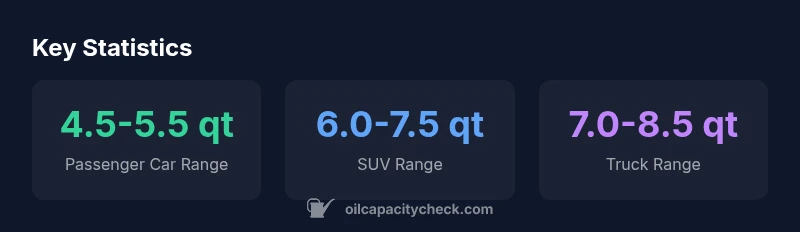
- Passenger cars: 4.5–5.5 quarts. This range covers common 4–6 cylinder engines found in many sedans and compacts. Your exact figure will depend on the engine and filter configuration.
- SUVs: 5.5–7.5 quarts. Modern utility vehicles with larger displacement engines and sometimes dual-fill filters tend to sit toward the upper end of this range.
- Pickup trucks: 6.5–8.5 quarts. Heavier-duty engines, including some diesel options, push capacity higher, and factory recommendations should be consulted for precise figures.
- Motorcycles (large): 3.0–5.0 quarts. Motorcycle engines, with distinct lubrication systems, require checking their manual for exact oil capacity.
Using these ranges in your planning helps you budget for the oil you need and ensures you stay within manufacturer guidelines across a variety of vehicles.
Best Practices for Accurate Oil Measurements
Always read the dipstick with the engine at normal operating temperature and after the oil has settled for several minutes. Temperature affects oil volume and viscosity, so a cold-reading can mislead you, especially for vehicles designed for cold-start efficiency. Use the correct dipstick technique and verify that you are using the recommended oil grade and viscosity as specified by the manufacturer. Maintain a consistent oil-change interval and log your results so you can identify trends over time. Finally, never exceed the chart’s upper bound without explicit OEM confirmation, as overfilling can lead to foaming and increased crankcase pressure. By combining the chart with careful measurements, you’ll maintain ideal lubrication and engine health.
Typical oil capacity ranges by vehicle type
| Vehicle type | Typical oil capacity (quarts) | Notes |
|---|---|---|
| Passenger Car | 4.5-5.5 | Common range; verify exact figure in manual |
| SUV | 5.5-7.5 | Higher-end engines; check model-specific data |
| Pickup/Truck | 6.5-8.5 | Diesel engines often higher; confirm spec |
| Motorcycle (large) | 3.0-5.0 | Different category; refer to manual |
People Also Ask
What is an oil capacity chart and why use it?
An oil capacity chart summarizes typical oil fill ranges for different engine types and vehicle classes. It helps DIYers estimate how much oil to add, compare against the manufacturer spec, and plan maintenance without guessing.
An oil capacity chart shows typical fill ranges by engine type. Use it to estimate how much oil to add and to plan maintenance, always cross-checking with your manual.
Do capacities vary by oil type?
Yes. Some charts adjust slightly for synthetic versus conventional oils. The change is usually small, but it’s best to confirm with the OEM spec for your exact engine.
Yes, oil type can tweak capacity a bit. Check the official spec for your engine to confirm.
Can I rely on a single chart for all engines?
A chart provides a solid baseline, but engines vary by year, trim, and regional spec. Always verify against the manufacturer’s current data for your exact model.
Not a one-size-fits-all. Use the chart as a baseline and verify with your manual for your exact model.
How often should I check oil capacity after an oil change?
After changing oil, check the level with the engine warmed up and parked on level ground. If it’s near the bottom of the range, top off within the next few miles.
Check after an oil change when the engine is warm. Top off if you’re near the bottom of the range.
What if my dipstick shows overfilled?
If the reading is above the chart range, drain a small amount of oil and recheck after a few minutes. If needed, consult a mechanic for guidance.
If over the range, remove a little oil and recheck. If unsure, ask a mechanic.
“An oil capacity chart turns theory into practical targets you can apply at every oil change; it helps you plan, check, and verify with confidence.”
The Essentials
- Use the chart alongside official specs for accuracy
- Account for engine type, oil, and filter changes
- Verify capacity with a measured dipstick reading
- Record your observed values for future changes
- Expect variation by model year and trim