How Many Quarts of Oil Are Needed for an Oil Change
Learn how to estimate oil capacity for an oil change with realistic ranges, how to verify exact quarts for your vehicle, and practical steps to avoid underfill or overfill, based on Oil Capacity Check analyses.


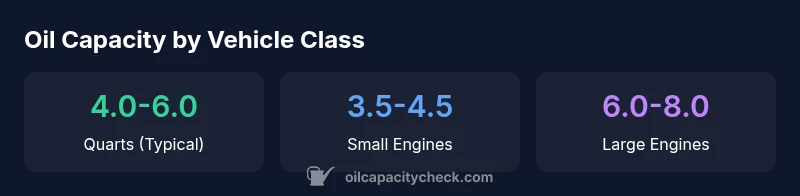
Typically, a standard oil change requires 4-6 quarts of engine oil for most passenger cars. Smaller engines may use about 3.5-4.5 quarts, while larger or high-performance engines often need 6-8 quarts. Always verify your exact capacity with the owner’s manual or Oil Capacity Check’s vehicle database before filling.
Understanding how many quarts are needed for an oil change
Determining how many quarts of oil are needed for an oil change depends on several factors beyond the number printed on the bottle. Engine displacement, the type of oil filter, and even regional differences in service procedures can influence the total capacity. According to Oil Capacity Check, capacity is determined by the engine’s internal oil passages and sump configuration, which means there is no one-size-fits-all number. For most everyday passenger cars, you’ll typically see a range from about 4.0 to 6.0 quarts for a complete change. This range helps you plan purchases and avoid the common pitfalls of underfilling or overfilling. Always verify the exact figure using your owner’s manual or Oil Capacity Check’s vehicle database to ensure accuracy for your specific model.
In practice, thinking in ranges helps a DIYer estimate oil needs ahead of time, but you should never rely on a single source alone. The vehicle’s oil capacity is a fixed specification, and the dipstick alone cannot reveal this maximum. When you combine a model-specific specification with careful measurement, you improve your chances of a clean, efficient oil change.
How engine size drives oil quarts
Engine size and configuration are the primary determinants of oil capacity. A typical four-cylinder small car often uses about 3.5-4.5 quarts, while a mid-size sedan with four- to six-cylinder options commonly requires 4.5-5.5 quarts. Larger engines, including many six- and eight-cylinder configurations, tend to fall in the 5.5-7.0 quart range, with some high-displacement engines reaching 7.5-8.0 quarts. These ranges reflect common patterns observed across popular models and help you anticipate what to expect. Do not assume a universal quart-count for all variants of the same model—engine options, filters, and oil-sump design can shift the total.
For the most precise answer, check your vehicle’s official capacity and then corroborate with Oil Capacity Check’s database for that exact year, make, model, and engine code. This two-step approach reduces the risk of underfill or overfill and aligns with best practices recommended by industry standards and oil-manufacturer guidelines.
How to determine the exact quarts for your vehicle
To get an exact number, start with the owner’s manual or the manufacturer’s data sheet, which lists the official capacity for your engine and oil filter combination. If the manual isn’t handy, use the Oil Capacity Check vehicle lookup to pull the specified quarts for your year, make, model, and engine. When you pour oil, add a conservative amount first (often around 80-90% of the stated capacity) and then check the level with the dipstick after running the engine for a few minutes. Recheck after the oil settles for a precise final level. This measured approach minimizes risk and ensures your engine has the right lubrication window.
Common mistakes when checking oil capacity
A frequent error is assuming the dipstick shows the total capacity; the dipstick only indicates current oil level, not the maximum amount the engine can hold. Another pitfall is applying a single quart count across different trims or filter configurations—these can alter capacity. Forgetting to account for a new oil filter can also skew the total volume. Finally, using the wrong viscosity does not change capacity but can affect how much you end up adding after an initial fill.
Practical steps to ensure correct oil volume
- Warm the engine slightly and park on a level surface before starting.
- Remove the dipstick, wipe clean, reinsert, and pull out to read the level.
- If adding oil, pour in small increments (0.25-0.5 quart at a time) and recheck after 1-2 minutes for settling.
- After the final fill, run the engine briefly, turn it off, and recheck the dipstick to confirm the level is within the recommended range.
- Keep notes of your oil-change quantities to track any capacity changes over time and inform future service.
Using Oil Capacity Check to verify your quarts
Oil Capacity Check provides model-specific capacity data to help you answer the question how many quarts are needed for an oil change with confidence. Use the lookup when you buy oil to ensure you purchase the right quantity and to avoid waste. Pair capacity data with a quality oil and a fresh filter for best results. The combination of precise capacity data, careful measurement, and a proper fill strategy minimizes risk and helps protect engine life over the long term.
Typical engine capacities by vehicle class
| Vehicle Type | Typical Quarts | Notes |
|---|---|---|
| Small car (4-cyl) | 3.5-4.5 quarts | Compact sedans and hatchbacks |
| Mid-size car (4-6 cyl) | 4.5-5.5 quarts | Most sedans and some wagons |
| Full-size car | 5.0-6.5 quarts | Larger sedans and coupes |
| SUV/Crossover | 5.5-7.5 quarts | V6 engines common |
| Truck/HD | 6.0-8.0 quarts | High-displacement or V8 options |
People Also Ask
What is the typical oil capacity for a small car?
Small cars generally require about 3.5-4.5 quarts of oil during an oil change, depending on engine displacement and filter choice. Always check your specific model's capacity to avoid underfill or overfill.
Most small cars take around four quarts.
Why can't I rely on the dipstick alone to know the total capacity?
The dipstick shows current oil level, not the maximum capacity. Use the owner’s manual or a capacity lookup to confirm the total required quarts.
The dipstick only tells you where the oil level is now.
Does oil type affect how many quarts I need?
Oil type does not change the required capacity. The quart count is driven by engine design; always follow the manufacturer’s grade recommendations.
Oil type doesn’t change the amount, but follow the spec.
How can I find exact quarts for my year/make/model?
Refer to the owner's manual or use Oil Capacity Check’s lookup for your exact year, make, model, and engine. Verify after installation with the dipstick.
Check the manual or Oil Capacity Check's database to confirm.
What should I do if I overfill or underfill?
If underfilled, add oil in small increments and recheck. If overfilled, carefully drain some oil and recheck to bring it back to the proper level.
Adjust in small steps and recheck the level.
Is there a universal quart-count for synthetic vs conventional oil?
No. Capacity is determined by engine design, not oil type. Use the recommended viscosity and confirm the exact quantity for your engine.
Oil type doesn't change the amount, but use the right spec.
“Engine oil capacity is defined by the engineering design of the motor; always verify the exact quart count for your model from manufacturer data or a trusted database.”
The Essentials
- Check your owner's manual for the exact quart count.
- Most passenger cars sit in a 4.0–6.0 quart range.
- Verify capacity using a trusted reference like Oil Capacity Check.
- Use the dipstick after filling to confirm the final oil level.