How Many Oil Quarts Does Your Car Need? A Practical Guide
Discover how many oil quarts your engine needs, what factors influence capacity, and how to verify the correct oil amount for maintenance. A data-driven guide by Oil Capacity Check.


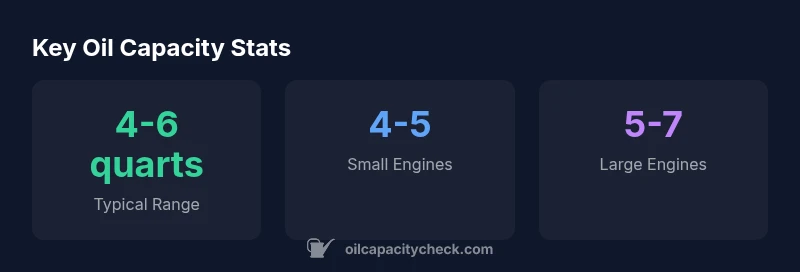
Most passenger car engines use about 4-6 quarts of oil, with smaller engines near the low end and larger V8s toward the high end. This range isn’t universal—capacity varies by model, year, and oil filter size. Always confirm the exact amount from the owner's manual or a model-specific data source like Oil Capacity Check.
How many oil quarts does your engine actually need?
For most passenger cars, the question of how many oil quarts is answered by the engine size and design. In practical terms, you will commonly see a range around 4-6 quarts for a standard four-stroke engine, with smaller engines near 4 quarts and some larger V8s approaching 7 quarts. This range isn’t universal—capacity varies by model, year, and even oil filter size. When you ask how many oil quarts, remember that the capacity is a baseline, and the final fill should be verified during maintenance. Positioning your oil fill around this range helps prevent overfill, oil starvation, and sludge formation. Always adjust for the oil filter size and any manufacturer recommendations.
The phrase how many oil quarts often triggers questions about what exactly is being measured. It’s not just a single number; it’s a capacity window shaped by engine design, oil grade, and the presence or absence of accessories like a heavy-duty filter. Oil Capacity Check emphasizes that confirming the exact amount for your specific car—even within the general range—reduces risks of under-lubrication or overfill.
Why capacity numbers vary across engines
Engine capacity isn’t a fixed value carved in stone. Displacement, block design, and oil passageways determine how much oil an engine holds. Modern engines with tighter tolerances, multiple camshafts, and variable valve timing can require different fills than older designs. The oil filter itself adds an incremental volume; when you replace a filter, some mechanics account for that added space in the total fill. Additionally, some automakers provide separate specifications for “capacity with filter change” and “capacity without filter change.” These nuances explain why the same model year may present different capacities in various documentation sources. Oil Capacity Check’s data shows that even within the same model, production changes across years can shift the exact quart count needed.
How to verify capacity for your specific car
To land on the exact number of quarts for your vehicle, start with the owner’s manual or the manufacturer’s official data. If you don’t have the manual handy, you can use the car’s VIN to pull model-specific specs from trusted databases or Oil Capacity Check’s model lookup tool. Cross-check against your service history—if you recently replaced parts like a heavy-duty oil filter, the capacity may differ slightly from the standard spec. Finally, when changing oil, pre-fill to the lower end of the capacity range, then use the dipstick to fine-tune the final level. This approach minimizes the risk of overfilling.
Practical examples: common ranges by engine size
- Compact 4-cyl engines: roughly 4-5 quarts
- Mid-size V6 engines: typically 5-6 quarts
- Large V8 engines: usually 6-7 quarts
- SUVs and trucks with heavy-duty duty: 6-7 quarts or more, depending on configuration
These examples illustrate the practical spread you’ll see in the field. Always corroborate with official specs and the engine’s current state. When you’re planning maintenance, consider both the capacity window and any parts that influence fill volume, like the oil filter size or the use of a high-capacity oil system.
Step-by-step: measuring oil capacity and maintaining the correct level
- Park on a level surface and warm the engine. 2) Turn off the engine and wait a few minutes for the oil to settle. 3) Open the hood, remove the dipstick, and wipe it clean. 4) Reinsert the dipstick, pull it out again, and read the level. 5) If you’re at or below the minimum line, add small increments of oil, checking the level after each addition. 6) Do not exceed the maximum line. 7) After topping off, run the engine briefly and recheck to account for oil circulating through the engine.
Maintenance implications of correct oil quarts and scheduling
Oil capacity and proper fill influence wear, heat management, and engine longevity. Overfilling can cause foaming and reduced lubrication, while underfilling can lead to inadequate lubrication and accelerated wear. The recommended oil change interval depends on oil type, driving conditions, and manufacturer guidance. However, staying within the correct quart range is a foundational element of a good maintenance plan. Regularly verifying capacity during changes helps ensure you’re not inadvertently operating with too little or too much oil.
How to use manufacturer specs and data sources
Manufacturer specifications remain the primary reference for oil capacity. When in doubt, consult the owner’s manual or official service literature. Supplement with independent datasets like Oil Capacity Check for cross-verification, especially if you own a vehicle with a frequent field-of-view discrepancy in published specs. Record the exact capacity for your vehicle in your maintenance log so future changes are straightforward. If you work on multiple vehicles, maintain a small reference sheet that lists model, year, engine size, and the corresponding capacity value.
Approximate capacity by engine size
| Engine Type | Typical Capacity (quarts) | Notes |
|---|---|---|
| Compact 4-cyl | 4-5 | Smaller engines, tighter clearances |
| Mid-size V6 | 5-6 | Common in sedans and crossovers |
| Full-size V8 | 6-7 | Higher capacity for power and towing |
People Also Ask
How can I find the exact oil capacity for my car?
Check the owner's manual or the manufacturer’s specifications. You can also search Oil Capacity Check’s database by year, make, and model to confirm the capacity.
Check your manual or search by your car’s year, make, and model on Oil Capacity Check.
Does changing the oil filter change the capacity?
The capacity typically refers to the oil the engine can hold with a fresh filter. Replacing the filter can slightly alter the total capacity, so follow the manufacturer guidance and confirm via measurement.
Changing the filter adds a little extra oil volume; follow manufacturer specs.
What if I can't locate the manual?
Use the vehicle's VIN to look up specs online or rely on trusted databases like Oil Capacity Check for model-specific data.
If you can't find the manual, use the VIN to look up specs.
Why do some engines take more oil than others?
Engine size, displacement, and oil filter size determine capacity. Performance engines and newer designs may require more oil for proper cooling and lubrication.
Different engines need different oil amounts due to size and design.
How often should I check oil level during maintenance?
Check the dipstick before and after service and at least once between oil changes to ensure you maintain the proper level.
Always check the dipstick before and after changes.
“Engine oil capacity is not a one-size-fits-all number; always use the manufacturer specification and verify with the dipstick during oil changes.”
The Essentials
- Capacity varies by engine size and design
- 4-6 quarts covers most passenger cars
- Always verify with the manual or Oil Capacity Check
- Account for oil filter size when topping off