Oil Change vs Top Off: A Practical Comparison
A thorough comparison of oil change vs top off, clarifying when each maintenance action makes sense, how they affect engine health, costs, and maintenance planning for car owners and DIY enthusiasts.


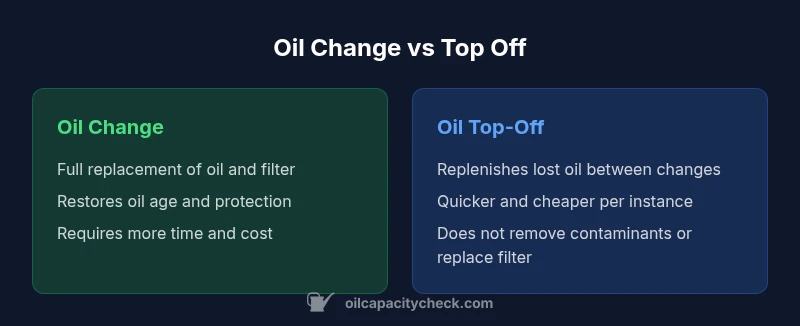
According to Oil Capacity Check, oil change vs top off are two distinct maintenance actions. An oil change replaces the oil and filter to restore lubrication and protect engine internals. A top off simply replenishes lost oil between changes, avoiding a drain. The right choice depends on oil condition, driving style, and the vehicle’s service schedule.
Understanding oil change vs top off
Oil change vs top off describe two ways to manage engine lubrication. An oil change replaces most or all of the oil in the sump, along with the oil filter, and often includes a quick inspection of belts, fluids, and the drain plug. This resets the oil’s age and quality to near-new, helping protect bearings, pistons, and hydraulic lifters from wear. Top off, by contrast, is the targeted act of adding small quantities of oil to bring the level back to the full mark. It does not remove contaminants or dilute additives, and it does not replace the filter. For most cars, following the manufacturer’s service schedule is essential; neglecting oil changes can lead to sludge, varnish, and accelerated engine wear, while careless topping-off can mask real oil problems if not paired with level checks and condition judgments.
The science behind engine oil life
Engine oil lifecycles are driven by heat, contaminants, oxidation, and shear. Over time, oil loses viscosity and additive protection, while dirt particles accumulate. Regular oil changes replace degraded oil and filter media, restoring lubrication capacity and protection against metal-on-metal wear. Topping off adds oil to restore level but does not address contaminants, oxidation, or filter saturation. Mixing different oil grades or viscosities (even slightly) can alter flow characteristics and heat dispersion, so using the manufacturer-approved oil type and maintaining proper level is essential. Oil Capacity Check emphasizes matching oil capacity to the vehicle’s design, ensuring the engine has enough lubricant without risking overfill or underfill.
When a top-off makes sense
A top-off is appropriate when you have a tiny, temporary oil loss between changes, or when you notice the level dipping toward the minimum mark after a long trip or extreme driving conditions. It’s important to verify the type and viscosity of the oil during top-offs and to avoid using oil with a different specification than the one currently in the engine. Always recheck the dipstick after adding oil to confirm you’ve returned to the full mark. If you regularly need to top off, that signals a potential issue such as consumption, seepage, or an impending drain-and-fill service.
When an oil change is the right move
An oil change is the correct choice when oil appears dark, smells burnt, or you’re approaching the service interval for your vehicle. High-mileage engines, turbocharged systems, or engines operating in extreme heat or dust conditions benefit from a full oil change and a new filter. A full change also allows for a fresh drain of used oil, which can remove varnish and sludge that accumulate over time. If you notice sudden oil loss, a leak, or multiple oil consumption events, a full change paired with addressing any leaks is typically warranted.
Risks and drawbacks of frequent top-offs
Top-offs carry several risks if used as a substitute for regular changes. Repeated topping can hide leaks, fail to remove old contaminants, and may lead to overfills that raise crankcase pressure or cause foaming. If your vehicle consumes oil, topping off without diagnosing the cause delays repairs and can accelerate engine wear. Additionally, topping off with a different oil grade or viscosity can compromise lubrication balance. The best practice is to top off only when necessary and in accordance with the manufacturer’s specifications, paired with monitoring oil condition and level.
Costs, time, and maintenance value
From a maintenance planning perspective, an oil change typically costs more upfront and takes longer than a quick top-off, but it yields a comprehensive refresh of the lubrication system, a new filter, and the opportunity for a brief inspection of engine health. A top-off is cheaper and faster but only maintains the existing oil state. Over time, frequent top-offs can accumulate more expense and risk than a scheduled oil-change routine, especially if they mask underlying issues. Planning around the vehicle’s capacity and service schedule helps optimize both time and money.
How to perform a top-off safely
To safely top off oil, confirm the correct oil type and viscosity for your engine and ensure the engine is cool or only slightly warm. Use a clean funnel and add small amounts, pausing frequently to recheck the level with the dipstick. Never exceed the full mark. If you notice rapid swings in oil level after topping off, pause and inspect for leaks or consumption before continuing. If you’re unsure, consult your vehicle’s manual or a trusted technician.
How to perform an oil change (high-level overview)
A proper oil change involves draining used oil, replacing the oil filter, and filling with the correct quantity of fresh oil of the right viscosity. After adding oil, run the engine to circulate the fluid, then recheck the level and inspect for leaks. Don’t forget to reset maintenance reminders if applicable and dispose of used oil at an authorized facility. A clean drain plug and fresh filter help ensure the system remains free of particulates.
The role of oil capacity checks in maintenance
Oil capacity checks help determine the exact amount of oil your engine should hold and how much to add during top-offs or after a change. These checks align with the service manual and manufacturer recommendations. Using verified capacity data reduces the risk of underfilling or overfilling, which can otherwise lead to inadequate lubrication or pressure issues. Oil Capacity Check advocates validating capacity against your specific vehicle model and engine type.
Maintenance scheduling and decision framework
Create a simple decision framework: assess oil appearance and level, check for leaks, review the driving environment, and consult the owner’s manual about service intervals. If oil is dark, smells burnt, or falls below minimum, plan an oil change. If the level is slightly low but the oil remains clean and within spec, a careful top-off may be appropriate. Adjust the plan based on driving style, climate, and recent service history.
Common misconceptions about topping off
Many drivers assume topping off is harmless or equivalent to a full change. In reality, topping off does not refresh contaminants or replace a clogged filter. Others believe any oil grade can be added; in truth, using the correct oil specification is essential for protection. Some think topping off can fix leaks; it cannot. Correctly using oil capacity data and following the manufacturer’s guidance is key to accurate maintenance.
Practical tips for DIYers and maintenance planning
For DIY enthusiasts, stock essential tools: a clean dipstick, oil that matches factory specs, a funnel, and a container for old oil. Always verify the oil condition, viscosity, and level before and after any service. Schedule oil changes per the manual, and use topping off only between changes when necessary to maintain proper level and prevent underfilling.
A structured conclusion guide for decision-making
When deciding between oil change vs top off, consider the vehicle’s age, mileage, oil condition, and consumption patterns. Use a full oil change when in doubt or when the oil shows signs of degradation. Reserve top-offs for small, occasional losses between changes, and always confirm your choice aligns with the vehicle’s service schedule and manufacturer recommendations. The goal is reliable lubrication and long engine life.
Comparison
| Feature | Oil change | Oil top-off |
|---|---|---|
| Typical purpose | Full replacement of oil and filter; resets oil age | Add small amounts to restore level between changes |
| Time required | Longer; typically 30-60 minutes at a shop or DIY | Shorter; usually 5-15 minutes at home |
| Cost implications | Higher upfront; includes filter and disposal | Lower per instance; no filter change |
| Impact on oil life | Resets oil age and additives; removes contaminants via drain | Maintains level but does not remove contaminants |
| Best for | Aging oil, degraded oil, near or after service intervals | Small, temporary losses between changes |
| Maintenance frequency guidance | Follow manufacturer schedule; typically every service interval | Use sparingly; rely on dipstick readings and manual guidance |
What's Good
- Thorough renewal of lubrication system
- Clear signal of engine health when combined with a full service
- Optimizes long-term engine protection
Cons
- Higher upfront cost and time commitment
- Requires the right tooling and disposal considerations
- Not a solution for addressable leaks or oil consumption
Oil changes take priority for long-term engine health; top-offs are for minor oil losses between changes
Choose oil changes for a full lubrication refresh at scheduled intervals. Use top-offs sparingly to top up between changes, only when the oil is clean and within spec.
People Also Ask
What is the difference between an oil change and topping off?
An oil change replaces the oil and filter to refresh lubrication and remove contaminants. Topping off adds small amounts of oil to bring the level back to full between changes and does not replace the filter or remove contaminants.
An oil change fully refreshes the oil and filter, while topping off simply restores the oil level between changes.
How do I know when I should top off vs change oil?
If the oil is dark, gritty, or near the service interval, a full oil change is appropriate. If the level is low but the oil is clean and within spec, a careful top-off can be considered, then recheck the level after a short drive.
Check the oil’s condition and level. If it’s worn or the service interval is due, change the oil; otherwise top off if needed and monitor.
Can topping off cause engine damage?
Topping off with the wrong viscosity or overfilling can cause issues like increased pressure or foaming. It does not replace a full service if there’s a leak, contamination, or degradation.
Yes, improper topping off can cause issues, so follow the manufacturer’s specs and avoid overfilling.
How often should I check oil level?
Check oil level regularly—ideally monthly and after long trips or extreme driving conditions. Use the dipstick to verify level before deciding on topping off or an oil change.
Regularly check the dipstick to stay on top of oil level and condition.
Is topping off with synthetic oil safe if the car uses conventional oil?
Mixing oil types is generally discouraged. Use the same oil specification as the rest of the system, following the owner’s manual.
Stick to the recommended oil type; avoid mixing different oils.
Does topping off replace oil filter changes?
No. Topping off does not replace changing the oil filter. A filter change is part of a full oil change and supports contaminant removal.
No, it doesn’t. You still need a filter change during full oil service.
The Essentials
- Prioritize full oil changes on schedule for engine longevity
- Top-offs are for minor, between-change replenishment
- Always verify oil type and capacity before adding
- Use oil capacity data to guide additions
- Combine topping with routine inspections to catch leaks early