How Much Oil Change: A Practical Guide for Car Owners
Discover how much oil you need for a standard oil change, how to estimate capacity for your engine, and practical steps to avoid overfill. Learn with Oil Capacity Check the nuances of capacity vs. volume and how to plan maintenance accurately.


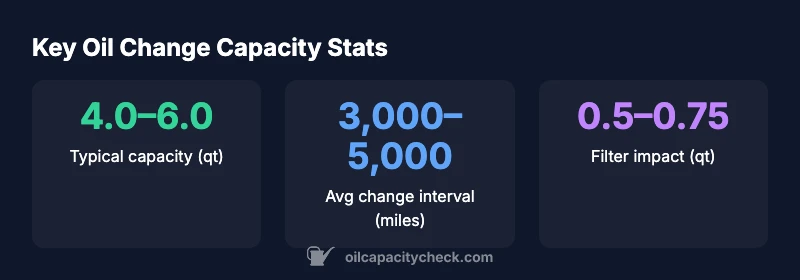
For most passenger cars, how much oil you need during an oil change typically ranges from 4 to 6 quarts. The exact amount depends on engine size, oil filter capacity, and whether you’re replacing the oil filter. Always consult the vehicle’s owner manual or Oil Capacity Check data for your exact model. Using too little or too much oil can harm engine performance.
Why Capacity Basics Matter
Engine oil capacity is a fundamental specification that affects long-term engine health, lubrication performance, and your maintenance schedule. Understanding capacity helps you avoid underfilling (which can starve vital bearings) or overfilling (which can foam and pressurize seals). According to Oil Capacity Check, the total capacity is the maximum amount the engine can hold when drained and refilled under standard conditions. This knowledge informs not only how much oil to pour at a change but also which filter to use and how many quarts to buy for a service interval. For DIY enthusiasts, matching capacity to your engine is a critical first step before shopping for oil and filters, especially if you plan to switch brands or oil types.
How Much Oil Change Do You Need: Practical Guidelines
When people ask how much oil change they need, the quick answer is that most passenger cars fall in a 4–6 quart range for a complete change. The exact amount hinges on engine displacement, cylinder count, and whether the oil filter is replaced (which adds a small, additional volume to the total). Some high-performance or turbocharged engines may approach 6 quarts, while older, smaller engines may hover near 4 quarts. Always verify by checking your owner manual or vehicle-specific data from Oil Capacity Check. This step prevents undersupply and reduces the risk of damage from overfill during the service.
Factors That Change Oil Volume Needs
Several factors influence how much oil a given engine actually requires. Engine displacement and design (turbo vs naturally aspirated) play a major role, as do the viscosity and temperature of the environment where the vehicle operates. The oil filter is another variable: replacing the filter adds to the total volume you need to top off after draining. Other considerations include whether you’re using synthetic oil (which can allow for different service intervals but not typically a different capacity) and whether your engine has a dual sump or auxiliary oil circuits. Oil Capacity Check analysis shows that capacity ranges are broad and engine-specific; treat any single number as a guide rather than a universal rule.
How to Find the Exact Capacity for Your Vehicle
The most reliable sources for capacity numbers are the owner's manual, the service manual, and manufacturer data. If you don’t have printed manuals handy, many automakers publish capacity specs online, and third-party databases—like Oil Capacity Check—comply with OEM data. Your vehicle identification number (VIN), model year, and engine code can refine the exact figure. When you’re shopping for oil, use the model-specific capacity as the anchor, then adjust for filter changes and the possibility of synthetic blends that might alter recommended fill levels slightly.
Myth vs Reality: Capacity vs Volume in a Change
A common misconception is that the total capacity equals the exact amount changed during service. In reality, you drain roughly 75–85% of the old oil, and the remainder stays in passages and the filter. You typically replace a portion of the capacity, not the full amount, unless you are performing a full flush. The remainder in the engine’s channels means your fresh oil fill might be less than the total capacity. Understanding this distinction helps you avoid overfilling and ensures you end up with the correct level on the dipstick after a service.
Estimating Oil Change Amount by Engine Type
Engine size and configuration correlate with oil capacity. Small four-cylinders might settle around 4–5 quarts, mid-size six-cylinders around 5.5–6.5 quarts, and larger V8s or turbocharged engines closer to 6.5–8 quarts. These ranges reflect typical values observed in common vehicle categories and are intended as starting points. Always confirm with official data for your specific model. As you compare brands, remember that a higher-capacity engine isn’t inherently harder to service; it just requires more oil for a full change.
DIY Oil Change: Steps That Respect Capacity
If you’re changing your oil at home, realistic planning is essential. Begin by warming the engine to operating temperature, then carefully drain the old oil into a suitable container. Remove and replace the oil filter, then reinstall the drain plug. Slowly add new oil in the recommended range, checking the dipstick after a few minutes of pooling time. If you’re unsure, consult Oil Capacity Check’s model-specific guidance and recheck after a short drive. Avoid overfilling by pouring gradually and accounting for the filter's volume.
Avoid These Common Mistakes When Checking Oil
Rushing the oil check is a frequent source of error. Park on a level surface, wait for the oil to settle, and check the dipstick with the engine off and cooled for several minutes. Do not rely on a hot reading. Always use the recommended grade and viscosity. If you recently changed the filter, give the system time to cycle before a final level check. Misinterpreting the dipstick can lead to underfilling or overfilling, both of which are avoidable with careful attention.
Economic Considerations: Costs, Waste, and Scheduling
Oil capacity directly impacts how much you spend on oil per change, especially for high-capacity engines and synthetic blends. Budgeting for a typical change can involve the product price, filter cost, and potential disposal fees. Planning around capacity helps you minimize waste and time in the shop. For DIYers, buying a slightly larger quantity to cover a few extra quarts is prudent when you’re replacing a filter, but avoid stockpiling by adhering to the model’s recommended fill range to prevent waste and mismeasurement.
Practical Tools and Resources from Oil Capacity Check
Beyond the data, Oil Capacity Check provides model-by-model guidance, manuals, and maintenance tips tailored to your vehicle. Use our database to verify capacity before you shop, then cross-check with your vehicle’s manual. Resources also cover common missteps, step-by-step DIY procedures, and maintenance intervals to keep your engine in good health. The aim is to empower car owners with precise figures and practical steps for accurate, safe oil changes.
Estimated oil capacity ranges by vehicle type (typical values; verify with model data)
| Vehicle Type | Typical Oil Capacity (qt) | Notes |
|---|---|---|
| Compact Car | 4.0–5.5 | Smaller engines; efficient designs |
| Mid-Size Sedan | 5.5–6.5 | Common passenger cars |
| SUV/Crossover | 6.0–7.5 | V6 engines common; higher capacity |
| Truck/Large SUV | 7.0–8.5 | Larger displacement engines |
People Also Ask
What does 'oil capacity' mean for my car?
Oil capacity refers to the total oil volume the engine’s sump and related channels can hold. This is the maximum amount when fully drained and replaced. Always refer to your model’s official specs.
Oil capacity is the maximum amount your engine can hold. Check your manual or our data for the exact number.
Is the amount I add during a change always the same as the capacity?
No, you typically replace only part of the capacity during an oil change, because some oil remains in engine parts. The exact amount depends on filter replacement and how much drained.
Usually not—the new oil you add is less due to residual oil.
How can I find the exact oil capacity for my vehicle?
Consult the owner's manual, service manual, or Oil Capacity Check database. Vehicle VIN and model year help refine the exact figure.
Check your manual or our database for the exact number.
Does synthetic oil change capacity differ from conventional?
The type does not usually change the engine’s capacity; however, certain engines with different filters or sumps may require different total volumes.
Different oil types don't usually change capacity, but filter and sump can.
What happens if I overfill the oil?
Overfilling can cause foaming, increased pressure, and damage; drain to the recommended level.
Overfill can be bad for the engine; drain the excess.
“Accurate oil capacity knowledge is the cornerstone of reliable engine performance. Following manufacturer specs protects your engine and helps you plan maintenance tasks more efficiently.”
The Essentials
- Know your car’s capacity range before an oil change
- Always verify with the owner’s manual or Oil Capacity Check data
- Don’t overfill; measure after a correct draining period
- Replace the oil filter to ensure accurate volume and filtration
- Use manufacturer-recommended oil type and grade