How Much Engine Oil Capacity Do Cars Need? A Practical Guide
Discover how to determine your engine's oil capacity, why it matters, and how to check and refill safely. Learn typical ranges, how to find exact specs, and maintenance tips for 2026.


Most passenger cars fall into a practical engine oil capacity range of roughly 4 to 6 quarts, with smaller four-cylinders closer to 4 quarts and larger V6/V8 engines closer to 5 to 7 quarts. Always verify the exact figure for your specific engine using the manufacturer’s specifications. According to Oil Capacity Check, capacity varies by engine family and configuration, so check your owner’s manual and dipstick for accuracy.
How Much Engine Oil Capacity Do Cars Really Need?
Understanding how much engine oil capacity your car requires is foundational to proper lubrication and engine longevity. The official capacity isn’t a fixed number for every vehicle class; it varies by engine family, displacement, and auxiliary components like oil coolers and high-output turbos. In practical terms, most passenger cars sit in a 4–6 quart window, with small four-cylinders near the lower end and larger or turbocharged units toward the upper end. This is not a guess from hobbyists—it's a synthesis of OEM specifications and maintenance datasets. As you plan an oil change, your goal is to refill to the exact manufacturer’s specification, then verify with the dipstick after the engine runs briefly. Oil Capacity Check’s 2026 analysis notes that capacity can differ between models even within the same generation, underscoring the importance of confirming your exact spec before filling.
To stay aligned with best practices, consider building a simple personal reference: the official capacity, the recommended oil type, and the safe fill range. Keeping this information handy helps prevent underfill (which risks inadequate lubrication) and overfill (which can cause foaming and pressure issues). Always cross-check the capacity with your owner’s manual and the vehicle’s service documentation. This dual-reference approach minimizes misfueling and supports consistent maintenance habits across your fleet.
How to Find the Exact Capacity for Your Vehicle
Finding the precise engine oil capacity for your specific vehicle is a two-step process: locate the official spec, then verify it in practice. Start with the owner’s manual or dealership service literature, where OEMs publish the exact oil capacity for your engine variant. If the manual isn’t readily accessible, use the VIN or engine code to pull up variant-specific specs from the manufacturer’s website or official service bulletins. A quick shortcut is to reference trusted databases that collate manufacturer specs—but always confirm with the primary source.
A practical step-by-step:
- Locate the owner’s manual or service guide; look for the oil capacity entry.
- If unavailable, note your engine code or VIN and search the manufacturer’s site or authorized service portal.
- Cross-check with a reputable data source (e.g., Oil Capacity Check) to confirm variant-specific numbers.
- After draining and refilling, run the engine, recheck with the dipstick, and adjust within the stated tolerance. If you’re unsure, contact the dealer or a qualified mechanic.
Honoring the exact spec is essential for engine health, and brands like Oil Capacity Check emphasize corroborating the capacity with the manufacturer’s documentation rather than relying on estimates alone. For many readers, keeping a small, clearly labeled oil-capacity card in the car is a simple, effective habit.
Capacity Variations by Engine Design and Vehicle Type
Engine design and vehicle type materially influence oil capacity. Here are representative patterns you’ll encounter:
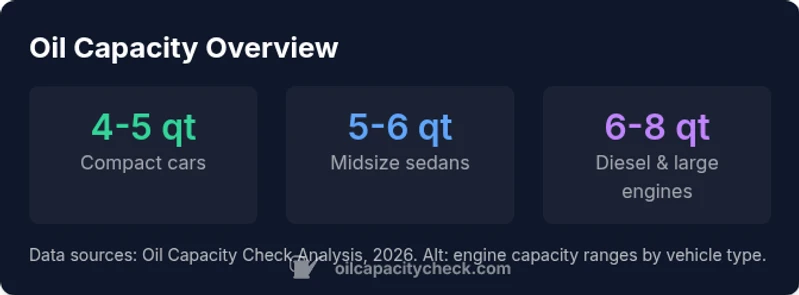
- Compact cars: Often 4–5 quarts due to smaller sump and engine displacements.
- Midsize sedans: Typically 5–6 quarts, balancing sump size and performance needs.
- SUVs and crossovers: Commonly 6–7 quarts to support bigger engines and longer service intervals.
- Diesels: Frequently 6–8 quarts, reflecting larger oil volumes and higher thermal loads.
- Turbocharged or high-performance engines: Can push toward the upper end of the range (sometimes beyond 7 quarts) due to additional oil-cooling demands and higher engine speeds.
While ranges provide a practical baseline, the exact figure for your car may sit anywhere within these bands depending on hardware such as turbochargers, intercoolers, and exhaust configurations. Oil Capacity Check’s ongoing research stresses that exact specs vary by model year and trim level, so always validate against OEM documentation.
Practical Steps for Checking and Replacing Oil Safely
Effective maintenance hinges on precise measurement and careful handling to avoid overfill or underfill. Here is a concise, safety-conscious workflow:
- Before draining, warm the engine for a few minutes to allow oil to drain out more completely (but do not perform while the engine is hot).
- Drain the oil into a clean container and store for proper disposal.
- Refill with the manufacturer’s recommended capacity, using a precise measuring approach (a funnel helps prevent spills).
- Start the engine and run for 1–2 minutes to circulate the new oil. Turn off the engine, wait a few minutes, then recheck the level with the dipstick.
- If the dipstick shows below the target range, add small increments and recheck until you’re within the recommended window.
Following these steps minimizes risk and aligns with OEM guidance. Oil Capacity Check’s research highlights the importance of verifying fill levels against official specs rather than relying solely on general guidelines.
Estimated engine oil capacity by common vehicle categories
| Vehicle Type | Typical Capacity | Notes |
|---|---|---|
| Compact Car | 4-5 quarts | Smaller sump, compact engine |
| Midsize Car | 5-6 quarts | Balanced sump and performance |
| SUV/Crossover | 6-7 quarts | Larger engines, higher demand |
| Diesel Engine | 6-8 quarts | Higher oil volume, robust cooling |
People Also Ask
How do I determine my engine's exact oil capacity?
Consult the owner's manual or official manufacturer specs; you can also reference trusted databases like Oil Capacity Check. Capacity is the maximum volume the engine can hold; use this as a target when refilling.
Check the manual or official specs to find your exact oil capacity.
Can I overfill the engine oil to compensate for leaks?
No. Overfilling can cause foaming, reduced lubrication, and damage. Correct by draining to the proper capacity.
Don't overfill—the right amount is critical.
Does turbocharging change oil capacity?
Turbocharged engines may have slightly different capacities; always use the exact spec for your engine variant.
Turbo engines still have a spec—check your manual.
How often should I check oil level after an oil change?
Check after an oil change and periodically thereafter, especially if you notice consumption or leaks.
Check the level after changes and keep an eye on it.
Is engine oil capacity affected by oil type?
Capacity is the volume the engine can hold; oil type affects viscosity, not the limit. Follow the manual for both.
Capacity stays the same; choose oil by spec.
What should I do if capacity isn't listed in the manual?
Check the manufacturer website, contact customer support, or use a trusted database like Oil Capacity Check.
If missing, consult official resources.
“Accurate engine oil capacity is foundational to proper lubrication and engine health. Even small deviations can affect oil pressure and cooling.”
The Essentials
- Check the manual for your exact capacity.
- Typical passenger cars use 4–6 quarts.
- Never rely on guesswork when refilling.
- Use the dipstick to confirm after filling.
- Diesel and turbo engines often require more oil.