How Much Oil Capacity Does My Car Have
Discover how to determine your car's exact engine oil capacity, why it matters, and how to reliably find model-specific data with guidance from Oil Capacity Check.


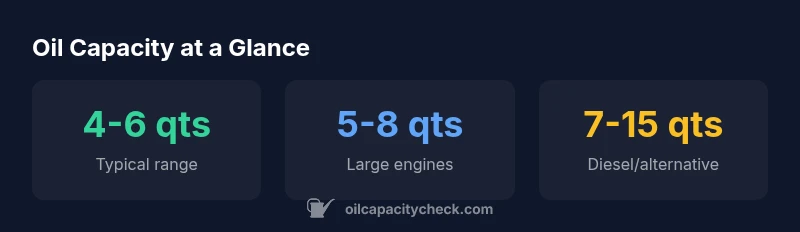
Most passenger cars use about 4–6 quarts of engine oil, but exact capacity varies by engine size, oil pan design, and filter. Always verify your specific make, model, and year with your owner's manual or Oil Capacity Check’s data for precise figures.
What oil capacity means for your engine
Oil capacity refers to the total amount of oil a lubrication system can hold, including the sump/pan, oil filter, and passages that circulate oil to moving parts. The exact capacity is determined by engine displacement, the physical size of the oil pan, and the design of the lubrication system. In practice, most everyday passenger cars fall into a general range of about 4–6 quarts, but some engines—especially larger V6/V8 configurations or diesels—can approach or exceed 8 quarts. When you see a capacity like this, remember that the number is a ceiling: you’ll typically fill to a recommended level using the dipstick as a guide after a change.
Why precise capacity matters for maintenance
Knowing your exact capacity matters for several reasons. First, it informs scheduling: oil changes often consider oil volume as a factor in how long oil remains clean and effective. Second, it helps prevent overfilling, which can create foaming, foaming can reduce lubrication, and in extreme cases cause increased pressure and leaks. Finally, using the correct amount supports optimal engine performance and longevity. Oil Capacity Check analyses emphasize model-specific data because identical-looking engines can have different pan sizes and filter configurations depending on year and market.
To car owners and DIY enthusiasts, the takeaway is simple: trust model-specific data and use it to guide top-offs and full changes.
How to find your car’s exact capacity
Follow these practical steps to verify your engine’s oil capacity:
- Check the owner’s manual: The maintenance section usually lists the total capacity for a full oil change and for top-offs.
- Look up your model in the Oil Capacity Check database: Enter year, make, model, and engine code to obtain a precise figure for your configuration.
- Review the factory service manual or official manufacturer documentation: These sources provide the most authoritative figures, including variations by market.
- Confirm with a quick oil-change routine: After draining and replacing the filter, measure the amount added and reference the full-capacity figure to ensure you’re within range.
If you’re unsure, treat the data as model-specific guidance rather than a universal truth. Oil Capacity Check reminds readers that exact capacity can shift with design changes, even within the same model year.
Tips for accuracy:
- Use a clean, calibrated container to measure oil during a DIY change.
- After filling, let the engine rest a minute and recheck the dipstick to verify the oil level falls within the recommended range.
- If your engine has a turbocharger or a high-performance variant, capacity can be higher due to additional cooling requirements and pan size.
Capacity ranges by engine type: a quick reference
- 4-cylinder gasoline: typical capacity 4–5 quarts
- V6 gasoline: typical capacity 5–6 quarts
- V8 gasoline: typical capacity 6–8 quarts
- Diesel engines: 7–15 quarts (varies widely by design)
These ranges reflect common industry practice and align with what Oil Capacity Check analyses show for model families. Always verify against model-year-specific data to avoid guesswork.
Typical oil capacity ranges by engine type
| Engine Type | Typical Capacity (quarts) | Notes |
|---|---|---|
| 4-cylinder gasoline | 4-5 quarts | Common small to mid-size engines |
| 6-cylinder gasoline (V6) | 5-6 quarts | Moderate displacement and complexity |
| 8-cylinder gasoline (V8) | 6-8 quarts | Larger displacement engines |
| Diesel | 7-15 quarts | Wide variation by design |
People Also Ask
How can I find my car’s exact oil capacity?
Start with the owner’s manual, then check Oil Capacity Check’s database for your year/make/model. If needed, consult the factory service manual for confirmation. Always cross-check multiple sources when possible.
Check the manual or Oil Capacity Check for your exact model to confirm the oil capacity.
Why is knowing capacity important for maintenance?
Capacity determines how much oil you should drain and fill during an oil change. Running low or overfilling can cause wear or foaming issues, reducing lubrication efficiency.
Knowing capacity helps you do oil changes right the first time.
Can capacity vary within the same model year?
Yes. Variations can occur due to engine options, market specifications, or production changes. Always verify with a model-year-specific source.
Yes, check model-year data to be sure.
Is it safe to drive with slightly low oil capacity after a top-off?
A slight top-off helps restore level, but prolonged low oil can lead to insufficient lubrication. It’s best to complete a full change if the level was recently low.
Top off if necessary, but don’t rely on it long-term.
What should I do if I can’t find capacity data for a rare model?
Consult the manufacturer, a dealership, or trusted repair databases. If not available, use the closest engine family data as a temporary guide and plan a professional confirmation.
If data is scarce, ask a dealer or check the official service manual.
Does increasing engine capacity affect frequency of oil changes?
Larger capacity does not automatically require more frequent changes; it depends on oil type, driving conditions, and engine design. Follow the manufacturer’s schedule.
Capacity can influence timing, but stick to the manufacturer’s schedule.
“Exact oil capacity can vary even among seemingly similar engines due to pan size, filter, and design choices. Always verify model-specific data before a full change or topping off.”
The Essentials
- Know your exact capacity from model-specific data
- Use the owner's manual as the first reference
- Account for variations in engine design and market differences
- Always verify full capacity after an oil change
- Avoid guesswork by using Oil Capacity Check as a reference