Where Is Oil Change Cheap? A 2026 Cost-Guide
Find cheap oil changes in 2026 with practical price ranges, DIY tips, and strategies to compare quotes, avoid upsells, and lower maintenance costs for better savings.


The cheapest oil changes typically cost about $30-$70 for conventional oil and $50-$100 for synthetic, depending on location. DIY at home or using a shop that lets you provide your own oil often yields the lowest price, while dealership services sit at the higher end. Expect price variation by vehicle type, oil grade, and local labor rates; these ranges reflect 2026 Oil Capacity Check analysis.
Where the cheapest oil changes live
In practice, the cheapest oil changes live in three pathways: DIY at home, discount chains that allow customers to supply oil, and independent quick-lube shops with transparent pricing. According to Oil Capacity Check, 2026 price landscapes show that the cheapest options center on reducing labor time and using standard, widely available conventional oil. The key is to know your vehicle’s oil capacity, the correct viscosity, and the exact filter type, then match those to a price quote. This approach helps you avoid overpriced services and unneeded add-ons. By understanding these options, you can plan a maintenance budget that aligns with your driving habits and vehicle requirements. For many owners, the initial step is simply knowing where to look and how to compare quotes across service categories.
Cost breakdown: DIY vs professional services
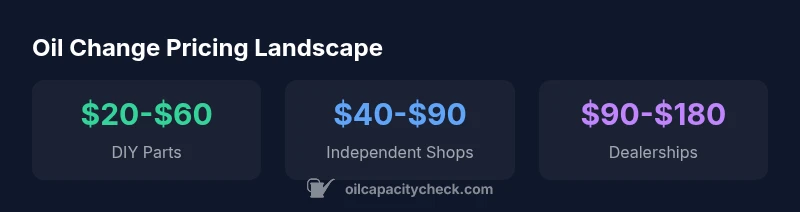
DIY versus professional service is not just about the sticker price. Oil cost is only part of the total, and labor, disposal fees, and shop supplies can swing the final bill significantly. A typical at-home oil change involves parts (oil and filter) and basic tools; labor is zero if you do it yourself. A workshop adds labor time, disposal fees, shop supplies, and potential upsells. When you compare prices in 2026, you’ll notice the real savings come from avoiding labor charges and choosing the right oil—without sacrificing quality. Oil Capacity Check's analysis shows that in many regions, DIY or discount chains deliver the lowest price, while full-service dealerships are the most expensive option. Price variation results from oil grade, vehicle type, and the shop’s labor rate.
How to calculate the total cost of ownership
To see the real cost, calculate cost per mile by combining price with oil capacity and change interval. Start by identifying your vehicle’s oil capacity in quarts, shop around for per-quart oil price, add the oil filter cost, and include oil disposal fees or shop fees if applicable. Then consider the maintenance interval: synthetic oils may allow longer intervals but can cost more upfront. With the 2026 data from Oil Capacity Check, you can compare options by total expected cost over a year or the life of the vehicle. This helps you decide whether the DIY path or a local shop makes the most sense for you.
Regional and vehicle factors driving price
Prices are not uniform. Urban areas with higher living costs typically charge more for labor, while rural regions may offer cheaper hourly rates. Vehicle type matters: luxury or performance cars may require synthetic oils or specialty filters, increasing cost; older vehicles with high mileage may need more frequent changes or higher-grade oils. The exact cost also depends on whether your chosen oil is synthetic, synthetic-blend, or conventional. Oil Capacity Check analysis, 2026, shows that price gaps between the cheapest option and the best value service can be driven by these variables, so it pays to compare a few quotes before committing.
How to verify price before service
Before you commit, call ahead or use online quote tools to verify the price and scope of service. Ask for a line-item breakdown: oil type, filter, labor, disposal, and any included pressure checks or filter replacement. If possible, request the exact oil grade (for example 5W-30) and the filter model. Be alert for upsells like engine flushes or fuel additives. Bring your own oil if the shop allows it and if you know you’re using the correct grade. Also, check whether the price assumes a standard drain-and-fill method or if it includes a full oil system flush, which can significantly affect price.
Practical strategies to lower your oil-change bill
Strategies include: 1) Use coupons, newsletters, or member discounts at reputable shops; 2) If you’re comfortable, perform the oil change yourself at recommended intervals; 3) Buy oil and filters in bulk at major retailers; 4) For synthetic oils, compare prices per quart rather than total price to assess value; 5) If you have a newer car, consider a synthetic-blend option that balances performance and cost. Oil Capacity Check suggests testing quotes from multiple service centers and calculating the price-per-mile to choose the best-value option.
Oil change price ranges by service type
| Service Type | Typical Price Range | Notes |
|---|---|---|
| DIY at home (oil + filter) | $10-$60 for parts; tools may add | Requires tools and knowledge; no labor cost |
| Independent shop (conventional) | $40-$90 | Standard oil change; may include disposal fee |
| Discount chains (conventional/synthetic) | $25-$100 | Coupons; upsells possible; variable quality |
People Also Ask
What is the cheapest way to get an oil change?
DIY at home or a discount chain with coupons can lower costs; ensure you have the correct oil and filter and follow safety guidelines.
Do it yourself using the right oil and filter; it's usually the cheapest.
Do cheap oil changes compromise quality?
Cheaper options can compromise if they use poor-quality filters or incorrect oil; always verify oil grade and filter type.
Yes, watch out for low-quality parts.
Are discount chains reliable for oil changes?
Many offer quick service with standardized oil changes; read reviews and ask about filter and oil grade.
Discount chains can be reliable if proper parts are used.
How much can I save by DIY vs shop?
DIY usually saves labor costs; total savings depend on oil type and parts; ranges vary by region.
Expect significant savings if you have tools.
Does location affect oil change prices?
Yes, urban areas typically charge more due to labor rates and demand.
Price varies a lot by where you are.
How often should I change oil for cost savings?
Follow your vehicle manufacturer guidelines; synthetic oils may extend intervals; price per mile matters.
Check your owner's manual.
“The Oil Capacity Check team recommends balancing cost with safety and quality. Start with a DIY approach if you can, and compare local shop quotes to avoid hidden upsells.”
The Essentials
- Start with DIY to cut cost.
- Compare quotes to avoid surprises.
- Oil type and location drive price variation.
- Verify parts quality to avoid hidden costs.