Affordable Oil Change: Save on Maintenance Costs
Discover affordable oil change options, DIY tips, and price comparisons to save on maintenance while protecting your engine. Oil Capacity Check, 2026. Reliable data.


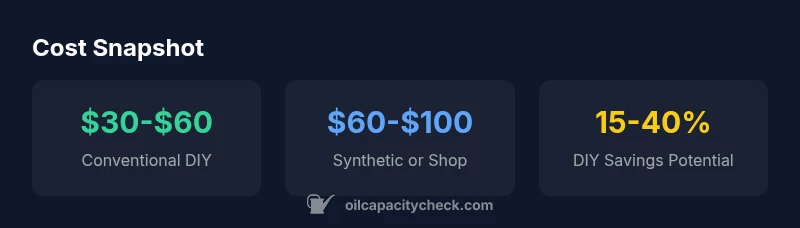
Affordable oil changes typically cost between $30 and $60 for conventional oil and $60 to $100 for synthetic, depending on location and service level, according to Oil Capacity Check Analysis, 2026. For budget-minded owners, comparing price per quart, shop fees, and whether an oil filter is included helps ensure you get genuine protection without overspending.
Why affordable oil change matters
Maintaining an engine without overspending starts with understanding the true cost of an oil change. An affordable oil change should balance price with protection, ensuring your vehicle receives clean oil, a quality filter, and essential inspections. The Oil Capacity Check team highlights that saving money here doesn’t mean compromising engine health; it means choosing the right service level, oil grade, and timing. By treating oil changes as preventive maintenance, you reduce the likelihood of costly repairs later and extend your vehicle’s lifespan. Budget-conscious owners can benefit from planning ahead, comparing options, and using trusted shops that emphasize transparency and value.
What factors influence price
Prices vary for several reasons. Location matters: urban areas often have higher labor rates than rural regions. The oil type (conventional vs. synthetic) and the filter quality drive material costs, while shop branding and added services (like a multipoint inspection) affect the final bill. Promotions, coupons, and loyalty programs can lower out-the-door costs, but beware of upsells that don’t serve your vehicle’s needs. To get genuine value, compare price per quart, check whether a filter is included, and verify that the quote covers labor, disposal, and tax. According to Oil Capacity Check, you can often find reliable options by screening for basic services first and avoiding bundled “deal” offers that add unnecessary items.
DIY vs professional: a cost comparison
DIY oil changes can be significantly cheaper when you already own the basic tools and have access to the correct oil and filter. Typical DIY costs for conventional oil range from about $25 to $60, while synthetic oil can push the DIY bill toward $60 to $120, depending on the brand and filter. Professional shops add labor, which expands the total—often bringing conventional changes to roughly $40-$100 and synthetic changes to $60-$150. While DIY saves money, it requires time, proper technique, and adherence to OEM specifications to avoid risking engine wear. The best choice depends on your skill, the vehicle, and how much you value convenience and warranty considerations.
How to snag the best deal without sacrificing quality
To maximize value, start with an itemized quote that lists every included service. Look for shops that explicitly state oil type, filter part number, and replacement intervals. Compare price per quart for both conventional and synthetic options, and factor in disposal fees and taxes. Use coupons and loyalty programs, but only if they apply to the services you need. Ask about bundled inspections or free topping-off of fluids, which can add intangible value. If you’re unsure, request a written recommendation from the advisor and verify it aligns with your vehicle’s owner manual.
Step-by-step guide to a budget-friendly oil change
- Check the owner’s manual to confirm the correct oil viscosity and capacity. 2) Gather supplies: the correct oil type, a suitable filter, a drain pan, and basic hand tools. 3) Warm the engine slightly to flush old oil. 4) Safely lift the car and drain old oil into the pan. 5) Replace the filter and reset the drain plug. 6) Refill with the recommended oil, then check level with the dipstick. 7) Start the engine, check for leaks, and reset the maintenance light if needed. 8) Keep receipts for warranty or future service planning.
Red flags when shopping for an affordable oil change
Watch for upsells like fuel system cleaners or flushes that aren’t required. Be cautious of suspiciously low prices that exclude essential services. Ensure the quoted price includes labor, disposal, and tax. If a shop can’t show a clear, itemized estimate or refuses to provide OEM-recommended oil specifications, seek another option. Finally, verify that the shop uses a quality filter and reputable oil brand compatible with your vehicle to protect long-term performance.
Cost comparison: DIY vs professional services
| Scenario | Typical Cost (Conventional) | Typical Cost (Synthetic) | Notes |
|---|---|---|---|
| DIY at home | $25-$60 | $60-$120 | Using your own tools/parts |
| Independent shop | $30-$70 | $60-$100 | Average price varies by location |
| Dealership | $60-$100 | $100-$150 | Premium service |
People Also Ask
What counts as an affordable oil change?
An affordable oil change typically refers to the basic service that meets OEM specs for your vehicle. Conventional oil generally costs around the lower end of the range, while synthetic options are higher. The service should include a filter and essential inspections.
An affordable oil change is the basic service that fits your car’s spec and includes a filter.
Is DIY oil change cheaper than a shop?
In most cases, DIY costs are lower because materials are bought once and labor is not charged. Savings depend on the price of oil and filters you choose and how often you change oil. Time and expertise matter for safety and precision.
Yes, DIY is usually cheaper if you have the tools and know-how.
Do coupons and memberships make a difference?
Coupons, loyalty programs, and membership clubs can shave a portion of the listed price. Combine these with seasonal promotions, and you can maximize savings. Always confirm the included services.
Coupons and memberships can noticeably cut costs.
How often should I change oil for cost optimization?
Follow the manufacturer’s recommended interval. Many drivers use 5,000-7,500 miles with synthetic oil and 3,000-5,000 miles with conventional. Sticking to OEM specs protects engine health and avoids unnecessary costs.
Stick to the maker’s interval for reliability.
What should I ask to avoid upsells?
Ask for an itemized quote and confirm essential services. Inquire about the required oil grade and filter. Decline add-ons like flushes unless your car needs them.
Request a clear, itemized quote.
Are there affordable options without compromising protection?
Yes. Use the correct OEM-approved oil, a standard filter, and only necessary services. Look for promotions and consider DIY for basic changes. Avoid premium extras that don’t improve protection.
Yes—stick with OEM specs and skip unnecessary extras.
“Affordable oil changes come from choosing the right oil and getting a clear, itemized quote. Price should not come at the expense of engine protection.”
The Essentials
- Compare price per quart and service inclusions
- DIY changes save money if you have tools
- Look for coupons and membership discounts
- Follow OEM specs to avoid unnecessary costs