Oil Change vs Top Up: Choosing the Right Oil Maintenance Path
Explore the differences between oil change and top up, when to choose each option, and how to perform them safely. A detailed, practical guide from Oil Capacity Check for long-term engine health.


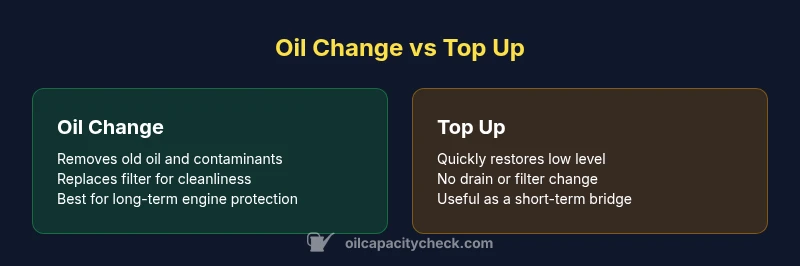
Oil change vs top up: a full oil change replaces worn oil and filters for long-term protection, while a top up only restores the oil to the correct level without removing contaminants. For most vehicles, a complete oil change provides better engine protection and reliability over time, whereas topping up is a temporary measure when the level is slightly low.
What differentiates oil change from topping up?
In everyday car maintenance, the phrases 'oil change' and 'top up' describe two different actions with distinct outcomes. An oil change replaces the used engine oil and typically the oil filter. It’s a planned service that removes contaminants and replenishes additives designed to protect moving metal parts, reduce wear, and maintain proper lubrication. By contrast, a top up simply adds more oil to bring the level back to the manufacturer’s recommended range, without removing old oil or changing the filter. Topping up can be a quick interim fix when the level is slightly low, but it does not correct low-quality oil or address sludge, varnish, or degraded additives. The distinction matters for engine wear, fuel efficiency, and long-term reliability. For many drivers, keeping oil within the recommended range is essential, but the rate of oil consumption, driving conditions, and vehicle age determine whether topping up is a sensible shortcut or a temporary placeholder. According to Oil Capacity Check, regular oil maintenance is essential for engine longevity.
Why maintenance matters for engine health
Engine lubrication reduces metal-to-metal contact, manages heat, and helps maintain proper viscosity under varying temperatures. Over time, oil degrades, adds contaminants, and loses protective additives. A full oil change clears out old, degraded oil and replaces it with fresh oil and a new filter, which helps restore optimal flow, filtration, and cooling. Regular oil changes can improve fuel efficiency, reduce engine deposits, and extend the life of critical components such as bearings and camshaft lobes. In contrast, topping up simply replenishes oil to the correct level but does not address the quality of the existing oil or the presence of sludge. Oil Capacity Check analyses emphasize that long-term engine health depends on following manufacturer-recommended service intervals and using the correct oil grade and filter.
When topping up makes sense (and when it doesn’t)
Topping up can be appropriate as a short-term bridge when the level is just below the minimum line and the vehicle is due for a scheduled oil change soon. It should never be used to mask very old, dirty oil or to replace a lost filter. If you notice consumption beyond the normal range, leaks, or a spike in oil usage, a full oil change is usually warranted. It’s also reasonable to top up when travelling long distances, during extreme driving conditions, or in a location where a service is temporarily unavailable, provided you plan a full change at the next opportunity. The decision should consider driving style, engine type, and the vehicle’s age. Oil Capacity Check recommends prioritizing quality oil and the correct filter during any servicing to protect engine longevity.
Practical steps: assessing oil condition at home
Start by checking the dipstick with the engine cold. Note the level and color: fresh oil is amber, not dark brown. Smell matters too: burnt or very strong odors indicate contamination or overheating. Look for sludge or varnish on the dipstick or around the oil filler cap. Consider the service history: if you’re approaching or past the manufacturer’s recommended change interval, plan a full change. If the oil is within the proper level but looks dirty, a top-up might be acceptable as a temporary measure, but prepare for a full change soon. Record mileage, driving conditions, and any oil consumption trends to guide future decisions.
How to perform a safe top-up
If you must top up, use the correct oil grade and viscosity as specified in your owner’s manual. Add small increments, then recheck the level with the dipstick after a few minutes to allow oil to settle. Avoid overfilling, which can cause foaming and increased pressure. If you’re unsure, consult a professional or refer to the vehicle’s maintenance schedule. Always use the same oil family (synthetic or conventional) if you can to maintain consistent lubrication properties. A cautious, measured approach minimizes risk while bridging the gap to the next service.
How to perform a full oil change: a practical overview
A full oil change involves draining the old oil, replacing the oil filter, installing a fresh drain plug gasket if needed, and filling with the recommended oil type and quantity. It’s important to warm up the engine slightly to improve drainage, then dispose of the used oil through proper channels. Replace the oil filter with a compatible unit to ensure contaminants are removed efficiently. After filling, run the engine, check for leaks, and recheck the oil level. This process restores optimal lubrication, cooling, and additive balance, supporting long-term engine health. Always consult your service manual for exact torque specs and intervals.
Cost, time, and maintenance planning
Costs vary by location, vehicle type, and oil choice. A DIY oil change typically costs less in parts but requires time and basic tools, while professional service includes labor and disposal fees. Oil changes are usually scheduled every 5,000–7,500 miles (or 6–12 months) for many vehicles, though sports cars or older engines may require more frequent changes. Topping up is a faster, cheaper stopgap but should not replace full changes on a regular schedule. When planning maintenance, consider miles driven, climate, and driving style. Oil Capacity Check suggests maintaining a consistent service cadence to optimize engine protection and resale value.
Practical checklist and best practices
- Follow the manufacturer’s oil viscosity and capacity specifications.
- Change the oil and filter at recommended intervals.
- Use the correct filter type and high-quality oil.
- Monitor oil consumption and address leaks promptly.
- Keep records of services for warranty and maintenance planning.
- When in doubt, consult a qualified technician.
Comparison
| Feature | Oil Change | Top Up |
|---|---|---|
| Purpose | Replace used oil and filter for full protection | Restore oil level to within the recommended range |
| Includes | Drain old oil, replace filter, add fresh oil | Add oil only, no drainage or filter change |
| Contaminant removal | Removes sludge and particulates via drainage | Does not remove contaminants; oil quality remains |
| Oil quality | New oil with fresh additive balance | Depends on current oil quality; may still be degraded |
| Frequency | Typically every 5,000–7,500 miles or 6–12 months | Between changes as needed to maintain level |
| Best for | High mileage or protection-focused maintenance | Short-term gap-filling when level is low |
| Cost | Higher upfront due to parts and labor | Lower upfront, but may require later full change |
| Maintenance impact | Maximizes engine health when done on schedule | Keeps oil level adequate, but won’t restore top-end wear |
What's Good
- Delivers comprehensive engine protection and longevity
- Removes old oil and contaminants to restore lubrication
- Includes filter change for improved cleanliness
- Helps maintain optimal oil viscosity and additives
Cons
- Higher upfront cost and longer service time
- Requires vehicle to be out of service temporarily
- Disposes used oil properly, adding logistical considerations
- Not ideal for engines with extremely low oil level or leaks
Full oil changes win on long-term protection; topping up is a practical stopgap
Choose a full oil change for ongoing engine health. Use topping up sparingly to bridge short intervals, and schedule a complete change as soon as possible.
People Also Ask
What is the primary difference between an oil change and topping up?
An oil change replaces old oil and the filter to restore lubrication and remove contaminants. Topping up only adds more oil to bring the level back within acceptable range, without draining or filtering out contaminants.
Oil changes replace old oil and filters for full protection; topping up only adds oil to reach the proper level between changes.
When should I top up rather than change the oil?
Top up is reasonable when the level is just below the minimum line and a full change is not immediately possible. It should not replace a scheduled oil change on a regular basis.
Top up if the level is just low and you can schedule a full change soon; don’t skip the change long-term.
Can topping up damage the engine?
If overfilled, topping up can cause oil foaming and pressure issues. It can also hide underlying problems like leaks or excessive consumption. Always avoid overfilling and verify compatibility with your engine.
Overfilling can harm the engine; top up carefully and don’t delay a proper change if needed.
Is topping up compatible with synthetic oil?
Yes, topping up with the correct synthetic grade is possible, but ensure the oil type matches what the manufacturer specifies and plan a full change at the next opportunity.
You can top up with the same synthetic oil, but don’t rely on it as a replacement for a full change.
What should I do if I notice high oil consumption?
Investigate potential leaks, worn seals, or engine wear. A topping-up approach may mask a problem; a full oil change and a diagnostic check are advisable to identify root causes.
If oil consumption rises, get the engine checked; topping up won’t fix leaks or wear.
The Essentials
- Prioritize full oil changes for long-term engine protection
- Use topping up only to bridge short-term gaps to a scheduled change
- Always match oil grade and filter to manufacturer specs
- Regular maintenance cadence reduces risk of engine wear
- Dispose of used oil properly and keep service records