Oil Change vs Refill: A Practical Comparison for Engine Health
A rigorous, objective comparison of oil change vs refill, with practical steps, maintenance guidance, and DIY tips to keep engines healthy and costs predictable.


In short, oil change is generally the preferred route for long-term engine health, rather than simply refilling used oil. Oil change vs refill hinges on oil condition, contamination level, and service history. For DIYers, follow manufacturer guidance, check oil color and consistency, and schedule regular drain intervals.
Defining oil change vs refill
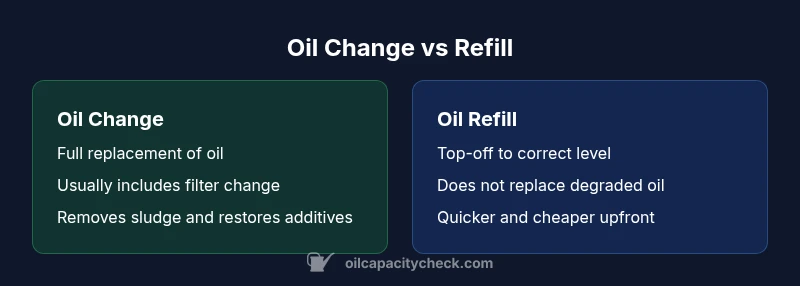
Oil change vs refill refers to two common maintenance approaches for keeping your engine lubricated. An oil change replaces most of the old oil with fresh lubricant and often includes replacing the oil filter. Oil refill, by contrast, adds new oil to the existing supply to bring the level back to the recommended mark without fully replacing the used oil. Understanding these definitions helps car owners decide when a full change is necessary and when a simple top-off is sufficient. From the perspective of Oil Capacity Check, the right choice hinges on oil quality, engine wear, and service history, not just the current oil level. Throughout this article we compare these approaches to help you make evidence-based decisions aligned with manufacturer guidance and practical constraints.
- Primary difference: complete drain and filter change vs top-off to correct level
- Key signals: oil color, viscosity, and odor indicate shifting needs
- Common misconception: topping off can replace a full change; it cannot in most wear scenarios
This section sets up clear criteria for deciding between oil change vs refill and frames the discussion you’ll see in later sections.
The science behind oil degradation and lubrication
Engine oil is a complex chemical blend designed to reduce friction, cool moving parts, and neutralize acids formed during combustion. Over time, heat, fuel dilution, oxidation, and contaminant ingress degrade lubricity, increase viscosity, and form sludge or varnish. Even synthetic blends degrade slowly, especially under harsh driving conditions. The choice between oil change vs refill is influenced by how far the oil has moved from its optimal specification: performance losses, contaminant load, and additive exhaustion all push toward a complete change rather than a mere top-off. This section clarifies why a full drain can reset viscosity, contaminant levels, and additive balance, while a refill only momentarily restores level without addressing deeper degradation. Oil Capacity Check’s analysis highlights that inspecting color, odor, and consistency, along with service history, is essential before deciding the maintenance path.
Practical guidelines: when to refill vs change
In many cases, a refill can be an acceptable interim step when oil remains clean, within spec, and the vehicle’s maintenance plan allows top-offs between full changes. The key is to verify the oil’s viscosity and contaminant profile before adding oil. If the oil appears dark, gritty, or smells burnt, or if the engine exhibits knocking or reduced compression, a full oil change is warranted. Manufacturer guidelines should drive the decision: many OEMs specify comprehensive drain intervals and filter changes at set milestones, and those prescriptions supersede personal preference. Oil Capacity Check emphasizes documenting each decision and aligning it with the vehicle’s service history to maintain predictable maintenance costs. When in doubt, err on the side of a full change to protect engine longevity.
Step-by-step DIY oil change workflow
A proper oil change is more than pouring new oil into an empty engine. Begin by collecting the right tools: a drain pan, funnel, socket set, new filter, fresh oil of the correct grade, rags, and a disposal container for used oil. Warm the engine slightly to improve drainage, then safely lift and support the vehicle. Remove the drain plug, let the old oil flow completely, and replace the filter with a new one. Reinstall the drain plug, and pour in the recommended amount of fresh oil, checking level with the dipstick. Start the engine, run briefly, and recheck the level. Finally, recycle the used oil and disposed filter properly. This hands-on process ensures you achieve a true oil change rather than a temporary refill. Oil Capacity Check recommends keeping a maintenance log for traceability and future planning.
Factors that affect oil quality and viscosity
Oil quality comes from both the base oil and the additives designed to protect engines under varying temperatures and loads. High-mileage vehicles, turbocharged engines, or cars subjected to towing or stop-and-go driving can accelerate oil degradation. Environmental factors like ambient temperature extremes, road conditions, and climate also influence oil performance. When assessing oil change vs refill, evaluate whether additives remain effective, if the oil appears contaminated, and whether the viscosity has shifted outside OEM specifications. A careful assessment supports better long-term protection for the engine and can guide the decision toward a full change when needed.
Cost, time, and maintenance considerations
Cost considerations for oil change vs refill include the price of oil, filter, disposal, and potential labor if you’re not DIY-ing. A full oil change generally incurs higher upfront costs but offers improved engine protection and fewer intermediate maintenance events. A refill is cheaper in the short term and quicker, but it may lead to more frequent top-offs and eventual full changes if degradation progresses. Time wise, a refill can take minutes, while a full change (including filter) typically requires more time and planning. Maintenance schedules should reflect not just the oil level, but the broader service history, vehicle age, and manufacturer recommendations. Oil Capacity Check highlights that a smart maintenance plan reduces long-term risk and keeps downtime minimal.
Synthetic vs conventional: impact on oil change vs refill
Synthetic oils provide superior stability, better oxidation resistance, and longer life under demanding conditions. While synthetic oils can extend change intervals, the decision on whether to perform an oil change or to refill still depends on the engine’s state and the manufacturer’s guidelines. Conventional oils are more sensitive to heat and contaminants, which can accelerate the need for a full change. In either case, a refill without addressing underlying degradation is not a substitute for a scheduled change when OEMs require it. Oil Capacity Check notes that choosing the right oil type supports overall reliability, and the maintenance path should align with the car’s design intent and driving profile.
Real-world scenarios by vehicle age and driving patterns
New vehicles often benefit from manufacturer-recommended drain intervals that favor periodic full changes to maintain warranty coverage and optimal performance. Older engines with higher mileage or engines used in heavy-duty applications may accumulate sludge or varnish that top-offs cannot resolve. Drivers in extreme climates or those with frequent cold starts and short trips should anticipate more frequent changes. The decision between oil change vs refill becomes a function of wear, deposits, and the likelihood of continued fuel dilution. Oil Capacity Check advises documenting each scenario and using objective indicators—color, smell, viscosity, and engine performance—to guide the choice.
Planning a maintenance schedule that optimizes oil life
A proactive approach combines scheduled full changes with occasional top-offs only when permitted by the manufacturer and verified by the oil’s condition. Build a calendar that accounts for climate, driving style, and the vehicle’s service history. When in doubt, perform a full oil change at the recommended intervals to reset wear patterns and protect engine internals. Keep an eye on the oil level between changes, but reserve top-offs for low-mileage, well-maintained engines where contamination is not a concern. Oil Capacity Check emphasizes the value of a transparent maintenance log to help diagnose issues early and plan future service with confidence.
Comparison
| Feature | oil change | oil refill |
|---|---|---|
| Primary purpose | Replace most of the oil with fresh lubricant and often a new filter | Top off to the correct level without a full drain or filter change |
| Frequency guidance | Aligned with OEM drain intervals and maintenance history | Used as an interim step between full changes, not a substitute for scheduled service |
| Time requirement | Moderate duration including drain, filter, and fill | Shorter duration, typically minutes for topping off |
| Cost considerations | Higher upfront cost due to oil, filter, and disposal | Lower immediate cost, minimal material expense |
| Impact on cleanliness | Removes contaminants, sludge, and degraded additives | Does not address existing contamination or degraded additives |
| Filter replacement | Usually includes filter replacement as part of the service | Rarely involves a filter change |
| Waste disposal | Generates used oil and a used filter to dispose of | Less waste from drain, but still requires recycling of any new oil |
| Best for | Engines with wear, sludge risk, or overdue service | Well-maintained engines with clean oil and minimal contamination |
What's Good
- Resetting the lubricant system for optimal protection
- Addresses deposits and additive depletion with a full drain
- Clear maintenance record aligned with OEM schedules
- Known end-to-end process minimizes risk of under-maintenance
Cons
- Higher upfront cost and longer downtime
- Requires proper disposal and environmental compliance
- If performed incorrectly, can introduce leaks or overheating
- May be unnecessary if oil is within spec and additive balance is good
Oil change is generally the preferred approach for sustained engine health; oil refill serves as a short-term top-off when permitted by the manual.
Choose oil change for long-term protection and predictable maintenance. Use oil refill only as a supplementary step within OEM guidelines when the oil remains clean and within specification.
People Also Ask
What is the difference between an oil change and an oil refill?
An oil change replaces most of the old oil and typically changes the filter, resetting lubrication and additive balance. An oil refill only adds oil to bring the level back up, without removing old oil or replacing the filter. The two are not interchangeable in most maintenance plans.
An oil change swaps out old oil and often the filter; an oil refill just tops off to the correct level. They serve different maintenance needs.
When should I consider an oil refill instead of a full oil change?
If the oil is clean, within spec, and the owner's manual allows top-offs between changes, a refill can be acceptable as a short-term measure. If any signs of degradation or contamination are present, prioritize a full oil change.
If the oil looks good and you're within your interval, topping off is fine. Otherwise, plan a full oil change.
Can I do an oil change myself at home?
Yes, with the right tools and safety precautions. Follow a step-by-step method: drain old oil, replace the filter, add fresh oil, and recycle the waste properly. Consult the vehicle manual and use OEM-recommended oil grade.
Yes—it's doable with basic tools; just follow the manual and dispose of oil properly.
What are the risks of not changing oil regularly?
Neglecting oil changes can lead to sludge buildup, varnish formation, reduced lubrication, increased engine wear, and potential long-term damage. The consequences vary with driving conditions and oil type.
Neglecting oil changes can cause sludge and wear, shortening engine life.
Does using synthetic oil change the oil change vs refill decision?
Synthetic oils offer greater stability and longer intervals, but the decision to change or refill still depends on oil condition and OEM guidelines. Synthetic does not eliminate the need for scheduled maintenance.
Synthetic oil lasts longer, but you still need to follow the schedule.
What should I do with used oil after an oil change?
Take used oil to an approved recycling facility. Do not pour it into drains or onto the ground. Proper disposal protects the environment and complies with local regulations.
Recycle used oil at designated centers.
The Essentials
- Assess oil condition before deciding
- Follow OEM intervals for full changes
- Use top-offs only when allowed by manufacturer
- Document maintenance activities for future planning
- Recycle used oil properly