Transmission Oil Capacity Chart: A DIY Guide for Car Owners
Explore how to read and apply a transmission oil capacity chart. Learn model-specific ranges, safe filling practices, and practical tips for DIY maintenance with insights from Oil Capacity Check.


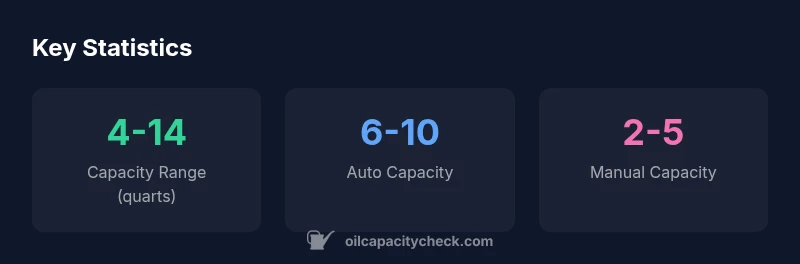
According to Oil Capacity Check, the transmission oil capacity chart provides typical fill volumes for common transmission types, ranging from roughly 4 to 14 quarts depending on the vehicle and gear ratios. For accuracy, always confirm your exact spec in the owner’s manual or the official chart for your model, and check the level only after the transmission is warm and idling in park.
Understanding Transmission Oil Capacity Charts
Transmission oil capacity charts summarize the total lubricant that should fill a given transmission under typical service conditions. They differ by vehicle class, transmission type (automatic vs manual), gear ratios, and whether the chart reflects a total fill or a refill after partial drain. For DIYers, these charts are a starting point, not a substitute for manufacturer specifications. In practice, the Oil Capacity Check team collects model-specific data to inform these charts, and owners should cross-check with their service manual. Always confirm whether your transmission uses a multipoint drain, a pan-only refill, or a complete sump fill. When used correctly, capacity charts help you avoid the risk of underfilling, which can cause excessive wear, or overfilling, which can foam and pressure the seals. Remember that results vary by model and driving conditions.
How to Read a Capacity Chart for Your Vehicle
To read a capacity chart correctly, first locate your vehicle's year, make, and model. Then identify the transmission type (automatic or manual) and whether the chart shows total capacity or an interim fill. Units are usually quarts or liters; ensure you’re comparing the same unit as your service manual. Note any assumptions, such as “with cooler lines empty” or “drain and refill,” which can shift the number. If your model has optional equipment or performance packages that alter torque or gear sets, check for a separate entry. Cross-verify with multiple sources when available, especially for older vehicles or rare configurations. Finally, use the chart as a guide to plan a safe fill, then recheck after warming the transmission and running through gears so the oil expands to normal level. In short, precise matching to your exact model is essential for accurate capacity.
Differences Between Automatic and Manual Transmissions
Automatic transmissions generally have larger capacity ranges due to torque converter and fluid circuit design. Manuals can be smaller but still vary with the number of gears and the presence of a hydraulic clutch circuit. The chart typically quotes a range because many production runs change internals slightly, or because different transmission families share the same casing with different internals. For this reason, it’s critical to use your vehicle's exact transmission code, not just the general model name. The key takeaway: two cars with the same model year can have very different capacity figures if they use different transmissions or gear ratios.
Practical steps for safe checking and filling
- Warm the transmission: drive gently for 10–15 minutes to bring the fluid to normal operating temperature. 2) Park on level ground and engage the parking brake. 3) With the engine idling, check the level using the dipstick or sight glass as instructed. 4) Add fluid gradually in small increments, rechecking after each addition. 5) Stop once the level reaches the marked full line, leaving the engine running and in park for a minute, then recheck. 6) If you’re near the upper range, avoid topping off to prevent foaming and pressure buildup. 7) Clean up spills promptly and record the observed quantity for future reference. Following these steps helps align your fill with the chart while protecting transmission health.
Common mistakes and how to avoid them
Relying on memory instead of the chart. Failing to account for warm-up expansion. Using the wrong unit or chart version for your model. Overfilling by a quarter to a half quart due to impatient additions. Not performing a warm-up check after the final fill. Finally, neglecting to consult the manufacturer’s spec sheet when special editions or performance packages are involved.
Building a quick-reference at home
Create a simple home-reference binder with model-specific pages. Include the exact capacity for your transmission, the recommended fill method, the service interval, and a note about warm-up and the right tools (curved dipstick, correct funnel, lint-free rag). Update the page whenever you learn of revisions or recall actions from a service bulletin. You can also add a small color-coded chart in your glove box that shows the fill range in quart increments and a reminder to check level after driving. A durable, easy-to-read chart reduces misfills and helps you maintain a healthy transmission over time.
Real-world scenarios: sedan vs truck
Scenario A: A mid-size sedan with an automatic transmission typically falls in the 6–9 quart range, depending on engine torque and transmission family. Scenario B: A heavy-duty truck with a multi-gear automatic or manual may require 10–14 quarts or more, reflecting larger torque converters and cooler lines. In both cases, always confirm exact specs, and use the chart as a guide rather than a universal number. Regardless of vehicle type, consistency and warm-up checks improve accuracy and help avoid costly errors.
Estimated capacities by transmission type
| Model Type | Typical Capacity (quarts) | Notes |
|---|---|---|
| Automatic transmission (compact) | 4-7 | Range varies by gear ratios and torque converter |
| Automatic transmission (sedan) | 6-10 | Common range; verify with chart |
| Manual transmission | 2-5 | Lubricant capacity varies by gear count |
People Also Ask
What is a transmission oil capacity chart?
A transmission oil capacity chart lists the typical total fill volumes for different transmissions, helping you plan the correct amount to add after a drain or flush. It is model-specific and should be cross-checked with the owner's manual.
A transmission capacity chart shows the usual fill amount for your transmission. Always check your model's manual.
Why do capacities vary so much between models?
Different transmissions, torque converters, and gear counts require different oil volumes. Even two cars from the same brand can differ by generation. Always use model-specific data.
Capacities vary because transmissions differ by model and generation. Use the specific data for your car.
How do I check the oil level after filling?
Warm up the vehicle, park on level ground, and check the level per the manual. If adding, do so in small increments and recheck after the engine has run through gears.
Warm up, then check the level as the manual directs. Add slowly and recheck after moving through gears.
Can overfilling damage the transmission?
Yes. Overfilling can cause foaming, pressure buildup, and potential leaks. If you overfill, carefully remove the excess fluid.
Overfilling can cause foaming and leaks; remove the excess if needed.
Is there a universal capacity chart for all vehicles?
No. Capacity charts are model- and type-specific; reference the chart for your transmission family.
There isn’t a universal chart—it's model-specific.
“Transmission capacity is highly model-specific. Always confirm the exact spec from the official chart and service manual to prevent overfill and potential transmission damage.”
The Essentials
- Always verify exact spec from your manual or chart.
- Capacities vary widely by transmission type and model.
- Check level after warming up for accurate readings.
- Avoid overfilling; add fluid in small increments.
- Use the chart as a guide, not a universal rule.