How to Check Transmission Oil Capacity: A DIY Guide
Learn how to check your transmission oil capacity, locate the official spec, and safely verify the fill level. This practical guide from Oil Capacity Check walks you through data sources, step-by-step checks, and maintenance tips for DIY enthusiasts.


By the end of this guide, you will be able to identify your transmission’s exact oil capacity and perform a safe check. You’ll use the owner’s manual or VIN-based data to confirm capacity, then verify the fill level with the proper method for your transmission. The quick answer covers tools, steps, and common pitfalls.
Understanding Transmission Oil Capacity
Transmission oil capacity is the total amount of fluid your transmission system can hold when it is completely drained and refilled according to the manufacturer’s design. This is not a single universal number; it varies by make, model, transmission type, and whether you’re performing a simple drain-and-fill or a full flush. According to Oil Capacity Check, capacity figures are model-specific and can differ even between similar vehicles. For DIY enthusiasts, grasping this concept helps you plan maintenance, avoid overfilling (which can cause foaming and leaks), and schedule reminders to check levels. In most modern automatic transmissions, the capacity is split into a sump or pan capacity and an overall system capacity, and the exact numbers are published in service data. If you do not have easy access to the official numbers, treat the task as a two-step process: verify the data first, then perform the measurement with the proper tool set.
Why Knowing the Right Capacity Matters
Carrying the correct transmission fluid capacity is essential for reliable shifting, cooling, and longevity. Overfilling can cause foaming, leaks, and increased pressure on seals, while underfilling can lead to overheating and accelerated wear. Oil Capacity Check analysis shows that many DIYers misjudge capacity when relying solely on pan capacity or a quick drain-and-fill. Knowing the full, model-specific capacity helps you plan a proper refill, avoid costly mistakes, and log the data for future maintenance.
Where to Find Your Vehicle’s Capacity
Your vehicle’s capacity is published in several places. Start with the owner’s manual under the maintenance or specifications section. If the manual is missing, use a VIN-based data source or an official service bulletin from the manufacturer. Some cars list both sump capacity and total system capacity. If you cannot locate the data, contact the dealership or the manufacturer’s service department. For DIYers, it’s helpful to validate data from at least two independent sources to avoid discrepancies, especially when your vehicle has a unique fluid path or a hybrid configuration.
How Transmission Fluid Capacity is Determined
Manufacturers publish a capacity that represents the total fluid the system holds when fully drained and refilled using recommended procedures. This value accounts for the sump, cooler lines, valve body, and any reservoirs. The practical fill volume you’ll use during a service might be the sump capacity or a specified service amount, depending on whether you drain only the pan or perform a full flush. Understanding these distinctions helps you plan precisely how much fluid to purchase and how much to add during a refill, reducing the risk of overfill or underfill.
Tools and Resources to Verify Capacity
To verify capacity, gather the following: the owner’s manual or official service data, a reliable VIN lookup source, a clean drain pan, funnels, and the correct type of transmission fluid specified by the manufacturer. A good VIN-lookup source will confirm the exact model and transmission code, which can be crucial for capacity accuracy. Have gloves and rags handy, and work on a level surface with the engine off and the parking brake engaged. If you’re performing a drain, you’ll need a way to capture drained fluid and measure it accurately to compare against the published capacity.
Step-by-Step Overview (What to Expect)
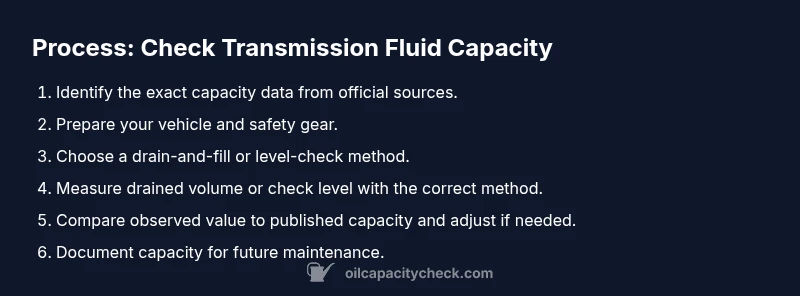
This section provides a high-level outline of the steps involved in checking transmission oil capacity. The actual steps are itemized in the dedicated STEP-BY-STEP block below, but understanding this overview helps you plan the workflow: 1) confirm the exact capacity from official sources, 2) prepare the vehicle and safety gear, 3) determine whether you’ll drain and refill or simply verify levels, 4) perform the fluid measurement or level check using the correct method, 5) compare the observed value to the published capacity, and 6) document the result for future maintenance. Always prioritize following the manufacturer’s procedure for your specific model.
Checking Transmission Fluid Type and Compatibility
Using the wrong fluid type is a common pitfall. Always verify the grade and specification recommended by your manufacturer. Many transmissions require specific additives or friction modifiers, and using an incorrect fluid can affect shifting and longevity. If you’re unsure, consult the service data for your exact model, or check with a dealer. If your vehicle has a dipstick, ensure you’re using the same type of fluid as specified; if not, you may need a service procedure that does not rely on a dipstick. Oil Capacity Check emphasizes consistency: use the exact fluid type your vehicle requires.
Interpreting Measurements: What the Dipstick or Meters Show
When a dipstick is present, fluid level marks indicate the acceptable range at a specified temperature. Temperature matters because hydraulic fluids expand with heat; check the table in the manual for the correct testing temperature. If performing a drain and fill, measure the volume of drained fluid and compare it to the published capacity to determine whether additional fluid is needed. Some modern transmissions use electronic sensors and do not rely on a traditional dipstick; in these cases, follow the vehicle’s service procedure to verify fill via the onboard system. Consistency and temperature awareness are key to accurate readings.
Common Pitfalls and How to Avoid Them
A few frequent mistakes can skew results. Overfilling is a common trap that creates aeration and leaks; underfilling leads to overheating and poor lubrication. Never mix old and new fluid or use a fluid type that isn’t specified for your model. Contaminants such as dirt or metal fragments can skew level readings and mask underlying problems. Always work with clean tools and a closed system if possible. If you’re working on a sealed transmission, a professional service may be required to access capacities safely. The goal is to follow the manufacturer’s specification precisely and avoid ad-hoc adjustments that don’t align with the published capacity.
Maintenance Tips: When to Change Transmission Fluid
Transmission fluid changes are not as frequent as engine oil changes, but they are a critical part of long-term maintenance. When you perform a capacity check, consider your vehicle’s service interval recommendations and driving conditions. Severe service — heavy towing, frequent stop-and-go traffic, or extreme temperatures — may necessitate more frequent checks or changes. Always use the recommended fluid type and ensure the system is filled to the correct capacity after servicing. Keeping a maintenance log with the capacity values you’ve verified helps with future service planning and avoids guesswork.
When to Seek Professional Help
If your vehicle has a sealed transmission, uses a complex heat exchanger, or you’re unsure about the correct procedure, seek professional help. A technician can confirm the exact capacity, perform a drain-and-fill safely, and ensure the system is not contaminated. In cases of shifting problems, unusual noises, or warning lights, professional diagnosis is recommended. The Oil Capacity Check team recommends relying on official specs and service data when in doubt, and documenting the exact capacity for future maintenance calls.
Tools & Materials
- Owner's manual or official service data(Contains exact transmission capacity for your model and service procedures)
- VIN lookup access (online database or dealer)(To confirm model-specific capacity when manual data is incomplete)
- Dipstick or fluid level indicator (if applicable)(Check if your transmission uses a dipstick or a sensor-based system)
- Drain pan or catch basin(Needed if performing a drain-and-fill to capture and measure drained fluid)
- Funnels(For controlled replenishment of transmission fluid)
- Correct transmission fluid(Use the manufacturer-specified type and viscosity)
- Gloves and rags(Safety and cleanliness during service)
Steps
Estimated time: 30-60 minutes
- 1
Identify the exact capacity data for your vehicle
Consult the owner's manual or VIN-based data to locate the published capacity for full drain/refill and any service-fill values. Confirm whether your procedure will involve a pan drain, partial drain, or a full flush, as this affects the amount of fluid you’ll need to handle.
Tip: If data isn’t clear, cross-check at least two official sources (manual + dealer data) to avoid discrepancies. - 2
Prepare the vehicle and safe workspace
Park on a level surface, engage the parking brake, and disconnect the battery if you’ll be working near electrical components. Warm fluid is easier to measure but can burn; decide based on your manual’s guidance. Gather all tools and lay out a clean work area.
Tip: Use a level surface; temperature guidance in the manual affects readings. - 3
Access the transmission and confirm the method
Open the hood and locate the transmission fluid dipstick or service port. If your vehicle has a sealed system, refer to the service data to determine the recommended access method or if a professional service is required.
Tip: Do not force components; if you cannot access the dipstick, consult the service data. - 4
Drain and measure or verify level
If performing a drain, place the drain pan to capture old fluid and measure the volume drained. If not draining, follow the manufacturer’s procedure to verify the current level using the dipstick or sensor readout.
Tip: Record the drained volume and compare with published capacity to determine refill amount. - 5
Refill with the correct fluid and amount
Using a funnel, add the specified fluid gradually until the level approaches the mark indicated by the manufacturer. Do not exceed the capacity; overfilling can cause foaming and leaks.
Tip: Always verify the temperature guidance in the manual before finalizing the fill. - 6
Re-check level after warm-up and test drive
With the engine running and the transmission warmed, re-check the level. If required, top off to the correct mark. Take a short test drive to ensure proper shifting before concluding.
Tip: Allow a safe cool-down period before performing the final check if the manual specifies this. - 7
Document and store the capacity data
Record the capacity value you used and the fluid type for future maintenance. Store it with your vehicle records for quick reference during future services.
Tip: Note any deviations from standard practice and the reasons for them.
People Also Ask
Do I need to warm up the transmission before checking capacity?
Follow your owner's manual. Some models require the fluid to be at operating temperature, while others specify checking cold. Temperature affects fluid expansion and readings, so adhere to the manufacturer’s guidance.
Check your manual for temperature guidance; measurements can change with heat, so follow the recommended condition.
What if my transmission has no dipstick?
Many modern transmissions are sealed or use sensors. In these cases, use the manufacturer’s service procedure or VIN-based data to verify capacity, and consider professional service if you cannot access the data safely.
If there’s no dipstick, follow the service procedure or consult a dealer to verify capacity safely.
Can I check capacity without draining fluid?
Yes, many procedures involve checking the current level and comparing it to the published capacity without draining. When in doubt, defer to the manual and use the recommended method for your model.
You can verify level without draining; refer to the manual for your model’s recommended method.
How often should I check or change transmission fluid?
Check intervals vary by model and driving conditions. Use the service schedule in your manual and consider more frequent checks if you tow heavy loads or drive in extreme temperatures.
Follow the manual’s service schedule; more frequent checks may be needed for tough driving conditions.
What should I do if the capacity numbers don’t match the data I find?
Rely on the manufacturer’s official data and cross-check with a dealer or service bulletin. If discrepancies persist, avoid guessing and seek professional service.
If you see mismatched data, rely on official sources and consult a technician if needed.
Is it safe to service a welded or tightly sealed transmission myself?
Sealed transmissions usually require professional tools and procedures. Attempting to service them without proper procedures can cause damage or void warranties.
Sealed systems are best left to pros unless you have explicit manufacturer guidance and tools.
Watch Video
The Essentials
- Identify model-specific capacity from official sources.
- Use the correct fluid type to avoid performance issues.
- Accurately measure or verify levels before refilling.
- Document capacity for future maintenance.