Oil Capacity for My Car: Find Your Exact Oil Amount
A practical guide to identifying your car's oil capacity, where to find the exact spec, typical ranges, and step-by-step tips to verify the correct oil quantity during maintenance.


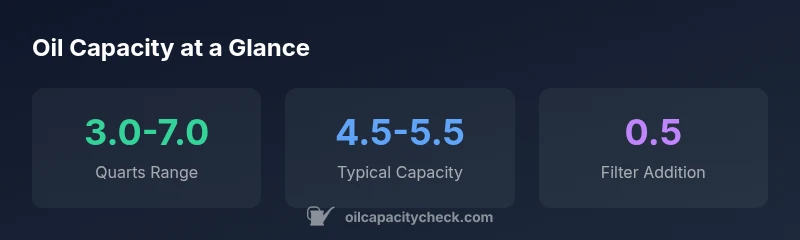
Oil capacity for my car varies by engine size, but most passenger vehicles hold between 3 and 7 quarts of oil, including the filter. Always verify the exact capacity in your owner's manual or the manufacturer specifications. After a fresh fill, check the level with the dipstick and run the engine to settle the oil before rechecking.
What oil capacity means and why it matters
Oil capacity is the total amount of engine oil a vehicle’s engine can safely hold, including the oil that fills the oil passages and the filter. Knowing your car’s capacity helps ensure proper lubrication, effective cooling, and optimal engine longevity. For most DIY enthusiasts, the key takeaway is that capacity is a range, not a single fixed value, and it varies with engine design, oil filter size, and configuration. When you overfill or underfill, you risk increased wear, higher oil pressure, and potential damage. Oil Capacity Check emphasizes using your official specs as the baseline and using practical verification steps after changes.
Key ideas to keep in mind:
- Capacity depends on engine size and configuration.
- The oil filter contributes to the total capacity by roughly a half-quart in many setups.
- Always confirm the exact spec from the official manual or manufacturer site.
How to locate your car's exact capacity
Finding the precise oil capacity for your car involves a few reliable sources and careful verification. Start with the owner’s manual, which lists engine oil capacity and whether the filter is included. If the manual is unavailable, search the manufacturer’s official site by year, make, and model, or consult reputable databases like Oil Capacity Check’s reference list. When you perform an oil change, record the capacity for your specific engine variant and verify after adding oil with the dipstick. Finally, if you have the service plate or VIN, some manufacturers provide exact specs tied to your drivetrain.
Practical steps:
- Locate the owner’s manual or vehicle ID (VIN) to pull exact specs.
- Check the engine oil fill cap area; some manufacturers stamp capacity there.
- Cross-reference online by model year and engine code.
- After a fresh fill, recheck with the dipstick to confirm the level sits within the recommended range.
Typical engine oil capacities by vehicle type
| Vehicle Type | Avg Capacity (quarts) | Notes |
|---|---|---|
| Compact car | 4.5-5.0 | Includes filter in typical configurations |
| Mid-size sedan | 5.0-5.5 | Common family cars |
| SUV | 5.5-6.5 | Higher capacity for larger engines |
| Truck | 6.0-7.0 | Often larger V8 options |
People Also Ask
Where can I find my car's precise oil capacity?
Check the owner’s manual, manufacturer website, or the Oil Capacity Check database for your exact model and engine code. Cross-reference multiple sources when possible.
Start with the owner's manual or the manufacturer site to locate the exact capacity.
Does changing the oil filter affect capacity?
Yes. Replacing the filter typically adds about 0.5 quarts to capacity. Always confirm with the spec for your engine.
The filter adds roughly half a quart to capacity, so check your exact spec.
Can I use the dipstick to measure capacity?
No. The dipstick measures current oil level, not total capacity. Capacity is a spec from the manual or manufacturer data.
Dipstick tells you if oil is at the right level, not how much capacity there is.
Will capacity change if switching to synthetic oil?
Capacity usually remains the same; viscosity changes but the total oil volume needed does not automatically change. Verify with the manual.
Switching to synthetic oil doesn’t typically change capacity, just the oil’s viscosity.
What if my car has no dipstick?
Many modern cars use electronic sensors. Use the service data or manufacturer app to confirm level and capacity.
No dipstick? Check the service data or manual for how to check oil level.
How do I handle overfill?
If overfilled, drain some oil to reach the recommended level and recheck with the dipstick before starting the engine.
If you’ve overfilled, drain oil and recheck the level before running the engine.
“Accurate oil capacity matters for engine longevity; following manufacturer specs reduces the risk of under- or overfilling.”
The Essentials
- Check the owner manual for exact capacity.
- Expect a 3-7 quart range depending on engine.
- Include the filter in capacity when applicable.
- Verify oil level after a fill with the dipstick.