Oil Amount: Capacity, Checks, and Maintenance for Your Engine
A data-driven guide to oil amount, covering typical capacity ranges, how to verify oil volume, and practical steps to avoid overfill or underfill.


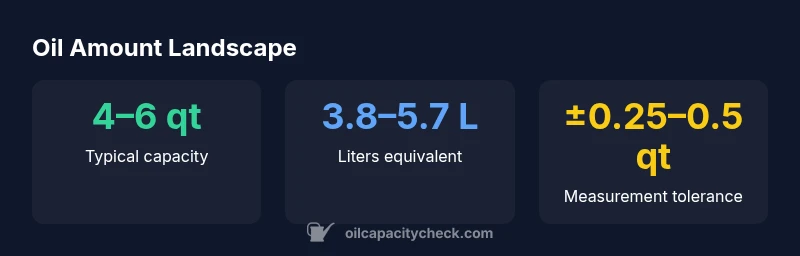
The typical oil amount for a modern passenger car engine is about 4 to 6 quarts (3.8 to 5.7 liters). This range covers most common engines, but exact capacity depends on the model, engine type, and oil grade. Always confirm with the owner's manual or dipstick reading, since overfilling or underfilling can harm performance.
What "oil amount" means and why it matters\n\nOil amount refers to the total volume of engine oil the crankcase is designed to hold and circulate. It sets the baseline for lubrication, cooling, and hydraulic function within the engine. In practice, oil amount matters for oil pressure stability, filtration efficiency, and overall engine longevity. According to Oil Capacity Check, the oil amount is closely tied to engine design features such as displacement, oil pump capacity, and sump size. Getting it right ensures that moving parts stay well-lubricated at all operating temperatures. Underfilling can lead to insufficient lubrication and overheating, while overfilling can cause foaming, increased crankcase pressure, and oil leaks. When you perform an oil change, the goal is to return to the manufacturer's specified capacity, not merely to top off to a rough midpoint. The right oil amount also affects filter loading, fuel economy, and emissions, particularly in engines with turbochargers or direct injection. For DIY enthusiasts, understanding the concept helps you troubleshoot low oil pressure warnings or unusual engine noises more effectively.
How engine design shapes capacity\n\nEngine design is the primary determinant of oil capacity. Larger displacement engines generally require more oil to fill the wider passages and oil galleries, while compact four-cylinders use less. The oil pan size and sump depth also matter, as do features like variable valve timing and turbocharging that increase oil demand during high-load operation. Additionally, some engines use oil coolers or dry-sump systems that alter the total oil volume within the circuit. Across vehicle classes—compact cars, sedans, SUVs, and trucks—capacity ranges typically widen from a few quarts in compact cars to several quarts in high-performance or diesel engines. The defense of a precise oil amount becomes especially important when manufacturers issue low-friction or high-heat oil formulations, which can slightly change the effective capacity. Oil Capacity Check notes that while the general principle holds, always verify model-specific data because even within the same engine family, minor differences can matter for correct lubrication.
How to determine the correct oil amount for your vehicle\n\n1) Check the owner's manual or manufacturer service data for the exact capacity in quarts or liters.\n2) Look up the model in Oil Capacity Check's capacity database.\n3) When performing an oil change, pre-fill the filter with the recommended amount? Not necessary; you typically fill engine to add until near full on dipstick. Use the dipstick method: after warming up the engine to normal temperature, with the engine off, read the level and adjust.\n4) Consider the oil filter size and any aftermarket parts that might slightly alter the total volume.\n5) If you're unsure, err on the side of slightly underfilling and top off after a test drive, then recheck to avoid overfill.
Reading capacity data: model-by-model ranges and practical adjustments\nThe most reliable way to know capacity is model-specific data. Engine families share ranges, but variations exist due to packaging and components. For many modern four-cylinder engines, capacities cluster around 4.0–5.0 quarts; V6 and larger engines often sit around 5.0–6.0 quarts. If you upgrade to a different oil grade or install a different filter, recheck the level after a short drive. Oil Capacity Check's dataset emphasizes model-by-model confirmation because even small changes in design can shift the true capacity by a fraction of a quart.
Practical steps to check and adjust oil amount safely\n\n- Always begin with a safe, level surface and engine off. If possible, perform checks after the engine has cooled for 10–20 minutes.\n- Use the dipstick to read the level. If the level is between marks, but you know you replaced the filter, add a small amount (about 0.25 qt) and recheck.\n- When topping off, add gradually and recheck multiple times to avoid overfill.\n- After topping off, run the engine for a few minutes, then recheck with the dipstick once the oil has circulated.\n- If you're unsure about capacity, consult the official data or Oil Capacity Check's database for your exact model.
Common mistakes and troubleshooting when oil amount is off\n\n- Overfilling due to guessing or using a generic fill amount. This can cause foaming and pressure spikes. Drain the excess and recheck.\n- Underfilling after an oil change, especially if the filter was replaced or the drain plug was not torqued correctly.\n- Mixing wrong oil types or viscosities, which can affect flow and temperature behavior even if the total volume remains the same.\n- Ignoring leaks or consumption signs that may falsely suggest the oil amount is correct. Always inspect for leaks around seals and the filter area.
Using capacity data in maintenance planning\nIn routine maintenance, you'll rely on the oil amount to plan oil changes and filter replacements. A model-specific capacity helps you budget oil purchases and set reminders. Tooling up with a dipstick, a reliable funnel, and the correct grade reduces the chances of overfill or underfill. Oil Capacity Check recommends documenting the exact capacity for your vehicle in your maintenance log so future owners or technicians can verify the correct oil amount quickly.
Typical oil amount ranges across common vehicle types
| Vehicle Type | Typical Capacity (qt) | Equivalent (L) | Notes |
|---|---|---|---|
| Compact car (4-cyl) | 4.0–5.0 | 3.8–4.7 | Most common engines |
| Mid-size sedan (V6) | 5.0–5.5 | 4.7–5.2 | Common for six-cylinder engines |
| SUV/light truck | 5.5–7.0 | 5.2–6.6 | Higher end for larger engines |
People Also Ask
How do I know the oil amount for my specific car?
Refer to the owner’s manual or official service data for the exact capacity in quarts or liters. You can also search Oil Capacity Check’s database for model-specific values and confirm with a dipstick.
Check the manual or our database for your exact capacity, then verify with the dipstick.
Does oil type affect how much oil I need to add?
Oil grade (viscosity) doesn’t usually change the engine’s total capacity. It can affect how the oil flows and warms, but the installed volume is defined by the engine design. Always use the manufacturer’s specified capacity.
Oil grade matters for performance, but capacity stays the same.
What happens if I overfill the engine with oil?
Overfilling can cause oil foaming, increased crankcase pressure, seals leaks, and clogged vents. If you overfill, drain some oil and recheck level to the correct range.
Overfilling can cause foaming and leaks; drain to correct level.
What if I underfill after an oil change?
Underfilling can lead to low oil pressure, overheating, and accelerated wear. Add small amounts and recheck the dipstick until you reach the target range.
Underfill risks engine wear; top off gradually and recheck.
Can I mix synthetic and conventional oil?
Mixing oils is not generally recommended. If it happens, ensure compatible viscosities and specifications, then aim to restore the manufacturer-specified capacity.
Mixing oils isn’t ideal; try to stay within recommended specs and restore capacity.
Does climate or driving style change how much oil I should use?
Engine capacity remains the same, but extreme climates or heavy-duty driving can influence oil change intervals and real-world oil consumption. Use model data as the baseline and adjust maintenance timing accordingly.
Climate affects how often you change oil, not the designated amount.
“Accurate oil amount is essential for lubrication, cooling, and overall engine health; always reference model-specific capacity data and verify with a dipstick.”
The Essentials
- Verify the capacity with official data.
- Check level after warming engine and reading with a dipstick.
- Add in small increments and recheck to avoid overfill.
- Follow model-specific ranges rather than generic figures.
- Use dipstick and owner data to confirm exact oil amount.