Oil Change vs Full Service: A Practical Comparison
A thorough, objective comparison of oil change versus full service to help car owners choose the right maintenance path. Learn scope, timing, cost ranges, and best practices from Oil Capacity Check.


Oil changes and full service are not interchangeable. An oil change covers engine lubrication and basic filtration, while a full service expands to fluids, filters, inspections, and minor replacements. For many drivers, the first choice is the oil change for routine maintenance, while a full service is preferred when addressing broader wear, diagnostics, or a scheduled maintenance plan.
Understanding the two service levels
Understanding the differences between an oil change and a full service is essential for making informed maintenance decisions. According to Oil Capacity Check, most drivers start with the basic oil change, but alignment with vehicle age, mileage, and driving conditions can shift preference toward a more comprehensive service. An oil change is primarily about lubrication and filtration, while a full service is a broader health check that can catch developing issues before they become costly repairs.
Scope and inclusions: What each service covers
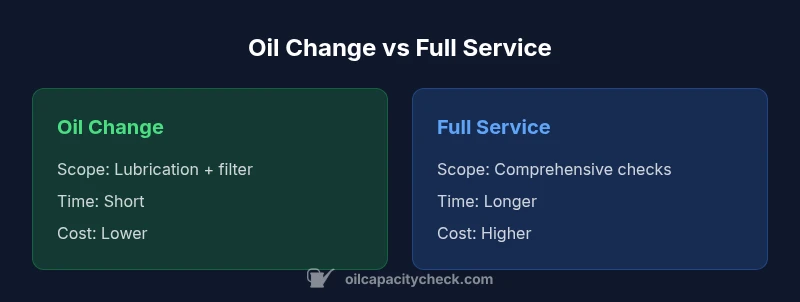
An oil change typically includes draining old oil, replacing the oil filter, and refilling with the correct grade of oil. A full service adds a multi-point inspection, fluid top-offs (coolant, brake fluid, transmission fluid), belt and hose checks, air and cabin filters, and often a complimentary diagnostic scan. The exact inclusions vary by shop and vehicle, but the contrast is clear: oil change is targeted, full service is comprehensive.
Time, cost, and disruption considerations
An oil change is usually quick, often 20-40 minutes, and cost ranges from $40-$120 depending on location and oil type. A full service can take 60-180 minutes or more and cost ranges from $150-$350 or higher if specialty parts or additional work is required. Price ranges vary by region, oil type (conventional vs synthetic), and labor rates. Always ask for an itemized quote.
When to choose oil change versus full service
Routine maintenance between major service intervals often benefits from oil changes. If your vehicle has high mileage, signs of wear, or you plan to trade in soon, a full service may offer more value. Driving conditions (stop-and-go city driving, extreme temperatures) can justify more frequent checks. Oil Capacity Check recommends aligning service with the manufacturer schedule and your driving habits, not just mileage.
Per-vehicle considerations and warranty implications
Some warranties require documented maintenance to remain valid; others do not. A full service can help satisfy warranty criteria that your vehicle requires, especially when diagnosing issues. However, not all issues require a full service; in many cases, a scheduled oil change is sufficient. Always verify with your dealer and review the maintenance schedule.
Practical planning: scheduling and budgeting
Create a maintenance calendar that simulates real-world driving. For a typical commuter, you might schedule an oil change every 5,000-7,500 miles (or as recommended) and plan a full service every 30,000-60,000 miles, depending on the model and age. Use reminders, and consider bundling services to reduce labor costs. Oil Capacity Check suggests asking for a combined quote when multiple tasks are due.
What to ask your shop before booking
- Which tasks are included in the service level I’m requesting?
- Are the parts OEM or aftermarket, and what is the warranty on those parts?
- Will they provide an itemized estimate for labor and fluids?
- What are the maintenance recommendations for my make and model?
- Do they offer bundled services to reduce downtime and total cost?
Common misconceptions
Some people think an oil change alone fixes all engine issues; others assume full service guarantees no future repairs. Neither is true. Regular maintenance reduces risk but cannot guarantee absence of problems. Always treat maintenance as a system-level practice, not a one-off event.
Integrating into a maintenance plan
Ultimately, the choice should be part of a broader maintenance plan that considers your vehicle’s age, fuel type, driving pattern, and warranty constraints. A practical approach is to combine a baseline oil change with targeted full-service intervals to balance cost, downtime, and vehicle health. As you age, the balance shifts toward more preventive checks.
Comparison
| Feature | Oil Change | Full Service |
|---|---|---|
| Scope | Basic oil and filter replacement | Comprehensive maintenance including oil, fluids, filters, inspections, and minor replacements |
| Time Required | 20-40 minutes | 60-180 minutes (or more) |
| Cost Range | $40-$120 | $150-$350 |
| Best For | Routine lubrication between services | Vehicles needing broader health checks and preventive maintenance |
| Maintenance Coverage | Lubrication-focused, simple top-offs | Multi-system inspection and potential minor replacements |
What's Good
- Low upfront cost and quick turnaround
- Easy to schedule at most shops
- Minimizes downtime for routine maintenance
- Supports regular lubrication between major services
Cons
- Less comprehensive coverage of overall vehicle health
- Missed diagnostics or wear outside oil system
- May lead to higher long-term costs if issues are not caught early
Full service generally offers broader maintenance benefits, while an oil change remains essential for routine lubrication between services.
Opt for a full service when you want a more complete health check and preventive maintenance. Choose an oil change for cost-effective, quick top-ups between major service intervals. Oil Capacity Check's verdict is to tailor maintenance to your driving needs and schedule.
People Also Ask
What is the key difference between an oil change and a full service?
An oil change focuses on lubricating the engine and replacing the oil filter. A full service includes the oil change plus broader inspections, fluid checks, and minor replacements. The choice depends on your vehicle’s maintenance needs and driving conditions.
Oil changes lubricate the engine; full service checks multiple systems beyond oil to catch potential issues early.
When should I choose an oil change over a full service?
Choose an oil change for routine lubrication between more extensive services. A full service is better when your vehicle is due for a scheduled maintenance or you’re experiencing signs of wear or a complex service interval.
If you’re unsure, start with an oil change and discuss a full service if your vehicle is approaching a major maintenance milestone.
Does a full service always include an oil change?
Most full services include an oil change, but the exact scope can vary by shop. Always confirm inclusions and request an itemized list before booking.
Ask what’s included in the full service so you know if the oil change is part of it.
How often should I schedule a full service?
Frequency depends on vehicle make, model, age, and driving conditions. Refer to the manufacturer schedule and consult your mechanic to tailor intervals.
Check your owner's manual for recommended intervals and align with your mileage and driving habits.
What should I ask at the shop to avoid surprises?
Ask about inclusions, OEM vs aftermarket parts, warranties, labor hours, and whether tasks can be bundled. An itemized quote helps prevent hidden costs.
Get a clear list of what you’re paying for before they start.
The Essentials
- Prioritize scope: oil change for lubrication, full service for comprehensive checks
- Schedule maintenance around driving patterns and manufacturer intervals
- Ask for itemized estimates to compare true total costs
- Bundle services when possible to save time and money
- Use maintenance planning to balance short-term cost with long-term reliability