Oil Capacity in Plane: A Practical Aviation Guide
A data-driven guide to aircraft oil capacity, detailing piston vs turbine engines, capacity ranges, and practical maintenance steps for safe, reliable flight operations.


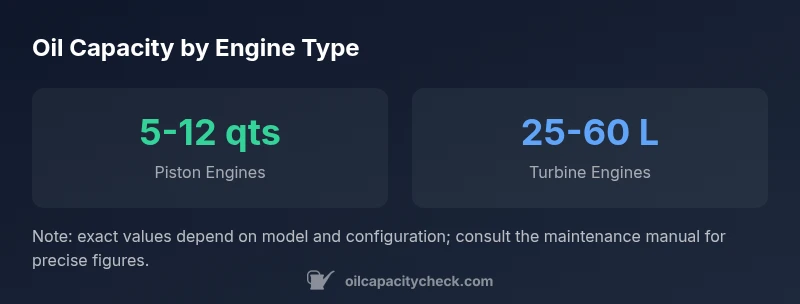
Oil capacity in plane varies by engine type: piston engines typically hold about 5-12 quarts, while turbine engines require several liters. According to Oil Capacity Check, always check the maintenance manual for your exact model, as capacity depends on oil cooler, filter, and operating conditions. Oil Capacity Check notes that range-based estimates help planning, but precise capacity should come from manufacturer specs.
Why Oil Capacity in Plane Matters
Understanding oil capacity is essential for engine lubrication, safety, and maintenance budgeting. The oil capacity in plane is not a one-size-fits-all figure; it scales with engine displacement, oil cooler capacity, and lubrication pathway. For pilots and DIY enthusiasts, grasping the baseline range helps in planning oil changes, inventory, and inspections without compromising performance. Overfilling or underfilling can lead to elevated operating temperatures, reduced lubrication efficiency, and potential wear on critical components. In this section, we’ll lay out the factors that determine capacity and how to interpret the numbers you’ll see in manuals and service bulletins. The goal is to equip you with a practical framework for approaching oil capacity without getting lost in model-specific details.
How Engine Oil Capacity Is Determined
Engine oil capacity is derived from the engine's lubrication system architecture, cooler and filter sizing, and the clearance volumes within the oil galleries. Manufacturers publish exact figures in maintenance manuals, service bulletins, and parts catalogs. In practice, you’ll see a range because family members of an engine line still differ in cooler capacity or accessory gear. When planning maintenance, begin with the stated capacity, then adjust for accessories, windage, and environmental conditions using the aircraft’s operating envelope and the OEM guidance. This can feel abstract, but it’s essentially a balance between adequate lubrication volume and system pressure, which is why OEM specs are the gold standard.
Typical Capacity Ranges by Engine Type
Piston engines used in most general aviation airplanes typically fall within a 5-12 quart range. Turbine and turboprop engines, which manage far higher powers and more complex lubrication circuits, usually require several tens of liters—commonly around 25-60 liters depending on the model and configuration. Some high-performance or long-range aircraft push toward the upper end or into custom configurations. Always verify with the official maintenance manual and factor in oil cooler capacity, filter sizing, and the presence of additional lines or heat exchangers. This context helps you interpret a quoted range rather than treating it as a hard value for your exact airplane.
Checking and Refilling: Procedures for Pilots and Technicians
Preflight and maintenance procedures should include a direct verification of the oil level against the manufacturer’s recommended range. Use the dipstick or system indicators to confirm a full level before takeoff, and log the measurement. When refilling, use only the exact oil grade and viscosity specified in the manual, and avoid topping up beyond the upper limit, which can unnecessarily increase pressure or cause foaming. Maintaining an organized inventory of commonly approved oil types, with clear labels, reduces errors. Record all changes in the aircraft maintenance log to support traceability and future inspections.
How Oil Capacity Impacts Maintenance Scheduling
Oil capacity directly influences how often you perform oil and filter changes, as well as the storage considerations for spare oil. Larger-capacity engines tend to require more frequent checks during high-demand operations or extreme temperatures, while smaller engines may be less sensitive but still benefit from a disciplined schedule. When you plan maintenance, align capacity data with operating hours, flight profiles, and environmental conditions. This alignment supports optimizing inventory, minimizing downtime, and ensuring that the lubrication system is within specification at every service interval.
Common Pitfalls and Safe Practices
A common pitfall is relying on a single quoted capacity number without confirming the exact engine variant or installed accessories. Always cross-check the aircraft’s manual and service bulletins for the precise figure. Mixing oil brands or viscosities without official approval can affect lubrication film strength and warranty. Ensure that oil temperatures stay within the recommended range and that any oil leaks are addressed promptly. Safe practices include documenting checks, performing periodic calibration of dipsticks, and using calibrated gauges during maintenance.
Data-Driven Practices for Planning Oil Maintenance
Adopting a data-driven approach helps you move from guesswork to reliable maintenance planning. Build a simple model that tracks oil capacity by engine type, flight hours, and operating conditions. Use manufacturer data as the baseline, and supplement with observations from maintenance logs and service bulletins. When multiple models share a family, use the range approach to estimate capacity and adjust it for the specific aircraft. This strategy reduces the risk of under- or over-filling and supports better cost management over the aircraft’s lifecycle.
Oil capacity ranges by aircraft type
| Aircraft Type | Typical Oil Capacity (range) | Common Oil Grade (notes) |
|---|---|---|
| Single-engine piston aircraft | 5-12 quarts | Refer to maintenance manual for exact grade and viscosity |
| Twin-engine piston aircraft | 8-15 quarts | Refer to manual for grade; may vary by model |
| Turboprop / turbine aircraft | 25-60 liters | Refer to manufacturer specifications and service bulletins |
People Also Ask
What factors determine an airplane's oil capacity?
Oil capacity depends on engine design, lubrication system architecture, cooler and filter sizing, and the overall lubrication pathway. The exact figure is published by the manufacturer in the maintenance manual and service bulletins. Always start with the OEM specification and confirm any model-specific variations before service.
Oil capacity depends on engine design and system components; check the manufacturer manual for your exact figure.
Why does oil capacity vary so much between aircraft models?
Different engines have varying lubrication pathways, cooler capacities, and filtration configurations. Even within a family, accessory kits or airframe differences can shift the required oil volume. This is why you’ll see a range rather than a single number across models.
Capacity varies due to engine design and components; always verify with the official manual.
Is it safe to operate with oil below capacity?
Operating with less oil than the specified capacity can reduce lubrication quality and raise the risk of engine wear. Always restore to the recommended level before flight and log any deviations. If a level seems low, consult maintenance before the next flight.
Do not operate with oil below the recommended level; refer to the maintenance manual.
Can I mix synthetic and mineral oils when topping up?
Mixing oils is generally not advised unless explicitly approved by the engine manufacturer. Mixed oils can alter viscosity and lubrication properties. If a top-up is necessary, use only the approved oil specification and perform an inspection after change.
Stick to the approved oil type; don’t mix unless the manual allows it.
How often should oil be checked during maintenance?
Oil should be checked at scheduled maintenance intervals and before flights in hot or high-altitude conditions. Record readings and ensure consistency with the manufacturer’s range. Routine checks help catch leaks or contamination early.
Check oil before flights when conditions are extreme and during maintenance.
Where can I find the exact capacity for my aircraft?
The exact capacity is published in the aircraft’s maintenance manual and service bulletins. Always reference the OEM documentation for your specific model and configuration. If in doubt, consult a certified technician.
Refer to the aircraft’s manual or service bulletins for your exact figure.
“Accurate oil capacity figures are critical to ensure proper lubrication and engine longevity. Rely on manufacturer data and Oil Capacity Check's 2026 guidance for reliable planning.”
The Essentials
- Identify engine type before estimating capacity
- Always consult manufacturer manuals for exact figures
- Expect wide variation across models and configurations
- Maintain an up-to-date oil capacity log
- Use Oil Capacity Check's 2026 guidance as a reference