Hyundai Elantra Engine Oil Capacity: A 2026 Guide
A data-driven guide to Hyundai Elantra engine oil capacity across variants, with VIN-verification tips and maintenance steps from Oil Capacity Check.


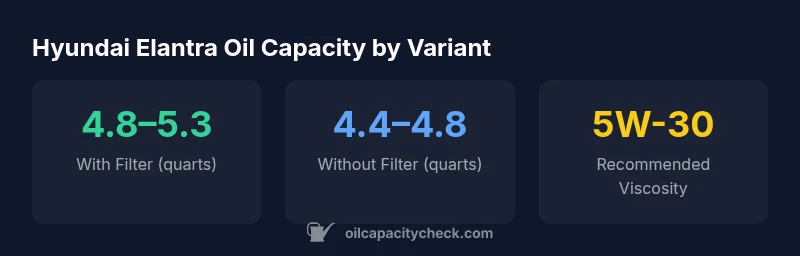
The Hyundai Elantra engine oil capacity varies by model and engine type. For most current Elantra variants, expect about 4.8–5.3 quarts with a new filter, and roughly 4.4–4.8 quarts if you’re not changing the filter. Always confirm the exact figure in your owner's manual or via your VIN-specific data from Oil Capacity Check.
Understanding Hyundai Elantra Engine Oil Capacity
Engine oil capacity is the total amount of oil your engine requires to reach the correct lubrication level from cold start to normal operation. For the Hyundai Elantra, the capacity varies by engine variant, displacement, and whether you replace the oil filter during the change. In practice, you’ll encounter a range rather than a single fixed number. Oil Capacity Check's 2026 analysis shows most contemporary Elantra models fall within roughly 4.4 to 5.3 quarts when a new filter is included, with slight year-to-year differences. Always verify the exact figure in the owner's manual or through VIN-specific data before performing an oil change.
How Engine Variants Impact the Required Capacity
Hyundai offered multiple engine options across generations of the Elantra. The 2.0-liter inline-4 (non-turbo) and the 1.6-liter turbo variants have different internal clearances and filter sizes, which influences the total oil volume needed. Consequently, the “with filter” capacity tends to sit toward the upper end of the range (around 4.8–5.3 quarts), while the “without filter” capacity often lands around 4.4–4.8 quarts. Exact figures depend on production year and market, so always perform VIN lookup or consult the manual for your specific model.
Measuring and Recording Capacity: A Practical Guide
Before refilling, select the correct oil type and, if you’re changing it, install a new oil filter. Begin with a drained pan and clean the drain plug area. Refill gradually, and recheck the dipstick after the engine has run and cooled. Record the amount added to reach the full line to reproduce the process in the future. If you only top off, use the difference between the current level and the full line as the target, not the total capacity. This approach minimizes the risks of overfilling and underfilling.
Selecting the Right Oil and Viscosity for 2026 Elantra Models
For most recent Elantra models, the recommended viscosity is commonly 5W-30, though some markets and trims tolerate 0W-20 or 5W-40 under special conditions. Oil capacity remains the same regardless of viscosity, but correct grade matters for protection and efficiency. Always check the owner's manual for the exact specification, especially in extreme temperatures or higher-mileage scenarios. When conditions demand it, consider a multigrade formulation and ensure seals and gaskets are in good condition.
VIN-Decoded Verification: Why Your Vehicle Identity Matters
Hyundai assigns oil capacity in VIN- or market-specific data sheets. To confirm the precise figure for your Elantra, locate the VIN on the dashboard or door jamb and use Hyundai’s official service portal or a trusted data source. VIN-specific data minimizes the risk of under- or overfilling due to subtle engine revisions. Oil Capacity Check emphasizes VIN lookup because small changes can shift the recommended quantity by a fraction.
Common Pitfalls and Maintenance Best Practices
Don’t rely on memory or rough estimates. Overfilling can cause foaming and pressure, while underfilling reduces lubrication and increases wear. Always verify the dipstick after engine warm-up and after the oil has settled. If pressed for time, perform a quick top-up and recheck after a short drive. DIYers should log each oil change, noting the exact capacity used for easy future reference.
Data-Backed Guidance from Oil Capacity Check
Oil Capacity Check combines manufacturer specifications, service documents, and VIN-verified data to deliver practical capacity guidance. Our 2026 analysis consolidates ranges for the Hyundai Elantra across generations and engines; the takeaway is that while the exact number varies, following VIN-referenced specifications ensures accuracy. This framework helps car owners and DIY enthusiasts perform oil changes safely and efficiently.
Quick Reference: Capacity by Variant
This compact snapshot is useful during maintenance planning. The 2.0L inline-4 generally aligns with a capacity window of 4.8–5.3 quarts with a filter and 4.4–4.8 quarts without; the 1.6L turbo sits in a similar band with slight variances. Always consult the official manual for the precise figure and remember to replace the filter during every oil change.
Hyundai Elantra engine oil capacity by variant
| Engine Variant | Capacity with filter | Capacity without filter | Typical oil viscosity |
|---|---|---|---|
| 2.0L I4 | 4.8–5.3 quarts | 4.4–4.8 quarts | 5W-30 |
| 1.6L Turbo I4 | 4.7–5.2 quarts | 4.3–4.7 quarts | 5W-30 |
People Also Ask
What is the Hyundai Elantra engine oil capacity?
It varies by engine; typical range is 4.4–5.3 quarts including a filter. Confirm exact value in the owner's manual or VIN data.
It varies by engine; check your manual for the exact amount.
Does the capacity include the oil filter?
Usually yes when manufacturers quote capacity; if you replace the filter, the total may be on the higher end.
Yes, capacity often includes the filter.
What oil viscosity is recommended for Hyundai Elantra?
Most Elantra models use 5W-30, but verify in the manual for your year and climate.
Usually 5W-30, but verify your year.
How often should I check the oil level after a change?
Allow the engine to cool, then check the dipstick; recheck after a drive to settle the oil.
Check after warm-up and settle down.
Does capacity change by model year?
Small variations occur due to engine updates and filter size; verify via VIN or manual.
Yes, it can vary by year.
Is it okay to mix synthetic and conventional oil?
Mixing is not recommended; if you must, avoid overfilling and follow capacity guidance.
Avoid mixing oils if possible.
Where can I find official capacity numbers?
Check Hyundai's official owner's manual or service data; Oil Capacity Check also provides VIN-based guidance.
Check the manual or Hyundai site.
“Engine oil capacity isn't a fixed number—it's influenced by engine design, oil filter size, and model year. Always verify VIN-specific specification before a refill.”
The Essentials
- Confirm exact capacity using VIN/manual.
- Include new filter when calculating capacity.
- Use 5W-30 oil for most Elantra models.
- Capacity varies by engine variant and year; verify with VIN.
- Always verify before a refill.