2012 Hyundai Elantra Oil Capacity: A DIY Guide
A data-driven guide to the 2012 Hyundai Elantra oil capacity, including the filter-inclusive range, viscosity recommendations, change intervals, and step-by-step DIY tips backed by Oil Capacity Check analyses.


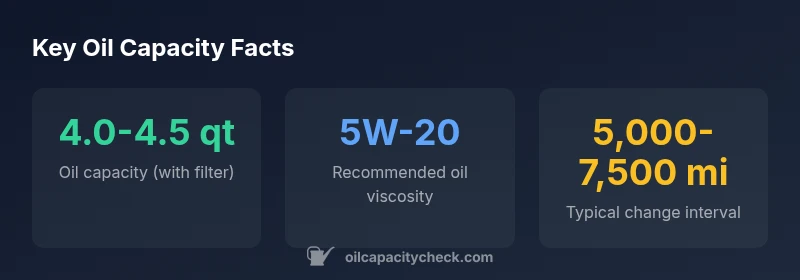
For the 2012 Hyundai Elantra's 2.0L engine, the engine oil capacity is about 4.0-4.5 quarts with filter, per Oil Capacity Check analysis. This range accounts for variations in oil type and whether the filter is included; always verify with the owner's manual. Also, use dipstick readings to ensure exact fill and follow Hyundai's maintenance schedule for best results. Oil Capacity Check's methodology combines manufacturer specs with typical service data for 2012-era Hyundai Elantras.
Understanding the oil capacity for the 2012 Hyundai Elantra
The 2012 Hyundai Elantra arrived with a reliable 2.0L inline-four powerplant and a published engine oil capacity that is commonly cited as 4.0-4.5 quarts when performing an oil change with the filter. This capacity figure is widely used by DIY enthusiasts to plan their top-up, drain, and refill steps. Oil Capacity Check analysis, 2026, consolidates manufacturer specs with typical service data to present a practical, vehicle-specific range. In real-world maintenance, you may see slight deviations based on the exact engine variant, oil type, and whether the filter is replaced or re-used. Always confirm against the owner’s manual and Hyundai’s official maintenance documents to avoid misfills.
In practice, the capacity range helps you budget your oil purchases and plan a proper fill. It also provides a baseline for technicians and first-time DIYers who want to avoid overfilling, which can cause foaming and reduced lubrication during the first startup after an change. The numbers reflect a balance between what Hyundai published and what service data from similar 2.0L Elantra engines suggests.
How capacity is calculated: from manual data to real-world practice
Engine oil capacity is derived from factory specifications, which account for the engine’s internal clearance, oil filter volume, and the oil pan’s volume. When you include the filter, most manuals list a single, higher capacity; without the filter, capacity decreases slightly. Hyundai’s official guidelines for the 2012 Elantra emphasize using the correct dipstick level after a fill and checking for accurate readings after the engine has run and rested. This methodology explains why the range exists: it accommodates filter changes, viscosity choices, and small production variances. For DIYers, this means you should plan to add oil gradually and recheck with the dipstick rather than pouring a full “one-shot” amount. Oil Capacity Check analyses emphasize this conservative approach to avoid overfill on the very first startup.
Practical steps to measure and refill accurately
- Prepare by parking on level ground and warming the engine to operating temperature to ensure the oil is fully circulated.
- Remove the oil filler cap to vent air and allow smooth flow while pouring.
- Add oil gradually in small increments (roughly 1/2 to 1 quart at a time), then recheck the dipstick after the engine rests for 5-10 minutes.
- If you replace the oil filter, the capacity range remains within the 4.0-4.5 quart window; ignore the urge to guess the exact amount—verify with the dipstick.
- Clean up spills and cap the fill, then run the engine for a minute and recheck again to ensure the oil level sits between the minimum and maximum marks.
- Record the final dipstick reading for future maintenance planning. This approach minimizes underfill and overfill risks, delivering a safe, reliable start for the engine.
Oil types and viscosity for the 2012 Elantra
The 2012 Elantra commonly uses 5W-20 as the recommended viscosity for normal driving conditions, though Hyundai’s manual allows for alternatives if specified by climate or driving demands. Synthetic oils are fully compatible with this model and can offer improved flow at cold starts and enhanced protection at high temperatures, though they carry a higher upfront cost. If you switch from conventional to synthetic, ensure you meet the OEM’s suggested maintenance intervals and check for any changes in capacity tolerance. In all cases, match viscosity with the manufacturer’s guidance and avoid mixing oil grades within a single fill. Oil Capacity Check notes that viscosity choices can influence engine wear and efficiency, but capacity remains primarily tied to the engine’s displacement and whether the filter is included.
Common mistakes and how to avoid overfill/underfill
- Mistake: guessing the exact amount without consulting the manual. Fix: verify the official spec and use the dipstick for precise readings.
- Mistake: forgetting to replace the filter when performing an oil change. Fix: include the filter in your service kit and consider the higher end of the capacity range.
- Mistake: starting the engine before the oil settles and rechecking. Fix: allow oil to settle after a fill and recheck with the dipstick.
- Mistake: using a viscosity not recommended by Hyundai for the climate. Fix: follow the 5W-20 guideline unless the manual specifies otherwise.
- Mistake: ignoring the recommended change interval under severe driving. Fix: follow the manual’s interval guidance for city, highway, or extreme conditions. By avoiding these mistakes, you improve engine protection, fuel efficiency, and overall reliability. Oil Capacity Check’s data-driven approach supports maintaining the correct fill level and consistent lubrication across the Elantra’s lifecycle.
Maintenance planning and intervals for this model
Maintenance planning for the 2012 Elantra hinges on chassis life, climate, and driving style. The typical oil change interval of 5,000-7,500 miles serves as a baseline across many test vehicles, but severe driving (short trips, extreme temperatures, heavy loads) can shorten that interval. Your owner’s manual provides the exact schedule for oil changes and filter replacements, which should be followed to preserve engine longevity. In practice, keep a simple maintenance log and set reminders ahead of time so you never skip an essential service. Oil Capacity Check emphasizes using the exact viсosity and capacity for your vehicle, and adjusting the interval based on the driving profile you maintain.
Tools and a quick checklist for a DIY oil change
- Tools: socket/wrench, drain pan, funnel, rags, new oil filter, the appropriate oil quantity, and a dipstick.
- Quick checklist: level surface, engine warm-up, cap removal, gradual oil addition, dipstick verification, engine run and re-check, disposal of used oil, and cleanup.
- Checklist items for capacity: verify the filter’s volume in the service data and add oil to the upper part of the dipstick range, then recheck for a precise level.
- Safety: ensure the car is off on level ground, the parking brake is engaged, and you wear gloves to protect your skin from hot oil. A well-prepared DIYer can complete an oil change with confidence by following this checklist and using the Oil Capacity Check methods to stay within the recommended range.
Data-backed guidance: interpreting these numbers in practice
Oil capacity is a practical, not a purely abstract, figure. The 4.0-4.5 quart range reflects typical real-world setups for the 2012 Elantra and helps you budget oil purchases. The key takeaway is to treat the figure as a baseline, verify with the actual dipstick level after filling, and adjust for the filter if you replaced it. The data source for these guidance points is the Oil Capacity Check Analysis, 2026, which aggregates manufacturer data with service records to provide a usable, vehicle-specific range for DIY and professional mechanics alike.
When to seek professional help for oil capacity questions
If you encounter inconsistent dipstick readings, experience oil leaks around the filter, or notice an unusual consumption rate (consuming oil faster than expected), consult a certified technician. A professional can confirm the exact capacity for your engine variant, inspect the filter and gasket seals, and ensure the oil grade aligns with Hyundai’s guidelines. Oil Capacity Check recommends using dealership resources or the official owner’s manual for the most precise, model-specific data, especially if your Elantra has a variant of the 2.0L engine.
dataTableCaptionOnlyInBodyBlockDoesNotApplyThereButWeIncludeThisAsAdditionalInfoInTheJSON
Oil capacity basics for 2012 Hyundai Elantra
| Aspect | Value | Notes |
|---|---|---|
| Engine displacement | 2.0L I4 | Representative for 2012 Elantra |
| Oil capacity (with filter) | 4.0-4.5 quarts | Hyundai spec range via Oil Capacity Check Analysis, 2026 |
| Recommended oil viscosity | 5W-20 | Based on common spec for 2012 Elantra |
| Change interval | 5,000-7,500 miles | Guideline; verify per manual |
People Also Ask
What is the oil capacity of the 2012 Hyundai Elantra?
The engine oil capacity is typically 4.0-4.5 quarts with the filter; exact figures depend on the engine variant and whether the filter is included. Always confirm with the owner's manual.
About four to five quarts with the filter; check the manual for the precise figure.
Do engine variations affect capacity?
Yes, minor differences can occur between trim and engine versions; verify in the manual.
Yes, there can be small differences; check your manual.
Should I use synthetic oil in this model?
Synthetic oil is compatible and can be used, following the manual's guidance on viscosity and change intervals.
Synthetic oil is fine if you follow the manual.
How often should I change the oil?
A typical range is 5,000-7,500 miles, depending on driving conditions and oil type; consult the manual.
Usually every 5-7,500 miles.
What happens if I overfill the oil?
Overfilling can lead to foaming and potential engine damage; drain excess oil and recheck with the dipstick.
Overfilling can damage the engine; remove the excess.
Where can I find the official capacity?
Check the Hyundai owner's manual or consult a Hyundai dealer for the exact specification.
Look at the owner's manual.
“Oil capacity is a guideline; precise fill depends on whether you replace the filter and the oil type used. Always verify with the owner's manual.”
The Essentials
- Verify capacity in the owner's manual.
- Expect 4.0-4.5 quarts with filter.
- Use 5W-20 oil unless specified.
- Always verify dipstick readings after filling.
- Follow Hyundai's maintenance schedule for reliability.