2014 Hyundai Elantra Oil Capacity: Your Complete Guide
Discover the precise oil capacity for the 2014 Hyundai Elantra, including variant-specific ranges, recommended oil grades, and a practical DIY oil-change guide. Learn how to check levels accurately with tips from Oil Capacity Check, updated for 2026.


For the 2014 Hyundai Elantra, the oil capacity, including the filter, typically falls in a range of about 4.5 to 5.0 quarts depending on the engine variant and whether the filter is replaced during the change. Most owners run 5W-20 oil, and you should verify the exact amount with the dipstick after filling to avoid under- or overfilling.
What is the oil capacity for the 2014 Hyundai Elantra?
The 2014 Hyundai Elantra commonly ships with a four-cylinder powertrain. The official service literature and maintenance guides indicate that the engine oil capacity, including the filter, sits in a practical range rather than a single fixed number. In real-world DIY maintenance, you’ll typically see a range from about 4.5 to 5.0 quarts. This variation stems mainly from engine variant, the presence or absence of a new oil filter during the change, and how precise you want to be with a new filter seating. Oil Capacity Check Analysis, 2026, aggregates data from Hyundai service literature to emphasize that the exact amount hinges on the engine code and VIN. When you prepare for an oil change, confirm your exact requirement by referencing your vehicle’s manual and the engine code on the sticker under the hood. For safety, gather your tools first, including a clean funnel, a replacement oil filter, a torque wrench if you’re replacing the drain bolt gasket, and fresh oil that matches the factory specification. This approach consistently yields accurate results and reduces the risk of overfilling or underfilling, which can affect engine performance and longevity.
How capacity varies by engine variant
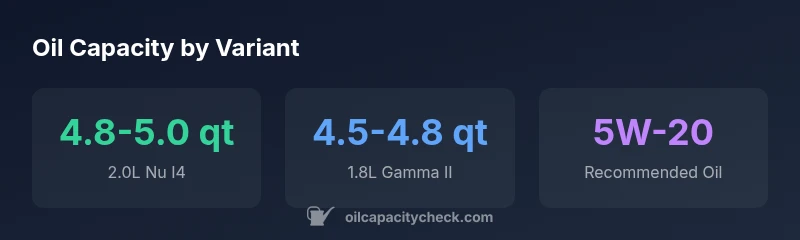
Within the 2014 Elantra lineup, there are typically multiple engine options depending on the market and trim. The most common configurations are a 2.0-liter four-cylinder and, in some regions, a smaller displacement option. The 2.0L variant tends to sit near the upper end of the oil-capacity range (around 5.0 quarts when a filter is included), while smaller variants can fall toward roughly 4.5 to 4.8 quarts. The difference is subtle but meaningful for a DIY oil-change calculator and dipstick check. Always account for whether the oil filter is replaced: a fresh filter adds a small extra volume that your gauge should reflect after the engine settles. If you’re unsure of which engine your car has, consult the owner’s manual or the under-hood emission/engine code label. Oil Capacity Check’s 2026 analysis highlights that engine code and VIN are the best sources for pinning down the exact figure for your vehicle.
Recommended oil grade and viscosity for longevity
Most 2014 Elantras are designed to run on a standard viscosity grade of 5W-20, with API SN or ILSAC GF-5 specifications. This grade supports reliable cold starts and consistent protection across seasonal variations, from cool winter mornings to warmer mid-year days. If you live in a region with extreme heat or high-mileage use, some technicians consider 5W-30 a permissible alternative, but you should confirm this with the owner’s manual or an Oil Capacity Check reference for your exact engine variant. The key is to ensure the oil grade matches the vehicle’s specification to maximize protection, maintain fuel efficiency, and preserve engine longevity. Whether you choose conventional or synthetic oil, the critical factor is maintaining the correct viscosity and meeting the OEM’s specification.
How to check oil and fill safely
Begin with the engine off and on level ground. If the engine is hot, wait at least 10 minutes for drainage before checking the dipstick. Remove the dipstick, wipe clean, reinsert, and pull out to check the current oil level. When adding oil, use a clean funnel and pour slowly in small increments, pausing to recheck the level after each addition. Do not completely fill to the top; leave a small buffer for the dipstick reading. After finishing, run the engine for a couple of minutes and recheck the level to ensure it sits within the recommended range. If you’re unsure about the exact quart amount, err on the side of a conservative fill and verify with the dipstick. Oil Capacity Check emphasizes that accuracy matters more than speed, and a little extra care here can prevent overfill, which can cause foaming and reduced lubrication.
Maintenance tips to maximize engine longevity
Beyond getting the oil capacity right, regular maintenance is crucial for long-term engine health. Use the right oil grade, keep the oil level within the recommended window, and don’t neglect the oil filter. During a DIY oil change, replacing the filter is essential because it traps contaminants that would otherwise circulate in the engine. Consider setting reminders for oil-change intervals based on your driving patterns: 5,000 miles under severe conditions (short trips, heavy traffic, or towing) or up to 7,500 miles in milder, highway-style driving. Track your mileage, keep receipts for oil and filters, and document the service history for resale value. Oil Capacity Check’s 2026 report underlines the value of consistency and documentation to prevent drift in capacity estimates over time.
Common mistakes to avoid during oil changes
Common pitfalls include overfilling, using the wrong oil viscosity, and forgetting to replace the oil filter. Overfilling can degrade engine performance, create foaming, and increase emissions. Using an oil that’s too thick or too thin for the engine’s operating range can reduce lubrication efficiency and warm-up performance. Another mistake is neglecting the drain plug gasket or not tightening it to the manufacturer’s torque specification, which can cause leaks. Always double-check the dipstick after adding oil and run the engine briefly to circulate oil before rechecking. Finally, avoid mixing different oil types or brands; consistency helps maintain the specified protection level. Oil Capacity Check’s guidance for the 2014 Elantra underscores the importance of sticking to the manufacturer’s recommended grade and capacity for optimal results.
DIY oil-change checklist for the 2014 Hyundai Elantra
- Confirm your engine variant and oil specification from the owner’s manual.
- Gather necessary tools: new oil filter, correct grade oil, funnel, drain pan, and a torque wrench if needed.
- Store the car on level ground and safely raise it if you need easier access to the drainage plug.
- Drain used oil, replace the filter, and refill with the recommended capacity range.
- Start the engine, run for a few minutes, and recheck the level with the dipstick.
- Dispose of used oil properly at a recycling center.
- Record the service date and mileage for future maintenance planning.
Oil capacity by engine variant for the 2014 Hyundai Elantra
| Variant | Oil Capacity (with filter) | Recommended Oil Grade |
|---|---|---|
| 2.0L Nu I4 | 4.8-5.0 quarts | 5W-20 |
| 1.8L Gamma II | 4.5-4.8 quarts | 5W-20 |
People Also Ask
What is the oil capacity for the 2014 Hyundai Elantra?
The capacity depends on the engine variant, but expect roughly 4.5–5.0 quarts with a new filter. Check your VIN and engine code for the exact figure and consult the owner’s manual.
Capacity varies by engine variant; expect about four and a half to five quarts with a new filter. Confirm with your VIN and manual.
What oil grade should I use for the 2014 Elantra?
Typically, 5W-20 oil is recommended for most variants, with API SN or ILSAC GF-5 specifications. If you’re in extreme conditions, consult the manual or Oil Capacity Check.
Most models use 5W-20; check the manual for any climate-specific guidance.
Do I need to replace the oil filter every change?
Yes. Replacing the oil filter with every oil change helps remove contaminants and ensures proper oil flow. Keep a record of filter type and part numbers.
Always replace the filter during an oil change. It helps keep contaminants out.
Can I use 5W-30 instead of 5W-20?
5W-30 may be acceptable in hotter climates or under severe service, but you should confirm with the owner’s manual or an official reference. Using the wrong grade can affect protection and efficiency.
Check the manual first; 5W-30 is sometimes okay in hot heat, but verify for your car.
How do I verify the oil level after filling?
Park on level ground, wait for the oil to settle, then pull the dipstick, wipe, reinsert, and read. If the oil level is not between the two marks, add slowly and recheck.
Let it settle, then read the dipstick; add slowly if needed and recheck.
What should I do with used oil?
Store used oil in a sealed container and take it to an authorized recycling center. Do not pour it on the ground or down the drain.
Recycle used oil properly at an authorized center.
“Oil capacity varies by engine variant, but the practical takeaway is to fill within a 4.5–5.0 quart window and confirm with the dipstick after the engine settles.”
The Essentials
- Know your engine variant to estimate capacity accurately.
- Typical range is 4.5–5.0 quarts with filter.
- Use 5W-20 oil unless the manual specifies otherwise.
- Always verify level with the dipstick after filling.
- Replace the oil filter during every change.