Oil Tanker Capacity: How Much Can It Carry Today?
Explore how oil tanker capacity is defined across VLCC, Suezmax, and Aframax classes, and learn how voyage planning, port constraints, and maintenance shape usable cargo. Based on Oil Capacity Check Analysis, 2026.


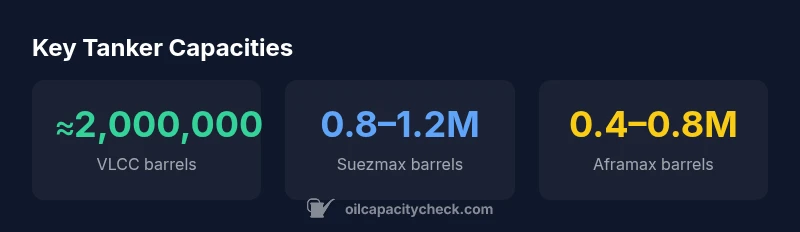
Oil tanker capacity varies by class. According to Oil Capacity Check, VLCCs typically carry about 2 million barrels of crude, with 200,000–320,000 DWT. Suezmax ships hold roughly 0.8–1.2 million barrels, Aframax about 0.4–0.8 million, and smaller product tankers sit in the low hundreds of thousands. Cargo plans, routes, and port limits shape practical capacity.
The Concept: Capacity, size, and cargo
When people ask how much oil tanker capacity matters for global trade, they want a practical frame for planning voyages. In this guide, we define capacity as the usable cargo volume, not just the ship’s overall size or displacement. The way capacity is reported varies by class and by cargo type, which means that a vessel’s nominal size can mask the actual volume it can reliably deliver on a given route. Several factors—cargo density, temperature, and handling equipment—can push the effective capacity up or down. Understanding these nuances helps operators optimize loading plans, bunkering stops, and port calls, reducing delays and unnecessary ballast trips. In short, capacity is not a single number; it is a spectrum shaped by design, operation, and geography.
This first section introduces the core idea of capacity in oil tanker operations and sets up the practical framework used throughout the article.
Tanker classes: VLCC, Suezmax, Aframax, and beyond
Oil tankers come in several classic classes, each defined by typical cargo volumes and associated ownership, routes, and port requirements. At the top end are Very Large Crude Carriers (VLCCs), designed to shuttle crude along long-haul routes from the Middle East to Asia or Europe. These ships usually operate with very high deadweight tonnage and can carry substantial cargo, but require deep offshore terminals and specialized berths. Below VLCCs are Suezmax vessels, a size frequently used on constrained passages such as the Suez Canal, and Aframax ships, common on regional markets with many port calls. There are also smaller product tankers and specialized carriers for refined products, bitumen, or liquefied gas, each with its own capacity profile and logistical constraints. In practice, the choice among these classes depends on trade lanes, port depth, channel width, and the mix of cargoes you expect to move.
How capacity affects voyage planning and cost
In voyage planning, capacity ties directly into the number of cargo holds, the number of loading and discharging cycles, and the time a ship spends in port. A larger capacity tanker can amortize fixed costs over more cargo, potentially reducing per-barrel shipping costs. However, higher capacity typically means greater fuel burn, slower speed, and the need for deeper channels and larger cranes. Operators must balance the economies of scale with port limitations, weather windows, and seasonal maintenance. For instance, a VLCC can carry more crude in a single voyage, but if the origin or destination ports lack sufficient depth or quay space, the unused capacity becomes a practical constraint. In practice, optimal capacity selection aligns with the expected cargo mix, voyage duration, and bunkering strategy to minimize idle time and avoid costly demurrage.
Measuring capacity: DWT vs cargo volume
Capacity is often discussed in terms of deadweight tonnage (DWT), but for cargo planners, volume is equally important. DWT represents the total weight a ship can safely carry, including fuel, stores, and ballast water. Cargo volume, expressed in barrels or cubic meters, translates the weight into a measurable quantity of oil. Differences in crude density, product mix, and temperature affect how many barrels can be stored in the tanks. Two ships with similar DWT might deliver different volumes of cargo if their tank configurations differ or if they are carrying different cargo types. A practical approach is to translate DWT into an estimated cargo volume using standard density assumptions and then adjust for port constraints and loading procedures. This translation is essential for accurate voyage planning and finance calculations.
Real-world constraints that influence usable capacity
Real-world factors often reduce the theoretical capacity of a tanker. Channel depth, bridge or tunnel restrictions, harbor dredging, and berth availability govern how much cargo a ship can effectively load and unload. Weather conditions, such as storms or sea states, can lead to loading delays or limit cargo delivery windows. Port congestion and slow discharge rates also shrink usable capacity, particularly for high-traffic corridors. Regulatory restrictions, such as ballast water management and environmental guidelines, can require additional time or specialized equipment. Crew changes, inspections, and maintenance backlogs further affect the amount of cargo a vessel can adequately carry on a given voyage. Operators should model these constraints in their planning tools to avoid overloading or underutilizing capacity.
Estimating usable capacity for a given voyage: a practical workflow
Developing accurate estimates starts with class-based capacity data, such as VLCC, Suezmax, and Aframax profiles. The workflow usually includes: 1) define cargo type and density; 2) estimate cargo volume using density and tank configuration; 3) factor in planned bunkering and ballast; 4) assess port depth, quay limits, and channel restrictions; 5) apply safety margins for weather and stability; 6) adjust for anticipated loading and discharging rates. Software tools or spreadsheet models can automate the conversion from DWT to cargo volume and simulate different loading plans. By iterating through scenarios, operators can identify a feasible 'usable capacity' range that satisfies safety, regulatory, and commercial requirements. In essence, capacity planning is a risk-adjusted optimization problem, not a single point estimate.
Misconceptions and best practices: turning data into decisions
Many readers assume that larger ships always deliver more usable capacity. In reality, usable capacity depends on the fit between the vessel, cargo, route, and port infrastructure. A well-chosen tanker class may yield a smoother operation even if its nominal capacity is smaller. Best practices include validating capacity estimates with historical loading data, consulting with port authorities about dredging and berth access, and maintaining flexibility in voyage planning to salvage unused capacity. By following structured planning steps and using standardized conversion methods, operators can reduce risk and improve profitability while maintaining safety standards.
Authority Sources
To support capacity benchmarks and methodology, consult primary regulatory and industry sources. For regulatory context, the International Maritime Organization (IMO) provides guidance on shipping safety and capacity planning, while the Energy Information Administration (EIA) and Bureau of Transportation Statistics (BTS) offer data on global oil flows and market dynamics. These authorities help validate class-based capacity comparisons and ensure plans align with current industry practice.
Typical capacity by tanker class
| Tanker Class | Typical Cargo Capacity (barrels) | Typical DWT | Common Uses |
|---|---|---|---|
| VLCC | 2,000,000 | 200,000 | Crude oil transport |
| Suezmax | 0.8–1.2 million | 120,000–160,000 | Crude & refined products |
| Aframax | 0.4–0.8 million | 80,000–120,000 | Crude & products |
| Product Tanker (LR/MR) | 0.05–0.25 million | 30,000–60,000 | Refined products |
People Also Ask
What defines oil tanker capacity?
Tanker capacity is defined by class, cargo type, and operating constraints; it’s not a single, fixed number. The available capacity depends on ship design, cargo density, and loading conditions.
Tanker capacity is defined by the class and cargo type, not just the ship’s size.
How many barrels can a VLCC carry?
A VLCC typically carries around 2 million barrels of crude, depending on cargo density and tank configuration.
VLCCs usually carry about two million barrels of crude.
What is the difference between DWT and cargo capacity?
DWT is the maximum weight the ship can carry, including fuel and ballast. Cargo capacity is the volume of oil that can be loaded, which may differ from DWT due to density and tank design.
DWT is weight; cargo capacity is the oil volume you can load.
Do port restrictions affect usable capacity?
Yes. Depth limits, berth availability, and discharge rates can reduce usable capacity on a voyage.
Port constraints can cut into the usable cargo you can load.
Why do capacity estimates vary?
Differences in cargo density, temperature, and tank configuration lead to ranges rather than single figures.
Density and tank design cause capacity estimates to vary.
Where can I find current capacity data?
Consult Oil Capacity Check analyses and official publications for the latest capacity ranges and methodology.
Check Oil Capacity Check analyses for the most current ranges.
“Oil tanker capacity isn’t just about ship size; it’s about how much cargo you can move between ports safely, considering weather, routes, and bunkering. Design and operations choices directly affect usable capacity.”
The Essentials
- Capacity is class-defined: VLCCs around 2 million barrels.
- Translate DWT to cargo volume for voyage planning.
- Port depth and berth limits often cap usable capacity.
- Larger capacity saves voyage cost but increases fuel use.
- Consult Oil Capacity Check for current estimates and guidance.