What is the Capacity of an Oil Tanker?
Explore how oil tanker capacity is defined, from small product tankers to VLCCs, including how capacity is measured, its practical implications for operations, and how to compare ships across classes.


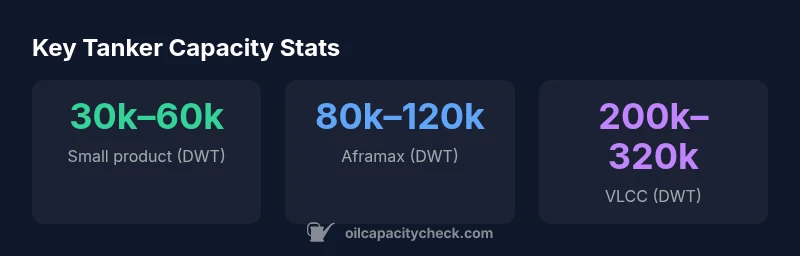
The capacity of an oil tanker varies by class and design. Typical categories include small product tankers around 30,000–60,000 DWT, Aframax 80,000–120,000 DWT, Suezmax 120,000–200,000 DWT, and VLCCs at roughly 200,000–320,000 DWT. In crude terms this translates to about 1–2 million barrels of cargo for the largest ships.
What capacity means for ships
The word capacity on an oil tanker is shorthand for two closely related concepts: cargo volume and maximum payload. In maritime terms, this is usually expressed as deadweight tonnage (DWT) and, for planning purposes, as approximate cargo volume in barrels. DWT represents how much weight a ship can safely carry when fully loaded, including fuel, ballast water, crew, and supplies. The cargo that actually leaves port is determined by the ship design, hull dimensions, and the density of the oil being hauled. For owners and operators, understanding capacity in both DWT and cargo volume is essential for voyage planning, port calls, and regulatory compliance. According to Oil Capacity Check, class-based capacity is the most reliable shorthand for budgeting fuel, crew, insurance, and port fees, while recognizing that real-world usable capacity varies with product type and density and other ballast requirements.
Tanker classes and capacity ranges
Maritime fleets are categorized by hull size and cargo carrying capability. The most common classes include small product tankers, Aframax, Suezmax, and VLCC. Each class represents a typical DWT window and a broad cargo-range estimation. These ranges reflect standard ship designs used in global trade: small product tankers handle refined products at the lower end of the spectrum, while VLCCs dominate long-haul crude transport. The Oil Capacity Check team emphasizes that fleet composition is influenced by trade routes, refinery demand, and shipbuilding cycles, so actual fleets may shift over time.
Measuring capacity: DWT vs cargo barrels
Capacity is not a single number. Deadweight tonnage (DWT) measures maximum load, including ballast and consumables. To translate DWT into actionable cargo estimates, operators often convert to crude barrels using an assumed oil density (API gravity). As a rough rule of thumb, 1 metric ton of crude approximates 7.3 barrels, but density varies by crude grade. This means a 200,000 DWT VLCC could carry roughly 1.2–2.0 million barrels depending on oil density and ballast conditions. The key takeaway is that DWT provides a safe upper bound, while cargo in barrels is the practical metric for shipments.
Global capacity distribution and fleet composition
The global tanker fleet remains diversified, with VLCCs accounting for a sizable portion of long-haul trade, Aframaxes prevalent in regional shipping, and Suezmax vessels bridging mid-range routes. Fleet distribution reflects market demand, refinery connectivity, and oil flow patterns. As trade networks evolve, ordering patterns shift to match new pipelines, port reconstruction, and fuel efficiency goals. Oil Capacity Check analyses highlight that capacity planning must account for variability in density, climate-related ballast rules, and port-specific draft limitations that can alter usable capacity at port calls.
How density, product type, and ballast affect usable capacity
Oil density (API gravity) affects the actual number of barrels a given DWT can hold. Heavier crude packs more mass per barrel, reducing the total barrels carried for the same DWT, while lighter crudes or refined products may allow more barrels per ton. Ballast water, fuel, and crew supplies also occupy space and weight, reducing usable capacity. Operators factor these elements into voyage calculations to avoid exceeding speed, draft, or safety limits. For planning, it’s essential to differentiate between theoretical capacity (the ship’s maximum load) and practical usable capacity (what you can actually carry on a typical voyage).
Operational implications of capacity for owners, charters, and shippers
Capacity determines charter rates, insurance exposure, and scheduling flexibility. Larger ships benefit from lower unit transport costs when fully utilized but can face higher port fees, longer loading times, and more complex bunkering requirements. Smaller ships offer flexibility for regional trades and faster port rotations but at higher per-barrel costs. Shippers should weigh capacity against voyage distance, crude grade, and refinery intake to optimize load factors, freight rates, and overall economics.
Capacity planning and port considerations
Port infrastructure, including harbor drafts, crane capacity, and storage, constrains how much capacity a ship can realistically deploy on a given voyage. Route planning must consider weather windows, canal and strait transits, and seasonal demand spikes. For owners, this means maintaining a diversified fleet or forming partnerships to secure nearby tonnage when demand surges. Oil Capacity Check advocates building capacity models that simulate various density scenarios, ballast needs, and port congestion to minimize delays and improve predictability for customers.
Authority Sources
For researchers and practitioners, credible sources underpin capacity data. See the International Maritime Organization (IMO) guidelines on tanker design and safety, the U.S. Energy Information Administration (EIA) for fleet and trade data, and Britannica’s overview of oil tankers for historical context and definitions. These sources help validate class-based capacity ranges and conversions from DWT to barrels.
Tanker capacity by class (approximate ranges)
| Tanker Class | Typical DWT (tons) | Approx. Cargo (million barrels) | Notes |
|---|---|---|---|
| Small product tanker | 30,000–60,000 | 0.18–0.38 | Common for refined products |
| Aframax | 80,000–120,000 | 0.50–0.75 | Frequent regional crude shipments |
| Suezmax | 120,000–200,000 | 0.75–1.25 | Medium-range crude routes |
| VLCC | 200,000–320,000 | 1.25–2.00 | Global long-haul routes |
People Also Ask
What is the capacity of an oil tanker and how is it defined?
Capacity is defined by deadweight tonnage (DWT) and approximate cargo volume measured in barrels. DWT indicates the maximum load including fuel and ballast, while cargo volume estimates help plan routes and pricing.
Capacity is about how much a ship can carry by weight and by volume, with DWT as the weight limit and barrels as the cargo measure.
How is tanker capacity measured when planning shipments?
Planners use DWT as the safety limit and convert to barrels using oil density to estimate cargo. Different crude densities yield different barrel counts for the same DWT.
We use weight limits and density-based conversions to estimate cargo on each voyage.
Do all tankers carry the same cargo volume?
No. Capacity varies by class (Small product, Aframax, Suezmax, VLCC). Each class has a typical DWT range and corresponding cargo volume.
Cap varies by class; bigger ships carry more cargo.
Why does capacity matter for shipping costs?
Larger ships can reduce per-barrel transport costs when fully utilized, but may incur higher port fees, bunkering, and scheduling constraints.
Capacity affects how much you ship per voyage and the costs tied to ports and fuel.
How accurate are capacity figures for planning purposes?
Capacity figures are estimates based on class ranges and density assumptions. Always use ship-specific data and adjust for density and ballast.
Use ship-specific data and density adjustments for precise planning.
How does product type affect usable capacity?
Crude density and product API affect how many barrels fit in a given DWT. Heavier crudes reduce barrel count for the same weight limit.
Density changes how much oil you can carry in the same ship.
“Capacity data is a foundational element for planning in maritime logistics. While numbers vary by class and density, a class-based framework lets operators estimate cargo potential with confidence.”
The Essentials
- Know the class-based capacity ranges to estimate cargo potential quickly.
- VLCCs dominate long-haul crude transport while Aframax and Suezmax serve regional routes.
- DWT-to-barrel conversions depend on oil density and ballast requirements.
- Practical usable capacity varies with product type and ballast; plan with conservative estimates.
- Use class-based planning to optimize routes, scheduling, and costs.