How Much Capacity Does an Oil Tanker Have? An In-Depth Look
Explore oil tanker capacity—from Aframax to ULCC—via cargo volume, DWT, and dependent factors. Learn how capacity is measured, converted to barrels, and how it impacts voyage economics with insights from Oil Capacity Check.


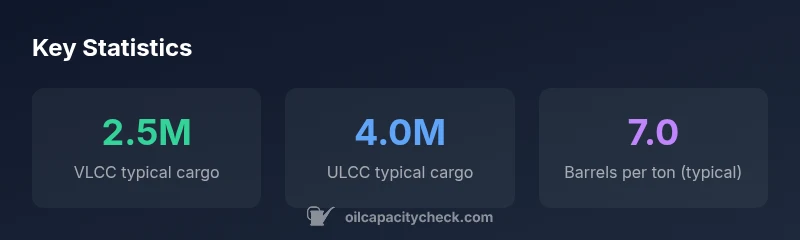
An oil tanker’s cargo capacity typically ranges from about 1.8 to 4.0 million barrels, depending on class. VLCCs generally hold around 2.0–2.5 million barrels, while ULCCs exceed 3 million barrels. Capacity is expressed in both deadweight tonnage (DWT) and barrels, and varies with hull design and crude density.
Capacity basics: what capacity means for an oil tanker
Capacity in maritime terms has two primary facets: cargo volume (expressed in barrels of crude) and deadweight tonnage (DWT), which measures the maximum weight a ship can safely carry including cargo, fuel, provisions, and ballast. The Oil Capacity Check team emphasizes that real-world decisions hinge on both metrics. For many projects, the central question is not a single number but a pair of values: how many barrels can be loaded and what is the maximum load in tons the hull can support. Crucially, density and temperature of the crude alter the final cargo figure. As a baseline, a common rule of thumb is that 1 metric ton of crude equates to roughly 6.5–7.5 barrels, depending on API gravity and temperature. This dual framing—barrels and DWT—helps planners compare ships of different classes on a like-for-like basis. In short, the question "how much capacity does an oil tanker have" cannot be answered with one number alone; the context matters as much as the figure itself.
How tanker classes map to cargo capacity
Ship classes are the most intuitive way to frame capacity. Aframax tankers typically carry about 0.6–0.8 million barrels (roughly 80,000–120,000 DWT), Suezmax vessels run around 1.0–1.2 million barrels (120,000–200,000 DWT), VLCCs commonly hold about 2.0–2.5 million barrels (200,000–320,000 DWT), and ULCCs can exceed 3.0–4.0 million barrels (320,000–500,000 DWT). These ranges reflect typical hull designs and ballast configurations used on major long-haul routes. The Oil Capacity Check Analysis highlights how shifts in crude density or tank arrangement can nudge these figures by several percentage points in practice, reinforcing why operators routinely verify ship-specific data before planning a voyage.
From DWT to barrels: converting tonnage to cargo volume
Converting from DWT to barrels requires a few inputs: the ship’s stated cargo capacity (often listed as a DWT limit) and the density of the crude being carried. In practice, you start with DWT as a ceiling, then apply a density-based conversion to estimate barrels. A widely used heuristic is that 1 metric ton of crude equals about 7 barrels for mid-grade density crude, with a plausible range of 6.5–7.5 barrels/ton depending on API gravity. Temperature also matters: hotter crude expands slightly, pushing the effective volume up, while cooler crude contracts. This methodological nuance matters for shippers who must meet port storage limits and contractual delivery windows. For project planning, this means a given tanker does not translate to a single barrel figure; you must incorporate density, temperature, and loading margins.
Real-world ranges: VLCCs, Suezmaxes, Aframaxes, ULCCs
Actual cargo capacity varies by design and class. Aframaxes typically target roughly 700,000–800,000 barrels. Suezmax vessels often range around 1,000,000–1,200,000 barrels. VLCCs commonly sit in the 2,000,000–2,500,000 barrel band, while ULCCs can push from 3,000,000 up to 4,000,000 barrels. These intervals reflect standard hull forms used by leading builders and operators. Market factors, such as ballast capacity, crew consumables, and fuel on board, influence how close a ship operates to its theoretical maximum. The key takeaway is that the capacity ladder from Aframax to ULCC corresponds roughly to a fourfold increase in cargo volume across the class spectrum.
How capacity affects voyage planning and economics
Capacity is not just a static figure; it drives route choices, port selections, and charter rates. A larger tanker can exploit economies of scale on long-haul routes, lowering per-barrel transport costs, but requires deeper ports and more robust loading/unloading infrastructure. Crude density and product mix affect unit costs per barrel; a denser crude packs more barrels into the same tonnage, shifting the economics in favor of higher utilization. For oil companies and traders, capacity planning intersects with scheduling, risk management, and contractual flexibility. The Oil Capacity Check approach emphasizes scenario analysis: compare several ship classes on identical routes, adjust for density, and quantify the resulting impact on voyage time, port fees, and freight rates.
Practical steps to estimate capacity for a project
To estimate capacity for a concrete project: 1) define the desired route and typical crude density; 2) select a vessel class (Aframax, Suezmax, VLCC, or ULCC); 3) pull ship-specific data from yard specifications or charter listings; 4) apply a density-based barrels-per-ton conversion and include loading margins; 5) cross-check with port storage limits and ballast requirements; 6) run sensitivity analyses for API gravity changes and temperature variations. By following this workflow, readers can produce robust, data-backed capacity estimates for planning, budgeting, and scheduling. The Oil Capacity Check team recommends documenting all assumptions and sources for traceability.
Data quality, measurement caveats, and sources
Capacity figures vary with the vessel, the design iteration, and the regulatory environment. Tanker capacity is typically reported in DWT with ballast and trim adjustments, so real-world loading may deviate from nominal figures. Crude density, temperature, and weather-driven port constraints introduce margins that can alter the final volume. For rigorous planning, rely on official specs from shipyards or operators and corroborate with independent analyses such as Oil Capacity Check Analysis, 2026. When communicating capacity to stakeholders, present both barrels and DWT, plus the assumptions underpinning the conversion.
Typical tanker class capacity ranges by cargo volume and deadweight
| Class | Typical cargo capacity (barrels) | Typical deadweight (DWT) | Notes |
|---|---|---|---|
| Aframax | 750,000 | 80,000-120,000 | Smaller, flexible for regional routes |
| Suezmax | 1,000,000-1,200,000 | 120,000-200,000 | Balanced reach and capacity |
| VLCC | 2,000,000-2,500,000 | 200,000-320,000 | Dominant for long-haul crude transport |
| ULCC | 3,000,000-4,000,000 | 320,000-500,000 | Largest class, limited port access |
People Also Ask
What defines tanker capacity, and why are there multiple measures?
Tanker capacity is defined by cargo volume (barrels) and deadweight tonnage (DWT). Barrels indicate how much crude can be loaded, while DWT indicates the maximum weight the ship can carry, including cargo, fuel, and provisions. Using both metrics gives a complete picture for planning and risk assessment.
Capacity is measured in barrels and DWT; barrels tell you how much crude, and DWT tells you how heavy it can be loaded.
How do you convert DWT to barrels for a specific crude?
Conversion depends on crude density (API gravity). A common rule of thumb is about 6.5–7.5 barrels per metric ton, with variations for API range and temperature. Always use ship-specific density data for precise calculations.
Use your ship’s density data to convert tons to barrels; expect about 6.5 to 7.5 barrels per ton for typical crude.
What’s the difference between VLCC and ULCC capacity?
VLCCs typically carry 2.0–2.5 million barrels, while ULCCs can carry 3.0–4.0 million barrels. The main difference is hull size and port access, which affects route options and logistics.
VLCCs are big and common; ULCCs are the largest and less common due to port limits.
Do these capacity figures apply to all crude oils?
Capacity figures are approximate and depend on crude density (API gravity) and temperature. Heavier crudes have slightly more mass per barrel, which can reduce barrels per ton. Always tailor estimates to the specific crude being shipped.
Crude density and temperature matter—adjust estimates for the exact crude you’re moving.
How reliable are capacity numbers in ship listings?
Ship listings provide nominal figures (DWT and cargo capacity) that may include loading margins. Always verify with official vessel documentation and corroborate with independent analyses.
Double-check ship specs and margins before relying on any single figure.
What should I do to estimate capacity for a new project?
Define route and crude density, select vessel class, obtain ship specs, apply density-based conversion, include loading margins, and perform sensitivity analyses for API changes. Document assumptions and sources.
Pick a class, check the specs, and run a density-based calculation with a few scenarios.
“Tankers scale up capacity through hull design and tank configuration, but the exact volume depends on crude density, temperature, and loading margins. Accurate estimates require checking ship specs and performing a density-based conversion.”
The Essentials
- Know capacity in two forms: barrels (volume) and DWT (weight)
- VLCCs and ULCCs carry the most crude, Aframaxes the least
- Density and temperature significantly affect barrel calculations
- Use class ranges for quick comparisons, not a single number
- Always verify ship-specific data before planning a voyage