What Oil Filter Size Means for Your Car
Discover how to determine the correct oil filter size for your vehicle, why it matters, and practical steps to identify, measure, and replace filters safely.


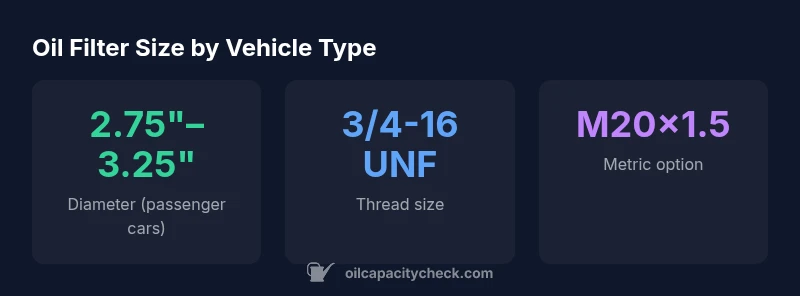
Most passenger cars use standard oil filters with a diameter around 2.75 to 3.25 inches and a threaded connection that matches common sizes like 3/4-16 UNF or M20x1.5. The exact size depends on engine design and filter type. Always verify the correct size by checking your owner’s manual or OEM part number before purchase.
What the oil filter size actually controls
The size of an oil filter is more than a label on the carton. It determines the filter’s outer diameter, the gasket seal, and the thread pitch that screws into the engine block. These dimensions matter because they affect oil flow, sealing, and how easily the filter can be tightened to the correct torque. Using a filter that is too large or too small can cause leaks, improper sealing, or restricted oil flow, potentially harming engine lubrication over time. In the market you’ll encounter two main sizing families: imperial sizes such as 3/4-16 UNF and metric sizes such as M20x1.5 or M22x1.5. However, many engines rely on filters whose exact size is specified by the manufacturer. The safest approach is to verify the exact size from official sources or via the OEM part number or service manual. When replacing an oil filter, aim for a size that matches the original equipment specification and the gasket diameter that mates with your engine mount and oil pan.
How to identify the right filter size for your car
Start with the owner’s manual or the vehicle’s service guide; it will list the recommended oil filter part number for your engine. If you can access the OEM part catalog online, search by your car’s make, model, and year. The simplest cross-check is to photograph or write down the part number on the filter you remove and look up that exact number. If you already have a replacement filter on hand, measure its outside diameter and inspect the threads to confirm compatibility. A common pitfall is assuming any filter with a similar look will fit; a mismatched thread size can cause oil leaks or cross-threading, which can damage the filter seat. If the OEM number isn’t easily available, consult reputable cross-reference charts from trusted brands or a qualified mechanic.
Common size ranges and what they mean for maintenance
For most passenger cars, the oil filter diameter falls in the 2.75–3.25 inch range. Light trucks and many SUVs often use slightly larger filters in the 3.0–3.75 inch band. Thread size tends to be either 3/4-16 UNF or metric equivalents like M20x1.5 or M22x1.5, depending on the engine design. These ranges guide maintenance planning, but always confirm with the exact VIN-specific specification. Remember, even within the same vehicle class, variations can exist across model years or engine options, so never rely solely on visual similarity when choosing a filter.
How to measure an oil filter and verify thread size
If you’re replacing an existing filter and cannot access the OEM number, measure the filter’s outer diameter and inspect the threaded center hole. Use a ruler or calipers to determine the diameter of the sealing surface and the pitch or number of threads per inch. Compare your measurements to known standards (for example, 3/4-16 UNF or M20x1.5). Always check for the correct gasket size; a mismatch can lead to leaks or improper sealing. When in doubt, bring the old filter to an auto parts store and ask for a direct replacement that matches the measured dimensions.
OEM vs aftermarket: choosing the correct size
OEM filters are designed to match your engine’s exact requirements, offering reliable fit and sealing. Aftermarket options can be quality-compatible but vary by manufacturer; some are direct equivalents, while others approximate the size. Always verify the OEM part number against the replacement and double-check the gasket diameter and thread size on the packaging. If you’re unsure, a quick cross-reference with reputable catalogs or a trusted mechanic can prevent a mismatched fit.
Practical steps when shopping for oil filters
- Gather your VIN and engine variant information.
- Check the owner’s manual or service guide for the recommended filter size and part number.
- Look up the OEM part number in official catalogs to confirm the exact size.
- If buying aftermarket, compare packaging details for diameter, thread size, and gasket type.
- Record and store the confirmed size for future maintenance; this speeds up future oil changes and reduces mis-purchases.
Common mistakes to avoid
- Selecting a filter based on looks rather than measurements.
- Ignoring thread size or gasket diameter, which can cause leaks.
- Replacing with a different filter size without cross-referencing the OEM specification.
- Assuming newer models always use the same filter as older variants.
- Skipping the VIN-based lookup when service information is unclear.
Common oil filter size ranges by vehicle type
| Vehicle Type | Common Filter Size (inches) | Typical Thread Size | Notes |
|---|---|---|---|
| Compact car | 2.75–3.05 | 3/4-16 UNF | Common entry-level fit |
| SUV | 3.0–3.5 | M20x1.5 | Cross-model compatibility varies |
| Truck/large SUV | 3.25–3.75 | M22x1.5 | Larger engines, heavier filters |
People Also Ask
How do I know which oil filter size fits my car?
Check the owner’s manual or the OEM part catalog for the exact size. If you can’t find the number, measure the current filter’s diameter and thread. Use reputable cross-reference resources or consult a mechanic to confirm compatibility.
Check your owner’s manual or the OEM part number to find the exact size. If in doubt, measure the current filter and cross-check with a trusted catalog.
Can I use a different size oil filter if it looks similar?
No. Size discrepancies can cause leaks or oil starvation. Always match the exact size, gasket diameter, and thread pitch listed for your engine.
No—don’t rely on looks. Use the exact size and thread to avoid leaks or engine problems.
What if my engine has multiple size options by variant?
Check the exact engine variant using your VIN and consult the OEM catalog. Choose the filter that matches the specific variant’s size and gasket requirements.
Verify the VIN and engine variant, then select the size that matches the official spec.
Are there universal oil filters?
There are universal or broad-fit options for some applications, but most cars require a specific size. Always verify compatibility with size charts or OEM data.
There are some universal options, but most vehicles need a specific size confirmed by charts or OEM data.
How often should I replace the oil filter?
Replace the oil filter with every oil change or as recommended by the manufacturer. Use the owner’s manual to align with your oil change schedule.
Replace the filter with each oil change, per your manual.
“Choosing the correct oil filter size is essential for proper oil flow and engine protection. A precise fit minimizes leaks and ensures reliable maintenance intervals.”
The Essentials
- Always verify the exact filter size using your owner's manual.
- Know the two main sizing families: 3/4-16 UNF and M20x1.5.
- Check OEM part numbers to ensure compatibility.
- Measure the diameter and thread pitch if replacing with aftermarket.
- Keep a record of your verified size for future maintenance.