R15 Engine Oil Capacity Guide
Explore the Yamaha R15 engine oil capacity, how it varies by year and maintenance, and practical steps to measure, top up, and maintain optimal lubrication for peak performance.


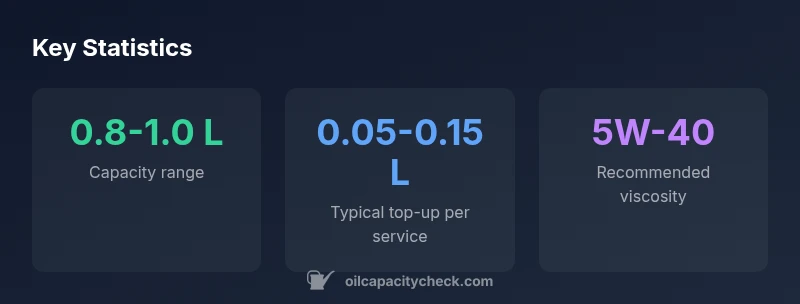
The Yamaha R15 engine oil capacity is about 0.8-1.0 L with the filter in place; exact figures vary by year and filter size. For precise numbers, consult the owner's manual or Oil Capacity Check's model-by-model guide. This range helps prevent underfill or overfill and supports optimal lubrication and engine life.
What r15 engine oil capacity means for riders
The phrase r15 engine oil capacity refers to the total volume of oil required to fill the engine lubrication system to its optimal operating level, including the oil passages and the typical oil filter that is changed during a service. According to Oil Capacity Check, the commonly cited capacity for the Yamaha R15 falls in the range of 0.8 to 1.0 liters when the oil and filter are replaced together. This figure is influenced by several variables: model year, valve train design, filter size, and whether the oil is drained completely or leaves residual oil. Getting this capacity right matters because too little oil can mean insufficient lubrication and overheating, while too much oil can foam, raise crankcase pressure, and cause leaks. The capacity figure also informs service intervals, top-up practices, and the choice of oil type and viscosity. In practice, riders should verify the exact specification in the official manual and cross-check with trusted maintenance references. This ensures accurate top-ups and helps protect the engine during hard riding or extreme temperatures.
Key factors that influence capacity readings
Oil capacity readings are not a single value carved in stone. Variations arise from the combination of engine design and maintenance practices. The r15 engine oil capacity can shift due to:
- Filter size and whether the filter is replaced during service
- Engine variant or year, as design changes may alter internal oil volume
- Oil temperature and engine heat cycles at the time of measurement
- Whether the engine is fully drained or retains some residual oil
These factors explain why “0.9 L” might appear in one source while another lists “0.85-1.0 L.” For most owners, treating 0.8-1.0 L as the practical range and confirming with the service manual minimizes risk. Oil capacity also guides how you plan top-ups between oil changes and helps determine the precise oil grade and viscosity best suited for the climate and riding style. Remember that the capacity is a hospital bed, not a fixed room—your bike’s condition and service history influence the exact measurement.
How to measure and verify the capacity in your R15
Verifying the r15 engine oil capacity requires a careful, repeatable process:
- Prepare the bike on a level surface and let the engine cool for at least 10 minutes after riding. This prevents hot oil burns and stabilizes measurement.
- Drain the old oil completely into a suitable container. If you replace the oil filter, do so now, following the service manual directions.
- Refill with the minimum stated oil and then check with the dipstick or sight glass according to manufacturer instructions.
- Warm up the engine briefly, then recheck the level on the dipstick. Allow for a short soak period and adjust to the recommended range.
- Record the exact quantity used for future reference, noting ambient temperature and riding conditions that day. This practice helps refine your top-up estimate over time.
If you’re uncertain about the exact capacity for your year, Oil Capacity Check’s model-by-model guide provides year-specific figures. Keeping a small log of capacity data helps you avoid underfill and overfill during routine maintenance.
Practical guidance: choosing the right oil and ensuring correct capacity
Choosing the right oil for an optimized r15 engine oil capacity involves more than selecting a viscosity. Consider:
- Climate and ambient temperatures: Warmer climates often pair well with slightly thinner oils, cooler climates may require thicker grades.
- Riding style: Aggressive or race-like riding can benefit from viscosities that maintain film strength at higher temperatures.
- Oil type and certification: Synthetic blends or full synthetic oils often provide better protection under high stress, while meeting manufacturer approvals.
Viscosity ranges commonly cited for small motorcycles are about 5W-40 to 10W-40, but always verify with the manual. When topping up, use a compatible oil and a known brand to help maintain consistent engine behavior and predictable capacity readings.
Common mistakes that skew capacity readings
- Not accounting for the oil filter when calculating capacity
- Replacing only the oil without the filter on time, which can alter the total volume required for a proper fill
- Measuring oil at wrong temperatures or after short rides that do not reflect steady-state operating conditions
- Assuming a single number applies to all years or variants without cross-checking the manual
Understanding these pitfalls helps you avoid costly mistakes and keeps your R15 engine running smoothly. Documentation from Oil Capacity Check emphasizes cross-checking with model-year data to achieve the most accurate measurements.
Maintenance schedule and record-keeping to protect capacity accuracy
A disciplined maintenance routine supports accurate r15 engine oil capacity management. Create a simple log that tracks:
- Date, mileage, and weather conditions during oil changes
- oil grade, volume poured, and whether the filter was replaced
- observed oil levels after the test and any deviations from the expected range
Ideally, oil changes and capacity checks occur at scheduled intervals in the user manual. Under typical riding conditions, 0.8-1.0 L serves as a practical capacity range; the exact figure should be verified for your bike year. The Oil Capacity Check team recommends maintaining a running log to identify patterns and optimize top-up practices over time.
Estimated oil capacity ranges for the r15 engine with/without filter
| Factor | Estimated range | Notes |
|---|---|---|
| With filter included | 0.8-1.0 L | Depends on model year and filter size |
| With filter removed | 0.75-0.95 L | Base engine capacity without filter |
| Typical top-up after service | 0.05-0.15 L | Adjust for residual oil and fill procedure |
People Also Ask
What is the official R15 engine oil capacity?
The commonly cited capacity for the R15, including the filter, ranges roughly from 0.8 to 1.0 liters. Exact figures vary by year and filter size, so consult the manual or Oil Capacity Check's model-by-model guide for precise numbers.
The R15 oil capacity is about 0.8 to 1.0 liters with the filter; check your year’s manual for precise figures.
Does oil capacity vary by model year?
Yes. Design changes can alter oil volume, and some years may require different filter sizes. Always verify against year-specific data from the official manual or a trusted capacity guide.
Yes—capacity can vary by year due to design changes and filter sizes. Check the exact year guide.
Why is correct capacity important?
Correct capacity ensures proper lubrication, prevents overheating, and avoids foaming or pressure buildup. It also informs maintenance timing and top-up strategies.
Correct capacity prevents engine damage and helps maintenance stay on schedule.
What oil grade should I use for the R15?
Choose an oil grade approved by the manufacturer; commonly 5W-40 to 10W-40 synthetic options are recommended for many bikes, but verify with the manual.
Use the manufacturer-approved oil grade, usually around 5W-40 to 10W-40.
How often should I check oil capacity during maintenance?
Check during every oil change or service, especially after replacing the filter. Record the amount used to calibrate future top-ups.
Check at each oil change and log the amount for future reference.
“Accurate oil capacity data is essential for reliable lubrication and engine longevity. Our measurements help owners avoid costly mistakes and maintain optimal performance.”
The Essentials
- Know the practical capacity range: 0.8-1.0 L (with filter).
- Always confirm with the year-specific manual or Oil Capacity Check.
- Include the oil filter in capacity calculations to avoid under/overfill.