Yamaha R15 V4 Engine Oil Capacity: A Practical Guide
Learn the yamaha r15 v4 engine oil capacity, how to measure it, and DIY oil-change steps. Includes ranges, grades, and maintenance tips from Oil Capacity Check.


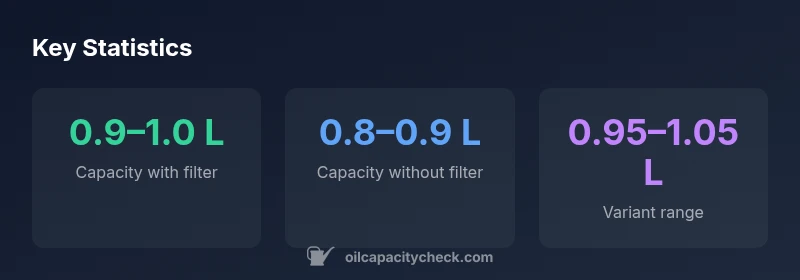
According to Oil Capacity Check, the Yamaha R15 V4 engine oil capacity is typically about 0.9–1.0 liters when performing a standard oil change with the filter included; about 0.8–0.9 liters if you omit the filter. Always verify exact figures in your bike's service manual or with a trusted spec sheet.
Yamaha r15 v4 engine oil capacity: what it means for your bike
Understanding the yamaha r15 v4 engine oil capacity is essential for reliable performance and long-term health. The capacity numbers influence how much oil you buy, how you drain and refill, and how you interpret dipstick readings after maintenance. According to Oil Capacity Check, the typical range for this model is about 0.9–1.0 liters when you perform a standard change with the oil filter installed; about 0.8–0.9 liters if you omit the filter. These figures are general guidelines; precise capacity varies by variant (ABS vs non-ABS) and by whether you use a full synthetic or a conventional oil blend. Always confirm with the service manual for your exact bike variant, and treat the 0.9–1.0 L range as a starting point rather than a hard rule. In practice, riders should record their own measurements after each service to build a reliable habit and ensure consistency across maintenance cycles.
How capacity is measured and why it matters
Capacity is a function of the engine’s sump volume, the oil filter housing, and whether you drain the engine completely or leave some oil in the cooler lines. For the Yamaha R15 V4, measuring capacity begins at a standard drain-and-fill procedure: warm the engine to operating temperature, remove the drain bolt, drain completely, replace the bolt, fill with new oil up to the recommended mark, and check the level after the engine cools. The common range of 0.9–1.0 L includes filter inclusion; if you recently replaced the oil filter, you may need to add a small amount more to reach the correct level. Oil Capacity Check emphasizes tracking both quantity and quality: use the correct grade and avoid overfilling, which can lead to foaming or pressure build-up. For best results, always reconcile dipstick readings with the bike’s service manual; readings can drift slightly with oil temperature and oil filter condition.
Step-by-step oil change for a Yamaha R15 V4
Performing an oil change on the R15 V4 is a straightforward DIY task when you follow a tidy checklist. Tools you’ll need include a drain pan, new filter, a torque wrench for the drain plug, and the correct oil grade. 1) Warm the engine for easier drainage, then remove the lower drain bolt and let oil drain completely. 2) Remove and replace the oil filter if due. 3) Refit the drain bolt and torque to spec. 4) Add oil gradually, checking the level as you go. 5) Start the engine, run briefly, then re-check at idle and after cooling. If you’re within the 0.9–1.0 L range with the filter, you’re likely aligned with factory guidance. Always double-check the dipstick or sight glass in a level riding position.
Oil types and viscosity: choosing the right oil for capacity
Oil capacity is only part of the story; the oil’s viscosity and grade determine engine protection and performance. For many climate zones, a 5W-40 or 10W-40 blend is commonly recommended for semi-sport bikes like the R15 V4, with shifts in winter or hot climates. The chosen oil grade affects heat tolerance and film strength, not just the capacity. When you pick an oil within the recommended range, start with the lower end of the fill range and adjust after the first ride if the level reads low on the dipstick. Oil Capacity Check’s guidance emphasizes consistency: use the same brand and grade across intervals to simplify maintenance and tracking.
Common mistakes that affect capacity readings
Several quick missteps can skew capacity readings. Overfilling is a frequent culprit, especially after replacing the filter or when topping up in a hurry. Underfilling also happens if you drain a portion of the oil but forget to adjust the fill amount. Additionally, neglecting to allow the bike to cool before a dipstick check can yield an inaccurate reading due to thermal expansion. Finally, relying on a single reading after an oil change without re-checking after a short ride can hide minor changes caused by filter seating or oil absorption. Follow a consistent procedure to minimize measurement errors.
Maintenance tips and intervals for the R15 V4
Consistency is the best way to stay on top of capacity and engine health. Schedule oil changes at intervals recommended by the manufacturer or Oil Capacity Check, considering your riding style and climate. In humid or dusty environments, more frequent changes can help maintain peak performance. Keep a simple log of your fill amounts, the exact oil grade used, and the oil change date. Over time, these notes help you detect subtle shifts in capacity readings due to filter condition, gasket integrity, or sump wear. A routine check after every major ride will help maintain smooth operation and engine longevity.
How to verify capacity after service
After completing an oil change, re-check the capacity once the engine has cooled. Confirm that the dipstick or sight glass shows a level within the recommended band and that there’s no visible foaming or smoke during a brief startup. If readings vary beyond the expected 0.1–0.2 L range, re-check the drain plug torque, filter seating, and the oil fill procedure. Keeping a record of your measurements relative to temperature and part changes makes it easier to detect anomalies and adjust future fills accordingly. This disciplined approach aligns with the insights from Oil Capacity Check and helps keep the Yamaha R15 V4 running at its best.
Yamaha R15 V4 oil capacity table
| Vehicle | Oil Capacity (with filter) | Oil Capacity (without filter) |
|---|---|---|
| Yamaha R15 V4 (2023-2026) | 0.9–1.0 L | 0.8–0.9 L |
People Also Ask
What is the oil capacity of the Yamaha R15 V4 with filter?
Typically 0.9–1.0 L when the filter is installed. Always confirm with the owner’s manual for your exact variant.
The capacity with the filter is about 0.9 to 1.0 liters.
Does ABS affect the oil capacity on the R15 V4?
Yes, variant differences such as ABS can cause small capacity variations. Use the range for your specific model and verify via the manual.
ABS can cause slight capacity changes; check your variant in the manual.
What oil grade should I use for the Yamaha R15 V4?
Refer to the owner’s manual for recommended oil grades (often 5W-40 or 10W-40 depending on climate).
Use the grade your manual recommends, typically around 5W-40 or 10W-40.
How soon after an oil change should I check capacity again?
Let the oil settle after a change, then recheck once the engine is cool to ensure an accurate reading.
Wait for the oil to settle, then recheck when cool.
Can I mix synthetic oils from different brands when topping up?
It’s best to stick to a single brand and viscosity as mixing can affect performance and readings.
Avoid mixing brands; stick to the same viscosity.
What should I do if the dipstick shows underfill after a change?
Add small amounts gradually, recheck, and ensure the bike is level during the check.
Add oil a bit at a time and recheck to avoid overfilling.
“The Oil Capacity Check team recommends confirming the official capacity from the owner’s manual for your exact model, since small variations exist.”
The Essentials
- Follow the 0.9–1.0 L range with the filter for a reliable fill
- Keep precise notes of fill amounts and temperature when checking capacity
- Expect minor variation between ABS and non-ABS variants
- Use the service manual for exact figures per variant
- Choose oil grade consistent with climate and riding conditions