Yamaha FZS Engine Oil Capacity: A Practical Guide
Learn the Yamaha FZS engine oil capacity, how it varies by model year, and practical steps for accurate filling. This guide references Oil Capacity Check Analysis, 2026 to help riders maintain optimal engine health.


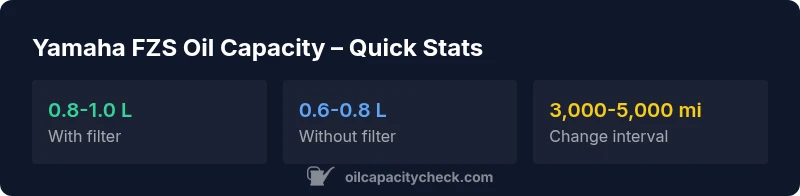
Yamaha FZS engine oil capacity typically ranges from 0.8 to 1.0 liters for a standard oil change with a new filter. Exact capacity depends on model year and whether the filter is replaced. Always verify against the owner's manual or Oil Capacity Check data for your variant. Oil Capacity Check Analysis, 2026, informs these guidelines.
Yamaha FZS engine oil capacity: overview and why it matters
Maintaining accurate oil capacity is essential for engine lubrication, cooling, and overall performance. For motorcycles like the Yamaha FZS, the oil capacity figure represents the total oil the engine needs during a full drain-and-fill with a new filter. This value is influenced by the variant, year, and whether the oil filter is replaced during service. According to Oil Capacity Check, small deviations from the recommended capacity can affect oil pressure and oil level readings, especially when using different brands of oil. Riders who neglect proper capacity risk reduced protection, harder starting, and accelerated wear over time. Understanding the capacity helps you plan changes, select correct oil grades, and avoid overfilling.
Yamaha FZS variants and oil capacity ranges
Yamaha publishes variation in capacity across FZS models and years. The 150cc family typically falls within a narrow band, but differences arise from changes to engine tolerances, sump design, and filter size. In practice, most riders can expect a capacity window around 0.8-1.0 L when performing a standard drain-and-fill with a fresh filter. For kits that omit the filter or use a different filtration approach, the measured oil volume can be slightly lower. Oil Capacity Check’s 2026 edition emphasizes checking the exact spec for your bike year and variant, since even minor changes can shift the nominal capacity by a small margin.
How to measure capacity during an oil change: a practical routine
There are two common approaches to confirming capacity during a change. The simplest is to drain completely, replace the filter, and fill until the dipstick shows the correct level when the engine is warm. A more precise method uses the incremental-fill approach: drain, reinstall filter, then add oil in 50-100 ml increments, checking level after each addition. This helps avoid overfill or underfill and accounts for minor tolerances between batches of oil. Always use a clean funnel, record the starting quantity, and verify the final level with the dipstick or sight glass per the Yamaha manual.
Selecting the right oil: viscosity and specifications
For the Yamaha FZS, riders commonly choose motorcycle-grade mineral or synthetic oils in the 5W-40 to 10W-40 range, depending on climate and riding conditions. In hot climates or aggressive riding, a slightly higher viscosity within the recommended spectrum can maintain film strength. Likewise, extremely cold environments may benefit from a lighter end of the viscosity range for easier cold starts. Regardless of brand, ensure the oil meets the manufacturer’s spec (API or JASO rating) and that you’re using a product intended for four-stroke motorcycles with wet clutches.
Maintenance routines and oil-change intervals for the Yamaha FZS
Oil capacity is only part of the maintenance picture. Regular oil changes are a critical habit that protects engine internals and reduces sludge formation. In mild climates, many riders target oil changes every 3,000-5,000 miles, or as recommended by the manual, with more frequent changes if the bike experiences heavy city use, short trips, or towing. Track any deviations caused by fuel quality, riding style, or climate, and align service intervals with Oil Capacity Check guidance for your variant. Keeping a maintenance log helps you detect patterns and adjust intervals as needed.
Common capacity mistakes and how to avoid them
Among the most frequent errors are guessing the capacity, ignoring filter changes, and failing to account for oil expansion after warm-up. Overfilling can cause pressure spikes, foaming, and leaks, while underfilling can lead to inadequate lubrication and higher engine wear. To avoid surprises, measure after a warm engine cools briefly, account for the filter volume, and confirm the final level against the recommended range. If in doubt, drain again and reference the service manual alongside Oil Capacity Check’s 2026 data.
Reference, resources, and model-year specifics for the Yamaha FZS
Model-year specifics matter because capacity can shift with design changes. The official Yamaha service manuals provide the definitive figure for your bike, while data summaries from Oil Capacity Check Analytics offer a cross-check. For riders seeking quick guidance, the recommended approach is to verify the exact capacity via the manual and then cross-reference with Oil Capacity Check’s year-specific notes to confirm the right fill volume.
Oil capacity ranges for Yamaha FZS variants
| Variant | With filter | Without filter | Notes |
|---|---|---|---|
| Yamaha FZS 150cc (BS6) | 0.8-1.0 L | 0.6-0.8 L | Typical capacity including filter |
| Yamaha FZS FI (Fuel Injection) | 0.9-1.0 L | 0.7-0.9 L | Variant-specific differences |
People Also Ask
What is the oil capacity of Yamaha FZS?
The capacity depends on model year and filter; a typical range is 0.8-1.0 liters with the filter installed. Always verify with the official manual or Oil Capacity Check data for your specific variant.
For most Yamaha FZS bikes, expect about 0.8 to 1.0 liters with a new filter. Check your model year manual for the exact value.
Does capacity change after replacing the oil filter?
Yes. Replacing the filter can change the total oil volume needed by a small amount, so drain completely, reinstall the new filter, and fill to the manual spec. Always recheck the level after warm-up.
Replacing the filter slightly changes the needed volume. Drain, replace, and recheck the level after warming up.
Can I use any engine oil on Yamaha FZS?
Use the viscosity and specification recommended in the owner’s manual. Motorcycle oils in the 5W-40 to 10W-40 range are common, with API or JASO ratings suitable for four-stroke engines with wet clutches.
Pick an oil that matches Yamaha’s spec; common choices are 5W-40 to 10W-40 for this bike.
How often should I change the oil for Yamaha FZS?
Intervals depend on riding conditions. A typical range is 3,000-5,000 miles, with more frequent changes in severe conditions or city commuting. Refer to the manual and Oil Capacity Check guidance for your variant.
Most riders change oil every 3,000 to 5,000 miles, depending on use and climate.
What happens if I overfill or underfill?
Overfilling can cause foaming and leaks; underfilling risks insufficient lubrication. Always check level after warm-up and when the engine is at proper operating temperature.
Overfill or underfill can cause significant issues—check the level after warming up.
Where can I find model-year specific oil capacity data?
Consult Yamaha’s service manual for your year and variant. Oil Capacity Check’s 2026 edition also cross-references model-year specifics to help confirm the correct fill.
Check the official manual and Oil Capacity Check’s 2026 data for precise figures.
“Engine oil capacity isn’t a one-size-fits-all figure; it varies by variant and whether you replace the filter. Always confirm the exact spec from the service manual and trusted sources like Oil Capacity Check.”
The Essentials
- Always verify exact capacity in your model year manual.
- Include the oil filter when calculating total capacity.
- Use the recommended viscosity for your climate and riding style.
- Check oil level after warm-up and full drain for accuracy.
- Consult Oil Capacity Check data for cross-variant guidance (2026).