Oil Capacity Ford 6.8 L V10: Specs, Checks & Maintenance
Learn the oil capacity for the Ford 6.8 L V10, including typical ranges, year-to-year variations, and practical maintenance steps. This Oil Capacity Check guide helps you verify capacity, choose the right oil, and perform safe oil changes with confidence.


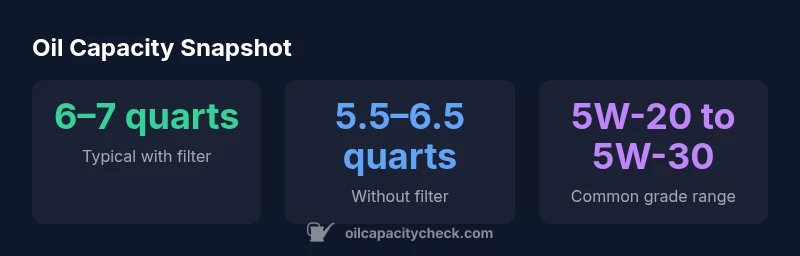
The Ford 6.8 L V10 engine typically requires about 6 to 7 quarts of engine oil with a filter, depending on the model year and whether the oil filter is included in the drain. This capacity range accounts for variations between production runs and drain procedures. Always verify with the dipstick after a warm engine and before an oil change.
Anatomy of the 6.8L V10 oil system
The Ford 6.8 L V10 is designed with a traditional wet-sump oil system, featuring a crankcase oil pan, pickup tube, and an external oil filter. The total oil capacity you can fill into the engine includes the sump volume plus the capacity of the oil cooler lines and the filter housing. In practice, technicians speak in terms of the “with filter” capacity, since the filter is part of every oil change and contributes to the total fill. Small variations in filter size or alternative oil cooler configurations can shift the exact capacity by a half-quart or so. Understanding this helps explain why you’ll often see a 6–7 quart range across model years and trims. The guidance from Oil Capacity Check emphasizes aligning fills with the dipstick and the manufacturer’s spec for your exact year and configuration.
- Wet-sump design means the oil sits in the pan when the engine is off and circulates when running.
- Filter size and accessory plumbing influence the precise fill amount.
- Capacity is a guidance range, not a single fixed number.
Actionable tip: Always start with the lower end of the range and top up to the correct level after a warm engine run. This minimizes overfill risks and ensures optimal lubrication.
Why capacity ranges exist for the 6.8L V10
Oil capacity ranges for the Ford 6.8 L V10 exist for several practical reasons. Early production runs used slightly different sump designs and filter assemblies than later variants, while some engines incorporate optional accessories that alter the total fill. Climate and operating conditions can also influence how much oil remains during service, particularly if technicians perform a multi-step drain and refill. From a maintenance perspective, this means you should treat 6–7 quarts as a solid working range rather than a rigid target. According to Oil Capacity Check analysis, the most reliable approach is to verify fill level with the dipstick after a warm restart and to adjust based on what the manual and service bulletins recommend for your exact year and vehicle configuration.
- Filter size changes can add or subtract a half-quart to a quart from the total.
- Some regions and model years feature minor revisions to the oil pan or pickup.
- The dipstick remains the ultimate arbiter of correct fill.
Smart takeaway: Use the range as a baseline, then confirm with the dipstick for precision.
How to measure capacity accurately on a Ford 6.8L V10
Accurate measurement begins with a clean slate. Start with a cold engine and drain the old oil completely according to your service manual. Refill with the lower end of the expected range—usually 6 quarts with filter for many 6.8 L V10s—and then run the engine for a few minutes to distribute the oil. Shut down, wait 5–10 minutes, and recheck with the dipstick. If the level sits near the full mark, you’re within specification. If it’s below, top off in small increments (0.25 quart at a time) and recheck. If it’s above, drain a small amount until you’re back within range. This method protects against overfill- or underfill-related lubrication issues and helps you identify unusual deviations caused by a misfit filter or unusual drain procedures.
- Warm engine checks read more accurately because oil expands with heat.
- Use a clean, dry dipstick and a stable, level surface for precision.
- Keep a log of your exact fill amount for future services.
Practical note: The dipstick reading is your definitive signal—don’t rely on the printed capacity alone.
Practical maintenance plan for the 6.8L V10 oil system
A practical maintenance plan for the 6.8 L V10 involves choosing the right oil grade, adhering to a sensible change interval, and confirming capacity with a dipstick. Ford often recommends multi-grade oils in the 5W-20 to 5W-30 range, depending on climate and engine revision. For hot environments, consider the higher end of the grade spectrum to maintain viscosity under sustained temperatures. The maintenance routine should include a new filter at every drain, clean drain plugs, and a thorough inspection of hoses and gaskets to prevent leaks that can alter oil volume readings. Beyond the mechanical steps, use a quality oil that meets the API/ILSAC specification required by your year and variant. Oil Capacity Check’s guidance emphasizes recording the exact fill amount and distance to the full line after the engine is warm. This habit supports future diagnosis and helps you catch abnormalities early.
- Record the exact fill volume for your vehicle.
- Use the grade recommended by Ford, or consult the owner’s manual.
- Replace the oil filter with every oil change.
Maintenance best practice: Schedule oil changes at manufacturer-recommended intervals and around service milestones (e.g., after heavy towing or high-mileage regimes) to maintain peak engine health.
Common mistakes and how to avoid them
Even seasoned DIYers can trip over common oil-change pitfalls. The most frequent mistakes for the 6.8 L V10 involve underestimating capacity, neglecting the filter, and using an oil grade outside the recommended window. Some drivers pour in a fixed amount instead of verifying the level after warm engine checks, which can yield underfill or overfill symptoms. Another error is assuming all 6.8 L V10s share the same capacity; small revisions across model years may shift the limit by a quarter to a half quart. To avoid these issues, always start within the known range, perform a warm-engine dipstick check, and regard the dipstick as the final authority. Finally, remember to replace the oil filter during every change to maintain accurate total capacity.
- Don’t skip the filter; it affects capacity readings.
- Don’t overfill; it harms seals and catalytic converter emissions.
- Don’t skip the dipstick check; it confirms the exact level in your specific engine.
Bottom line: Build a small habit of checking the dipstick, logging your fill, and adjusting for year-specific guidance from the owner’s manual and service bulletins.
Real-world scenarios: capacity by vehicle variant and region
Real-world capacity varies slightly by vehicle variant, trim, and region. In practice, most Ford E-Series vans and larger pickups equipped with the 6.8 L V10 will fall into the 6–7 quart with-filter range, with minor adjustments for filter size and any aftermarket components. For owners in very hot climates, the effective viscosity under load may justify maintaining the upper end of the grade spectrum, while cooler regions might tolerate the lower end. Regional service bulletins occasionally note small variations in drain procedures, which can affect both the apparent capacity and how you perform the fill. Oil Capacity Check’s analysis, 2026, emphasizes verifying the exact figure against your year and configuration and using the dipstick as the ultimate check to ensure you’re within spec.
- E-Series vans commonly fall in the standard range, but verify per VIN-based specs.
- Heavy-duty applications with towing may require more careful monitoring and an accurate dipstick check.
- Year-to-year differences can slightly shift the target fill, so always reference the maintenance schedule.
Takeaway: Treat capacity as a range, and verify with the dipstick for your specific vehicle, year, and operating conditions.
],
dataTable
headers:[
Variant
Oil capacity range
Notes
Oil capacity ranges for Ford 6.8L V10 variants
| Variant | Oil capacity range | Notes |
|---|---|---|
| 6.8L V10 standard (with filter) | 6–7 quarts | Common capacity across most 2000s-2010s Ford vans/pickups |
| Without filter (drain-only) | 5.5–6.5 quarts | Lower by ~0.5 quarts depending on filter size |
| High-output variant | 6–7 quarts | Capacity similar; verify with dipstick |
People Also Ask
What is the oil capacity of the Ford 6.8L V10?
Typically 6–7 quarts with filter; confirm for your year and model.
Typically 6–7 quarts with filter; confirm for your year and model.
Does oil capacity vary by year or trim?
Yes, capacity can vary slightly due to oil filter size and engine revisions; use dipstick.
Yes, it changes a bit by year and variant.
What oil grade should I use?
Most Ford 6.8L V10 engines use 5W-20 to 5W-30 depending on climate and year; check owner manual.
Use the recommended grade, typically 5W-20 or 5W-30.
Is there a difference between capacity with or without filter?
Yes; capacity with filter is higher than drain without filter. Check the actual fill.
Yes, the filter adds some capacity; factor that in.
How can I verify the correct oil capacity for my Ford 6.8L V10?
Consult the owner's manual, service bulletins, and use the dipstick after a warm engine; Oil Capacity Check guidance suggests per-year checks.
Check the manual and confirm with the dipstick.
“Oil capacity for the 6.8L V10 is generally within a tight range, but always confirm with the dipstick after a warm engine. Small variations come from filter size and accessories.”
The Essentials
- Verify engine variant and year for exact capacity.
- Expect about 6–7 quarts with filter on most runs.
- Use 5W-20 to 5W-30 oil, per Ford spec and climate.
- Always check dipstick after filling and warm engine.