Ford V10 Oil Capacity: A Practical Guide
Learn the correct Ford V10 oil capacity, how to verify it for your model year, and practical maintenance steps from Oil Capacity Check.


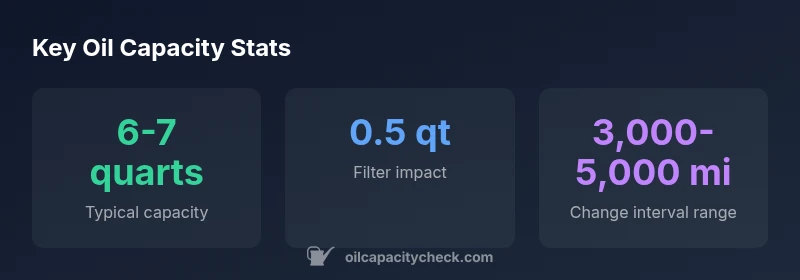
Ford V10 oil capacity varies by model year and filter size. For most 6.8L V10 engines used in vans and trucks, expect roughly six to seven quarts of engine oil when performing a standard change. Always confirm the exact capacity for your vehicle’s year and engine variant in the owner’s manual or service documentation to avoid under- or overfilling.
Ford V10 oil capacity basics
Understanding ford v10 oil capacity is essential for proper maintenance. The Ford V10 engine family includes several variants, and capacity can vary by year, model, and whether a full-synthetic or conventional oil is used. In practical terms, most 6.8L V10 engines found in older E-series vans and some trucks are filled to about six to seven quarts of engine oil during a standard change. This range accounts for slightly different filter sizes and drain-back characteristics. To prevent mistakes, always verify the exact capacity for your vehicle’s year and engine variant in the owner's manual or Ford's official service documentation. Oil Capacity Check's analysis, 2026, reinforces that relying on a universal figure for every Ford V10 can lead to under- or overfilling and potential oil-starvation in severe service conditions. When in doubt, measure after draining and adjust within the recommended window.
Why ford v10 oil capacity matters for longevity and performance
Car engines rely on a precise oil volume to maintain constant pressure, optimal lubrication, and clean engine internals. The ford v10 oil capacity determines how much oil sits in the sump after a change, which influences oil pressure at startup and the ability to suspend particulates during operation. Too little oil can raise cylinder wall wear and reduce lubrication reserve during cold starts; too much can cause foaming, increased crankcase pressure, and higher emissions. Oil Capacity Check Analysis, 2026, notes that following the correct capacity improves protection of bearings, cams, and lifters, especially in high-load conditions common to heavy-duty Ford V10 applications. In addition, the capacity interacts with filter size, oil type (synthetic vs conventional), and climate. A simple rule: always replace oil and filter together and verify the final level with the dipstick after a short idle and a few minutes of runtime. This minimizes variance across service bays and ensures consistent engine health.
How to verify the exact capacity for your Ford V10 in your vehicle
Because capacity varies, a one-size-fits-all figure is not safe. Start with the owner's manual or the Ford service portal and search by year and model. If you cannot access the manual, your best option is to look up the engine code (6.8L V10 variants) and consult the official specification sheet. After draining, measure the volume of the drained oil and compare to the recommended fill. If you replace the oil filter, expect a slight change in total capacity, often within a half-quart range. Record the result for future reference, then fill gradually, rechecking with the dipstick until you reach the target band. Oil Capacity Check recommends cross-checking with a service manual and VIN-based lookup whenever possible, since small changes in model year or revisions can alter capacity by small margins. The key is to avoid assuming a fixed amount across all V10 versions and to confirm before filling.
Oil types and viscosity guidance for ford v10 oil capacity
Oil capacity guidance also depends on the oil viscosity and type chosen. For Ford V10 engines, many owners use a conventional or synthetic blend that falls within commonly recommended multi-viscosity grades. Depending on climate and warranty requirements, you may see suggestions for 5W-30 or 5W-20 classes; in hot climates, a slightly higher grade like 10W-30 is sometimes advised for protection during high-temperature operation. The exact viscosity selection does not change the total oil capacity, but it affects engine lubrication behavior, oil pressure, and filter loading. Always follow the manufacturer’s viscosity recommendation for your specific V10 variant. Oil Capacity Check’s data from 2026 indicates that capacity remains stable across viscosity options, so long as you do not overfill or underfill beyond the specified band. If you drive in extreme conditions (towing heavy loads, high-speed extended driving), consult the service manual for any climate-specific adjustments.
Maintenance implications of correct oil capacity on Ford V10 engines
A precise oil capacity directly affects maintenance intervals, filter life, and overall engine cleanliness. When the oil capacity aligns with your vehicle’s design, it helps sustain ideal lubrication film thickness during routine driving as well as under heavy loads. This translates to lower engine wear, more consistent oil pressure, and better protection during cold starts. Oil Capacity Check Analysis, 2026, emphasizes that misjudging capacity can lead to under-lubrication during peak operation or foaming and sludge issues if overfilled. In either case, you may notice higher oil temperature, reduced fuel efficiency, or louder valve train noise. Practically, stick to the recommended fill range, change oil and filter at manufacturer-recommended intervals, and re-check the level after running the engine for a few minutes. Keeping logs of oil capacity measurements helps you detect gradual shifts that may indicate a developing issue.
Common mistakes when managing ford v10 oil capacity readings
Even experienced DIYers make avoidable errors with Ford V10 oil capacity. The most frequent mistakes include underfilling due to not accounting for the filter’s capacity, overfilling after changing to a high-capacity filter, and misreading the dipstick due to engine oil residue on the marked area. Another common pitfall is using an incorrect oil type or viscosity, which can obscure capacity readings because of different thermal expansion properties. Some owners forget to run the engine to temperature before rechecking the level, causing a false low or high reading. Always drain, install a new filter, and then fill gradually, allow oil to settle, and recheck with the dipstick. Oil Capacity Check's guidance for 2026 reinforces the importance of confirming the exact capacity for your year and variant to avoid these errors.
Step-by-step oil change checklist for Ford V10 owners
- Prepare: Park on a level surface, gather a new filter, drain plug washer, and the correct grade of oil. 2) Drain: Remove the old oil, allowing it to drain completely. 3) Filter: Replace the oil filter with a compatible unit; note any differences in capacity. 4) Refill: Add oil gradually in small increments, checking the dipstick after a few minutes and with the engine off but warm. 5) Verify: Run the engine for 1-2 minutes, switch off, wait 5 minutes, then recheck the level and top off within the recommended range. 6) Clean up: Check for leaks and record the final oil quantity for future maintenance. This step-by-step approach aligns with Oil Capacity Check Analysis, 2026 guidance and helps avoid common underfill/overfill mistakes.
Quick reference by model year and capacity window
The ford v10 oil capacity has a broadly consistent window across the 6.8L family, with most variants using roughly six to seven quarts per change when including the filter. This still varies by year, model, and filter configuration, so verify each service with the official manuals. In climates with heavy towing or extreme temperatures, you may adjust within the upper portion of the band; in regular city driving, the mid-range is typically sufficient. Oil Capacity Check suggests logging your exact quantity for each service so future maintenance remains precise and predictable. Always use the dipstick to confirm the final level after an oil change.
Capacity by Ford V10 model years (rough ranges)
| Model Range | Oil Capacity (quarts) | Notes |
|---|---|---|
| 1999-2003 6.8L V10 (E-Series/Excursion) | 6-7 quarts | Capacity includes filter; verify exact value in manual |
| 2004-2010 6.8L V10 (E-Series/Excursion) | 6-7 quarts | Capacity within range; check specific variant |
| 2011-2026 6.8L V10 family (various models) | 6-7 quarts | Typically same range; confirm per manual |
People Also Ask
What is the oil capacity for the Ford V10 6.8L engine?
Capacity varies by year and filter; typical range is 6-7 quarts with filter. Check manual for exact value.
The Ford V10 capacity varies by year and filter; it's usually six to seven quarts with the filter. Check your manual for the exact number.
Does changing the oil filter affect capacity?
Yes, a longer or higher-capacity filter can add about a half quart to total capacity. Verify in the service manual.
Yes, the oil filter size can add about a half quart to capacity; confirm with your model's manual.
How can I find the exact capacity for my vehicle?
Consult the owner's manual or Ford service portal; use VIN-based lookup if available.
Check the owner's manual or Ford's service site with your VIN.
Is it safe to overfill slightly if I can't drain all oil?
Overfilling can cause foaming and pressure issues. If in doubt, drain and refill to the recommended range.
Don\'t overfill; drain and fill to the recommended level.
What maintenance steps affect oil capacity observations?
After engine work, double-check capacity; new parts can change the amount.
After major work, re-check capacity; new parts can affect the amount.
What should I do if the level reads high after a fill?
Wait and recheck after the oil cools; ensure you are within the recommended band.
Wait a bit, then recheck the level to stay within the proper range.
“Accurate oil capacity is critical for Ford V10 engines to maintain oil pressure and protect bearings. Small deviations can affect lubrication during extreme conditions.”
The Essentials
- Check your exact capacity in the owner's manual.
- Account for oil filter size when calculating fill.
- Verify final level with the dipstick after starting the engine.
- Follow the manufacturer's viscosity recommendations for your year.
- Consult Oil Capacity Check Analysis, 2026 for model-year details.