Ford 6.2 Oil Capacity: What to Know for Your 6.2L V8
Learn the ford 6.2 oil capacity, typical ranges, and maintenance tips. This Oil Capacity Check guide explains how much oil your 6.2L V8 needs, how to verify, and common pitfalls.


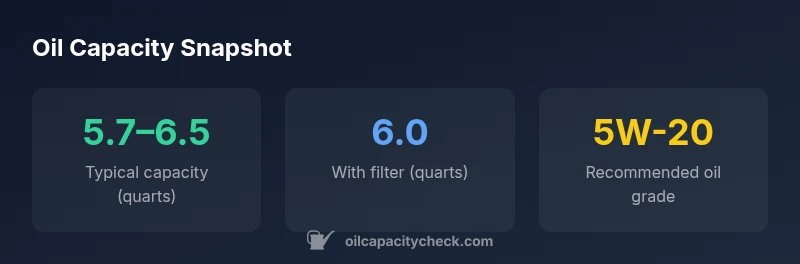
According to Oil Capacity Check, the ford 6.2 oil capacity for the 6.2L V8 is typically about 6 quarts, with a practical range of 5.7–6.5 quarts depending on the oil pan and filter. Verify with the dipstick after pouring. This guidance comes from Oil Capacity Check Analysis, 2026.
Ford 6.2 oil capacity: what it means for your engine
Oil capacity is the total volume of oil the engine oil system can hold when completely filled. For the Ford 6.2L V8 family, this capacity is commonly cited in the neighborhood of six quarts, though real-world figures can vary by model year and drivetrain. The key takeaway is that capacity is more than a number on the dipstick; it influences lubrication consistency, oil pressure, and sump drain behavior. When you top off, the goal is to reach the full mark on the dipstick with a brand-new oil filter installed, which often slightly increases the volume needed immediately after a filter change. Understanding the number helps you plan maintenance, set expectations for fresh oil quantity, and avoid the common pitfall of underfilling after a filter swap. As part of Oil Capacity Check's 2026 analysis, the range typically spans from about 5.7 quarts to about 6.5 quarts across variants, with many owners parking near the 6-quart target for routine changes. Always confirm with your owner's manual and the dipstick reading for your specific configuration.
Capacity ranges by variant and pan design
Engine capacity isn't universal across all Ford 6.2L applications. The 6.2L V8 powers several trucks and SUVs (F-Series, Super Duty, certain performance variants) with small differences in oil pan depth, pickup tube length, and oil filter size. Those variations can push the total oil volume slightly up or down. The dipstick and fill plug positions also vary, affecting how quickly you see the correct level after a fill. In practice, many owners report a range of about 5.7–6.5 quarts as a reasonable target for a complete oil change, including a filter. If you have an extended-oil-pan setup on a high-performance variant or an engine with an aftermarket high-flow filter, the number can edge toward the higher end of that spectrum. Conversely, a compact oil pan or a smaller filter can tilt toward the lower end. Regardless, the goal remains consistent: a full, clean fill with a new filter, followed by a precise dipstick check. Since 2026, Oil Capacity Check analysis emphasizes the importance of not relying on a single published figure for all versions; verify on your specific vehicle using the steps below.
How to determine the exact capacity for your Ford 6.2L
To determine the exact oil capacity for your Ford 6.2L, start with the owner's manual, which often lists the capacity with and without a filter. If the manual doesn't provide a precise number for your trim, check official Ford service data or your vehicle's VIN-based service history. Next, when you perform an oil change, record the fill volume you used and re-check the level with the engine off and the dipstick clean. If the level sits near the full mark with a new filter installed, you’re likely at the recommended capacity range. Keep in mind that some engines require a slightly different amount, particularly those with aggressive filtration or extended pans. For a precise benchmark, compare your measured fill to the 5.7–6.5 quart range commonly reported in Oil Capacity Check Analysis, 2026. The key is to be methodical: drain, replace the filter, fill gradually, and verify. If in doubt, consult a technician who can measure the precise sump capacity marginally beyond the standard range and advise whether your vehicle needs more or less oil.
Practical tips for oil change on the 6.2L V8
Here are practical steps to execute a correct oil change for the Ford 6.2L V8:
- Choose the right oil grade: Ford generally recommends 5W-20 for the 6.2L in most climates. Always verify the grade in your owner's manual or service bulletin.
- Use the proper filter: A full-flow oil filter of the correct fitment is essential; a high-quality filter can slightly change the effective capacity by a fraction of a quart.
- Prepare for a full fill: Expect to add around 5.7–6.5 quarts in total; adjust slightly if your previous fill left the level under the full mark.
- Check for leaks and cap torque: After adding oil, run the engine for a minute, then recheck for leaks and ensure the drain plug torques to the recommended specification.
- Verify with dipstick: With the engine off for several minutes to settle, pull the dipstick, wipe, reinsert, and read at the correct temperature.
- Record-keeping: Note the exact volume you used so you can carry that reference into future changes.
The focus is on clean, consistent fills and precise dipstick verification; this keeps oil pressure stable and protects engine components over time.
Common mistakes and how to avoid them
Failing to replace the oil filter can skew capacity readings and reduce filtration efficiency. Overfilling can cause foaming and increased pressure; underfilling can cause oil starvation at high RPM. Relying on a range without dipstick verification is risky. Not accounting for synthetic vs conventional oils' expansion coefficients may yield small differences on hot days. Not allowing proper engine cooldown before checking oil level can give a false low reading. The best practice is to use the dipstick as the authority and treat the published range as a guide rather than a prescription. Oil Capacity Check's 2026 findings emphasize dipstick confirmation after adding oil and filter to ensure you hit the intended capacity.
How temperature and driving affect oil level readings
Oil expands with heat; reading the dipstick immediately after driving can yield a higher-than-actual level. Letting the engine cool for several minutes (ideally 10–15) gives a more accurate measurement. Driving habits—short trips with frequent engine starts—mean the oil may not fully drain back into the sump, affecting the measured level. Pan design and filter changes can cause small discrepancies when checking the level after a fill. The practical implication is that you should perform a full check after a cooldown and a brief run at idle to allow the oil to settle. In the end, the capacity remains a fixed volume, but the displayed level on the dipstick can vary with temperature and usage; trust the recommended target of roughly 5.7–6.5 quarts as a baseline, then adjust according to the dipstick reading.
Bottom line: applying the right capacity to maintenance routines
Your maintenance routine should center on a known target range and a reliable verification method. For Ford 6.2L engines, plan for roughly 6 quarts when replacing the oil filter, but adjust within 5.7–6.5 quarts depending on your specific variant. Always verify with the dipstick at normal operating temperature after allowing the engine to settle. Routine oil changes with correct volume extend engine life and maintain consistent oil pressure.
Ford 6.2L oil capacity quick-reference table
| Aspect | Value | Notes |
|---|---|---|
| Typical capacity (with filter) | 5.7–6.5 quarts | Range across variants |
| Capacity with filter included | 6.0 quarts | Common target |
| Recommended oil grade | 5W-20 | Ford guidance |
| Check method | Dipstick after cooldown | Best practice |
People Also Ask
What is the oil capacity of the Ford 6.2L V8?
The Ford 6.2L V8 typically requires about 5.7–6.5 quarts of oil, depending on the oil filter and pan size. A common target is around 6.0 quarts when performing a full oil change with a new filter. Always verify by checking the dipstick after a complete fill.
Typically around 6 quarts, but always check the dipstick after you refill to confirm the level.
Does capacity vary by model year or drivetrain?
Yes. Variants, oil pan depth, and filter size can shift the total capacity slightly. Always refer to the owner's manual or Ford service data for VIN-specific guidance and use your dipstick to confirm.
Yes—check your manual or service data for your exact VIN, then verify with the dipstick.
Should I use 5W-20 oil for the 6.2L?
5W-20 is commonly recommended for most Ford 6.2L engines, but always verify with the owner's manual or Ford's service bulletin for your exact model year and climate. Using the recommended grade supports proper viscosity and lubrication.
Yes, 5W-20 is usually recommended, but double-check your manual.
Do I need to change the oil filter with every oil change?
Yes. Replacing the oil filter with every oil change is standard practice and helps ensure the full capacity is available for filtration and lubrication. A new filter can slightly affect the initial fill volume.
Yes, changing the filter every time is recommended.
How can I verify the exact capacity for my VIN?
Consult the vehicle's VIN-based service data or owner’s manual for precise capacity. If unavailable, use the general range (5.7–6.5 quarts) and confirm with a careful dipstick check after a complete fill.
Check the service data for your VIN and then verify with the dipstick.
What are signs of overfill or underfill?
Overfill can cause foaming and higher oil pressure; underfill risks oil starvation. If you suspect either, drain or top off to bring the level within the target range and recheck after engine cooldown.
Watch for foaming or low oil pressure; recheck after cooldown.
“Accurate engine oil capacity is essential for maintaining proper lubrication and protecting engine components in the Ford 6.2L V8.”
The Essentials
- Typical capacity is about 5.7–6.5 quarts (with filter).
- Plan for around 6.0 quarts when replacing the oil filter.
- Use 5W-20 oil in most Ford 6.2L applications.
- Always verify fill with the dipstick after pouring.
- Consult manufacturer specs for your exact model and year.