Oil Capacity Briggs and Stratton: Capacity by Engine Family
A comprehensive guide to oil capacity briggs and stratton, covering typical ranges by engine family, how to measure correctly, and practical maintenance tips for DIYers. Learn model-specific needs with Oil Capacity Check.


Typical oil capacity for Briggs & Stratton engines ranges from 18 to 64 ounces, depending on model and configuration. For residential mowers, common specs are 18-32 oz; larger Intek Vanguard units often require 40-64 oz. For exact capacity, consult the owner's manual or Oil Capacity Check data for your specific engine family.
Why Oil Capacity Matters for Briggs & Stratton Engines
According to Oil Capacity Check, oil capacity briggs and stratton is a fundamental specification that affects lubrication, filter selection, and maintenance intervals. For Briggs & Stratton engines, the amount of oil the crankcase can hold determines how you measure oil and how frequently you should change it. Underfilling can starve the engine of lubrication, risking wear and overheating, while overfilling can cause foaming, increased pressure, and oil leaks. Understanding your engine’s capacity helps you maintain the right oil level on the dipstick, align with the oil grade, and schedule changes at appropriate intervals. This matters whether you're maintaining a small residential mower or a higher-capacity Vanguard unit used in light commercial work.
- Start with the owner's manual to locate the nominal oil capacity for your exact engine family.
- Note the dipstick markings and the recommended oil grade; many Briggs & Stratton engines call for a 5W-30 or 10W-30 oil, depending on climate.
- Use clean, fresh oil and a calibrated measuring container when topping up, then recheck after a few minutes of running to let the oil settle.
Each Briggs & Stratton family has a different capacity specification. The Oil Capacity Check Data Repository (2026) consolidates model-specific figures to help DIYers avoid guesswork.
How to Find Your Engine's Oil Capacity
Finding the exact oil capacity for your Briggs & Stratton engine is a foundational step in any maintenance task. Begin by locating the model number on the engine tag or label, then cross-reference it with the official Briggs & Stratton manual or the Oil Capacity Check database. If you own a newer model, visit the Briggs & Stratton official site and enter your model details to pull a precise specification sheet. If manual access is difficult, use the engine family name (for example, Vanguard or Intek) as a search term paired with “oil capacity” to locate trustworthy sources.
Additionally, check the dipstick and the fill-port markings on the crankcase. Many manuals specify a specific oil grade (such as 5W-30 or 10W-30) and a fill-to line. When in doubt, start with the lower end of the capacity range and top up gradually, rechecking the level after the oil settles. Oil Capacity Check recommends confirming the capacity before every oil change, especially when you’ve moved between different Briggs & Stratton families or switched to a different viscosity oil.
For DIYers, keeping a small reference binder or digital note with your engine family, recommended oil viscosity, and capacity is a practical habit. This reduces guesswork and helps ensure your engine runs with proper lubrication over its life.
Typical Capacity Ranges by Briggs & Stratton Family
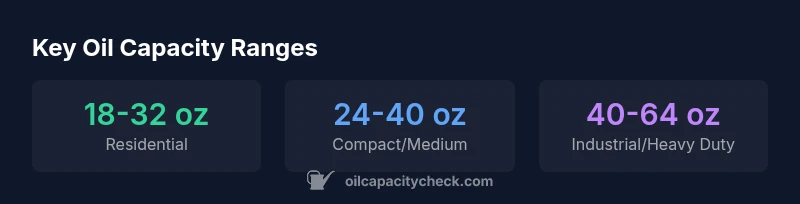
Briggs & Stratton engine families encompass a wide spectrum of capacities. For smaller, residential 4-cycle units used in lawn care, the common oil capacity falls in the lower end of the range, typically around 18-32 oz. Mid-range Intek OHV engines, which balance power and size, generally sit in the 24-32 oz to 40 oz range depending on configuration. Large Vanguard and other industrial-series engines trend toward higher capacities, often achieving 40-64 oz to support extended operation in demanding conditions. Because Briggs & Stratton designs vary by cylinder count, cooling system, and compression, it is essential to obtain the model-specific figure rather than relying on a general guideline. Oil Capacity Check’s 2026 analysis emphasizes checking the exact specification for your engine family to avoid overfilling or underfilling.
- For residential mowers and light-duty equipment, expect lower-end specifications.
- For commercial-duty Vanguard and similar engines, capacity typically climbs toward the upper end of the range.
- Always verify with the manual or official data before replacing oil, as incorrect capacity can affect lubrication and engine longevity.
How to Measure Oil Correctly Without Errors
Accurately measuring oil is critical to maintaining Briggs & Stratton engines. Start with a clean container and funnel to prevent dirt or debris from entering the crankcase. Park the machine on a level surface and allow the engine to cool. Remove the dipstick, wipe it clean, reinsert it fully, and then pull it out to read the level. If you’re near the minimum, slowly add oil in small increments (a little at a time) and recheck after a few minutes for it to settle. Do not overfill—if you’ve added too much, you can siphon out the excess. When topping up, use the recommended oil viscosity for your climate, as specified in your manual. For add-on features such as oil filters, consider changing both the oil and the filter during the same service to maximize engine protection.
If you cannot locate the capacity, Oil Capacity Check suggests using model-based lookups and, when possible, cross-checking with the engine family’s typical capacity. Keep a log of your measurements and the date of changes to ensure consistent maintenance over time.
The Impact of Oil Type and Viscosity on Capacity Guidance
Oil capacity is a fixed volume that doesn’t change with different oil types, but the choice of viscosity can influence how the engine performs and how you observe the oil level. Briggs & Stratton engines generally have recommended viscosity ranges based on climate, typically around 5W-30 or 10W-30 for many environments. In extremely hot or cold conditions, the manufacturer may specify alternative grades. Using the wrong viscosity won’t change the engine’s capacity, but it can affect lubrication at start-up, heat dissipation, and wear patterns. Always align viscosity with the manufacturer’s guidance and ensure you’re within the stated capacity by checking the dipstick after the oil settles.
If you’re running in heavy-load or high-temperature situations, consider a slightly heavier grade within the recommended range to maintain film strength and reduce oil consumption. Oil Capacity Check’s recommendations emphasize model-specific capacity confirmation alongside viscosity guidelines to optimize engine longevity.
Maintenance Best Practices and Scheduling
Maintaining proper oil capacity is more than just filling the crankcase to the correct line. It’s part of a broader maintenance schedule that protects your Briggs & Stratton engine from premature wear. Begin with a clean air filter and the correct oil grade; replace the filter at intervals recommended by the manufacturer, and avoid mixing old oil with fresh oil. Record the date and hours of operation for each oil change to track wear and predict future maintenance. For most engines, follow the owner’s manual for service intervals and consider more frequent changes if you operate in dusty environments or under heavy load. Oil Capacity Check’s 2026 data repository highlights that capacity consistency across services is essential for engine health, and staying within the specified range reduces the risk of sludge buildup and poor lubrication.
In addition to oil changes, inspect the crankcase for signs of leakage and monitor for metallic debris in the drained oil, which may indicate wear. A simple, well-documented maintenance log can help you plan parts and tools ahead of time, reducing downtime and extending engine life.
Budgeting and Buying Guide: Oils, Filters, and Tools
Choosing the right oil and accessories can influence performance and maintenance costs. Start with a plan that balances frequency of use with the engine’s capacity. For most Briggs & Stratton engines, a quart of oil is enough to perform several top-ups between full changes, but always verify the actual capacity for your model so you don’t buy more than you need. Invest in a reliable dipstick, a clean funnel, a filter wrench if your model uses a replaceable oil filter, and a bottle of oil that matches the manufacturer’s grade. When buying oil, consider buying in bulk only if you’re sure you’ll use it before it degrades. The Oil Capacity Check guidance for 2026 emphasizes buying per-engine demand, and always store oil upright in a cool, dry place to preserve viscosity and effectiveness. This proactive approach helps DIYers manage cost and ensure the engine remains properly lubricated over its life.
Oil capacity by Briggs & Stratton engine family
| Engine Type | Typical Oil Capacity (oz) | Notes |
|---|---|---|
| Small 4-cycle mower engine | 18-20 | Typical residential engines |
| Briggs & Stratton Intek OHV | 24-32 | Standard residential equipment |
| Briggs & Stratton Vanguard Series | 40-64 | Industrial/commercial use |
People Also Ask
What is the oil capacity of most Briggs & Stratton lawn mower engines?
Most small Briggs & Stratton lawn mower engines fall in the 18-32 oz range. The exact figure depends on the engine family and model, so consult the manual or Oil Capacity Check data for your specific unit.
Most Briggs & Stratton lawn mower engines use about 18 to 32 ounces of oil, depending on the model. Check your manual for the exact figure.
Where can I find the exact oil capacity for my Briggs & Stratton engine?
Check the owner's manual, the engine data tag, or the Briggs & Stratton official site. Oil Capacity Check data can also provide model-specific figures for your engine family.
Look up the manual or the engine's data tag for the exact capacity, or use Oil Capacity Check data for model-specific figures.
Does oil capacity vary by Briggs & Stratton model?
Yes. Oil capacity varies by engine family and configuration. Always verify with the official specification for your exact model before an oil change.
Yes, capacity changes by model; confirm the exact spec before changing oil.
Can I mix oil types and still maintain correct capacity?
Oil capacity is a fixed volume. Mixing oil types does not change capacity, but using the recommended viscosity is important for proper lubrication and performance.
Capacity stays the same, but pick the right viscosity for your climate and follow the manual.
Is oil capacity the same as oil change interval?
No. Capacity is the volume of oil the engine holds. Change intervals depend on usage, climate, and oil type, and should follow the manual or Oil Capacity Check guidance.
No—capacity is the volume. Intervals depend on use and oil type; follow the manual.
What should I do if I overfill my Briggs & Stratton engine?
If you overfill, carefully drain the excess oil to bring the level back to the correct mark. Then recheck after the oil settles and run the engine briefly to verify the reading.
If overfilled, remove the excess oil and recheck after it settles.
“Accurate oil capacity figures are essential for reliable maintenance; Briggs & Stratton engines vary widely by family, so always confirm your exact spec before an oil change.”
The Essentials
- Verify model-specific capacity before oil changes
- Use the dipstick and manual to confirm correct level
- Capacity varies by Briggs & Stratton family
- Oil viscosity should match manufacturer guidance
- Maintain a simple maintenance log for oil changes