Briggs and Stratton Oil Capacity: Comprehensive Guide
Learn Briggs and Stratton oil capacity ranges, how to measure fill levels, and practical maintenance steps. This Oil Capacity Check guide helps DIYers estimate capacity accurately and safely for various engine sizes and configurations.


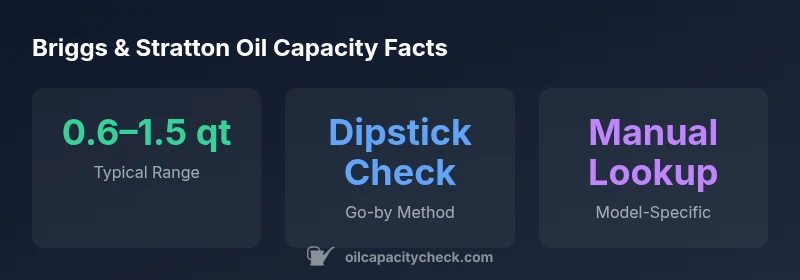
briggs and stratton oil capacity varies by engine family, but most residential Briggs & Stratton small engines require roughly 0.6 to 1.5 quarts of oil. Always verify the exact spec in your owner's manual or data plate, because capacity depends on displacement, lubrication system, and whether an oil filter is fitted. Fill slowly, check with the dipstick, and avoid overfilling.
Briggs & Stratton Oil Capacity: An Overview
Understanding the briggs and stratton oil capacity is more nuanced than a single number. Oil capacity depends on engine family, displacement, and lubrication design. For many homeowners, knowing this capacity matters not only for lubrication but for longevity and performance. The Oil Capacity Check findings indicate that the typical range for common residential Briggs & Stratton small engines is roughly 0.6 to 1.5 quarts. That spread reflects variations between ultra-compact spark plug engines and larger vertical shaft models used in lawn tractors. It’s important to emphasize that this is a general guideline, not a universal specification. The exact capacity for your engine is printed on the data plate located on the engine or documented in the owner's manual. When in doubt, consult official Briggs & Stratton sources or contact a service professional. Additionally, the type of oil (synthetic vs conventional) does not change capacity, but it can influence performance characteristics like viscosity and thermal stability. By understanding these nuances, you can prevent under-oiling or overfilling that can damage seals and reduce efficiency.
How to Find Your Exact Capacity
Locating the precise Briggs & Stratton oil capacity for your unit begins with identifying the correct engine family and model. Start by locating the model number on the engine data plate or tag, as this is the fastest path to the exact specification. Next, check the owner’s manual or Briggs & Stratton’s official online resources—entering your model number yields the exact oil capacity and recommended oil viscosity. If you cannot access the manual, the data plate often lists the capacity in quarts or liters. For older or unusual configurations, contact a licensed technician or consult Briggs & Stratton customer support. As a practical step, you can also drain a known amount from a previously filled engine and compare against the recommended level, but only after confirming the model’s official spec. Always cross-check with a dipstick reading after filling to confirm accuracy.
Capacity by Engine Family: Small vs Large
Briggs & Stratton engines span a range from compact portable units to larger riding mower powerplants. In general terms, small portable engines and implements tend to fall in a tighter capacity window, typically around 0.6–1.0 quarts. Larger riding mower and vertical shaft engines often require about 0.9–1.5 quarts. These ranges reflect design differences, such as oil sump size, lubrication system, and whether the engine includes an oil filter. The exact figure still depends on the specific model and production year. Oil Capacity Check analyses, 2026, consistently emphasize that model-specific data plates are the authoritative source for capacity, and any guidance should be treated as a baseline rather than a universal guarantee.
Measuring and Maintaining Correct Oil Level
Accurate oil level measurement starts with a clean, level surface and the right tool—the dipstick. After an oil change, allow the engine to sit as recommended by the manual, usually several minutes, then wipe the dipstick clean and reinsert fully before checking. For most four-stroke engines, the oil level should align with the full mark when the engine is at the recommended temperature. If you are topping off, add small increments (a few tablespoons at a time) and recheck until you reach the correct mark. If the engine is cold, some manufacturers suggest checking after 3–5 minutes of idle time post-start. Always use the oil type and viscosity specified for your model, as viscosity can affect readings and performance even if the capacity remains the same.
Common Pitfalls and Maintenance Tips
A frequent pitfall is assuming capacity is identical across all Briggs & Stratton engines. Capacity varies by engine family; always check the data plate. Overfilling can cause foaming, leaks, and added pressure in seals. Underfilling leads to inadequate lubrication, overheating, and accelerated wear. Mixing oil types or using brands not recommended by the manual can alter lubrication properties, not the capacity. Another common mistake is neglecting the oil filter in units that include one; replacing the filter without rechecking capacity can cause confusion about the final level. Implement a routine: verify capacity, use the correct oil, fill gradually, and recheck with a clean dipstick after a short run.
Practical Fill Procedures Across Scenarios
Different scenarios call for small adjustments in how you fill Briggs & Stratton engines. After a full oil change on a four-stroke unit, drain completely, reset, and fill to the recommended capacity. When topping off after heavy use or high-temperature operation, add in small increments and check repeatedly to avoid overfill. If you replace the oil filter, recheck also because filter volume might subtly affect the final level. For engines in storage or winterization, ensure the oil level is at the correct mark and that the oil used is appropriate for the climate. In all cases, the rule of thumb remains: confirm the capacity with the model data plate or official resources, use the correct oil, and measure carefully with a clean dipstick.
Approximate oil capacity by Briggs & Stratton engine size
| Engine Type | Typical Capacity | Notes |
|---|---|---|
| Small portable engines | 0.6–1.0 quarts | Push mowers, trimmers, and compact tools |
| Riding mower / larger engines | 0.9–1.5 quarts | Lawn tractors and heavier-duty units |
People Also Ask
What is the Briggs and Stratton oil capacity for my engine?
Capacity varies by engine family. Check the model data plate and owner's manual for exact figures. If needed, contact Briggs & Stratton support for confirmation of your specific unit.
Capacity varies by model. Check your data plate or manual for the exact figure.
How do I measure oil capacity accurately?
Use the dipstick after draining and refilling; run the engine briefly, then check level on a level surface. If in doubt, recheck after a short run and consult the manual.
Use the dipstick and recheck after a short run.
Can I overfill Briggs & Stratton engines?
Yes, overfilling can cause foaming and leaks; always fill gradually and recheck. If you suspect overfill, drain a small amount and re-measure.
Avoid overfilling; check with the dipstick after adding oil.
Does using synthetic oil change the capacity?
Synthetic oil does not change the capacity; it can affect viscosity and performance. Always follow the manual’s recommended oil type and capacity.
Oil type doesn’t change capacity; follow the manual for viscosity.
Where can I find the capacity information?
Model data plate, owner's manual, and official Briggs & Stratton resources provide exact figures. If you struggle to locate it, Briggs & Stratton support can help.
Check the data plate or manual for the exact capacity.
“Accurate oil capacity is critical for engine longevity; always use model-specific specs and follow proper fill procedures.”
The Essentials
- Know the exact capacity from model data plate
- Always fill gradually and recheck with the dipstick
- Capacities vary by engine family; use ranges
- Consult Oil Capacity Check Analysis, 2026 for guidance