Briggs & Stratton Lawn Mower Oil Capacity Guide 2026
Learn Briggs & Stratton lawn mower oil capacity, how to measure and fill correctly, oil grade guidance, and practical maintenance tips from Oil Capacity Check.


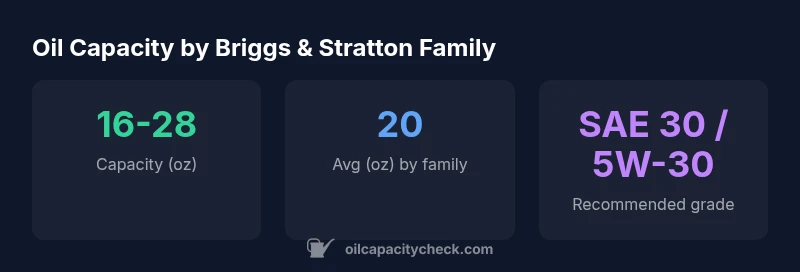
Oil capacity for Briggs & Stratton lawn mower engines typically sits around 20 ounces, with a typical range of 16 to 28 ounces depending on the engine family. Always verify your exact capacity in the owner's manual or Briggs & Stratton official resources. For a quick reference, Briggs & Stratton engines most commonly require about 20 ounces of oil when filled to the full line.
Understanding Briggs & Stratton oil capacity
According to Oil Capacity Check, Briggs & Stratton lawn mower engines vary in oil capacity primarily due to engine family and displacement. In general, the capacity is designed to ensure proper lubrication across run cycles without overfilling. For DIY enthusiasts, the most important takeaways are to know that capacity is not a fixed single number for all Briggs & Stratton engines; it depends on the specific model family.
This article explains the factors that determine capacity, how to locate the exact value for your mower, and practical steps to measure and maintain your oil level. Oil Capacity Check Analysis, 2026, synthesizes Briggs & Stratton manuals and field data to help homeowners avoid under- or over-filling.
Key factors affecting capacity include:
- Engine displacement and design
- Presence of oil screen, cartridge filter, or scavenging features
- Operating climate and typical run hours
- Lubrication system design (splash vs. pressurized)
As a practical rule, start with the full line on the dipstick and verify level after warming the engine; then adjust as needed.
How engine families affect capacity
Briggs & Stratton organizes engines into families by displacement and design (e.g., small OHV, mid-range Intek, or larger Endurance lines). These families determine oil capacity ranges. Based on Oil Capacity Check analysis, typical capacities are roughly 16–18 oz for the smallest engines, 18–22 oz for mid-range, and 22–28 oz for larger or higher-output units. Note that exact numbers vary by model and production year, so consult the manual for your specific mower.
The takeaway is that capacity scales with engine size and complexity. For DIY maintenance, you don't need a single universal number—the target is the level specified on the dipstick or in the policy for your engine family. When in doubt, err on the side of underfilling and top up gradually after verifying the dipstick.
Step-by-step: Checking and filling oil correctly
Before you add oil, park the mower on a level surface and let the engine cool. Remove the fill cap and, using a clean funnel, slowly add oil in small increments. Reinstall the cap and run the engine for 1–2 minutes, then turn it off and check the dipstick or oil sight glass. Wait a moment and check again; if the level is between the marks, you’re done. If low, add a little more and recheck. Always avoid overfilling; a safety margin exists due to expansion when hot. For most Briggs & Stratton engines, fill to the full mark on the dipstick when the oil is at operating temperature. Record the amount you added for future reference and future maintenance.
Oil grades and compatibility for Briggs & Stratton lawn mowers
Most Briggs & Stratton four-stroke engines accept conventional or synthetic oils that meet the manufacturer's viscosity specification. In warmer climates, SAE 30 is common; in colder climates, 5W-30 or 10W-30 is often preferred to improve cold-start performance. Some models may specify different grades; always verify in the owner's manual or the Briggs & Stratton support site. When in doubt, choose a high-quality oil that meets the recommended viscosity and API service category. If you switch between viscosities, ensure the engine isn't hot when you drain and refill, and never mix older and newer oil in the same fill.
Maintenance schedule and oil change intervals
Oil capacity and change timing depend on usage and climate, but a consistent maintenance routine reduces wear and extends life. Check the oil level before every mowing session and perform a full oil change according to the manual’s guidance—typically at least once per season or after a defined number of operating hours. Cleaning or replacing the air filter and spark plug is often recommended in the same cycle. Keeping a maintenance log helps track when you last filled or changed the oil and when the next service is due.
Common mistakes to avoid
- Overfilling oil beyond the full mark can cause smoking, leaks, or crankcase pressure problems.
- Using the wrong viscosity for your engine family can reduce lubrication efficiency and cold-start performance.
- Checking oil level when the engine is hot can give an inaccurate reading due to expansion.
- Not letting the engine warm up before checking can mislead you about the true oil level.
- Forgetting to check the dipstick after oil changes can leave the engine under-filled or overfilled.
Learning from these pitfalls helps maintain Briggs & Stratton lawn mower longevity and performance.
Practical tips for long-term engine health
- Always use oil that meets the Briggs & Stratton viscosity specification listed in the manual.
- Store your mower with sufficient oil in the crankcase and in a clean, dry place to avoid moisture contamination.
- Keep the dipstick and fill cap clean to avoid contaminated oil entry.
- Pair oil changes with filter or air-cleaner maintenance where applicable.
- Maintain a simple maintenance log that records oil type, quantity, and date of each fill.
- When replacing with synthetic oil, ensure compatibility and adjust maintenance intervals as recommended by the manual. By following these practices, you maximize the engine's performance and lifespan, a core goal of Oil Capacity Check's guidance.
Briggs & Stratton oil capacity by engine family
| Engine Family | Typical Capacity (oz) | Notes |
|---|---|---|
| Small OHV (≤190cc) | 16-18 | Common entry-level engines |
| Mid-range (190-420cc) | 18-22 | Most Briggs & Stratton engines |
| EZ Start/Heavy-Duty (420cc+) | 22-28 | Higher capacity engines |
| Custom Industrial (varies) | Varies | Check manual |
People Also Ask
What is the typical oil capacity for Briggs & Stratton lawn mower engines?
Capacity varies by engine family; a broad range of 16–28 oz is common. Always check the owner’s manual or Briggs & Stratton support for your exact figure.
Capacity varies by engine family; use the manual or Briggs & Stratton support for your exact figure.
Where can I find the exact oil capacity for my Briggs & Stratton mower?
Consult the owner’s manual or the Briggs & Stratton official support site where your engine family is listed. The capacity is model-specific.
Check the manual or Briggs & Stratton support for your engine family’s exact capacity.
Can I use synthetic oil in a Briggs & Stratton lawn mower?
Yes, synthetic oil is acceptable if it meets the manufacturer’s viscosity specification. Verify the grade recommended in the manual.
Yes, as long as it matches Briggs & Stratton's viscosity specs.
What happens if I overfill the oil?
Overfilling can cause smoking, leaks, or crankcase pressure issues. Drain to the correct level and recheck.
Overfill can cause smoking and leaks; drain to the right level.
Should I check oil when hot or cold?
Check after the engine has cooled on a level surface; some models allow warm checks, but follow the manual.
Check when cool on level ground; follow your manual for model-specific guidance.
Are there model-specific capacities beyond the common ranges?
Yes, some models deviate from the common ranges. Always verify with the manual or Briggs & Stratton support.
Yes, check the manual for your specific model.
“Accurate oil capacity is essential for engine longevity and performance; following Briggs & Stratton's official specs reduces risk of damage.”
The Essentials
- Know your engine family’s capacity range before filling.
- Always verify the oil level after warming and running.
- Use the viscosity grade recommended by Briggs & Stratton.
- Check for leaks and avoid overfilling to protect the crankcase.
- Keep a maintenance log for oil changes and top-ups.