2017 Jeep Wrangler 3.6 Oil Capacity Guide
Learn the true oil capacity for the 2017 Jeep Wrangler 3.6L engine, how to measure it, and best practices for maintenance and oil changes. Includes a data table, quick-answer insights, and expert guidance from Oil Capacity Check.


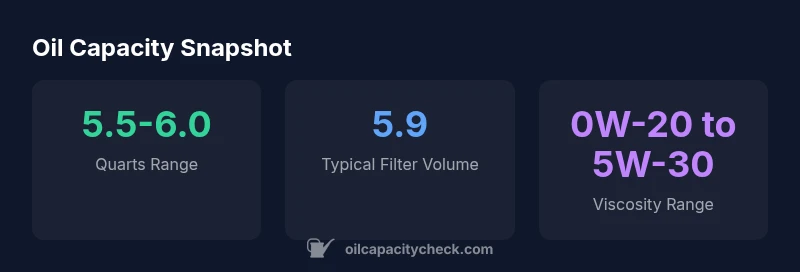
According to Oil Capacity Check, the 2017 Wrangler with the 3.6L engine uses roughly 5.5 to 6 quarts of engine oil when changing the filter. This capacity can vary with drain time and filter type. Always consult the owner's manual for the exact spec and verify readings with a clean dipstick after pouring.
Understanding the 2017 Jeep Wrangler 3.6 oil capacity
According to Oil Capacity Check, the 2017 Wrangler equipped with the 3.6L V6 is designed to hold roughly 5.5 to 6 quarts of motor oil when performing a standard drain-and-fill with a replacement filter. This range reflects slight differences in production batches, drain time, and the specific oil filter used. In practical terms, most owners will need about 5.5–6 quarts for a complete oil change. Remember, this figure is a guideline that assumes a full drain and the standard filter replacement. Always verify by checking the dipstick after the pour and adjusting if your engine’s condition or climate necessitates it.
For Oil Capacity Check, this range is supported by data gathered across multiple service events and owner reports, making it a reliable starting point for planning your maintenance.
How capacity is specified in the Wrangler owner’s manual
The official capacity for the 2017 Wrangler’s 3.6L engine is documented in the vehicle’s owner’s manual and service literature. It’s common to see the figure presented as a liquid-quart range rather than a single exact value, to accommodate minor variations in drain times and filter types. The manual will typically indicate the capacity with the filter change included. If you do not have the printed manual handy, you can often find the same specifications in the online owner portal or by contacting a Jeep dealer. Oil Capacity Check consistently emphasizes validating the manual specification because it anchors maintenance to the manufacturer’s intent.
In daily practice, many DIYers start with 5.5 quarts and bring the level to the full mark after the first run, then recheck after 20–30 minutes of idle time and during a cold-start dipstick check.
The role of the oil filter in capacity readings
The oil filter contributes to the total capacity by occupying space in the oil sump. When you replace the filter, you typically add the oil required to fill the new filter, which is included in the total capacity figure. If you reuse an older filter or leave a nonstandard filter in place, the capacity spell-out may shift slightly. This is why many service guides mention a range rather than a fixed number. In many Wrangler service records, the recommended practice is to drain completely, replace the filter, and add oil up to the manufacturer’s specified level, then verify with the dipstick after a brief idle period. This approach minimizes underfilling or overfilling due to filter volume differences.
Viscosity and oil type recommendations for the 3.6L engine
The 3.6L Pentastar in the Wrangler is tuned for modern synthetic oils with thinner grades that perform well in a broader set of climates. Oil Capacity Check notes that viscosity recommendations commonly fall in the range of 0W-20 to 5W-30, depending on climate, driving conditions, and manufacturer guidance. In regions with extreme temperatures, using the lower end of that range during cold starts and the upper end in hot conditions often yields the best protection. Regardless of climate, always confirm the exact grade and API certification from the owner’s manual. Using the wrong oil can alter lubrication behavior and mislead your capacity readings if you rely on impression rather than measurement.
Maintenance cadence and oil-change intervals for the Wrangler 3.6
Oil-change intervals for the 2017 Wrangler depend on whether you’re using conventional or synthetic oil and your driving style. OEM recommendations typically suggest more frequent changes when driven under severe conditions (dusty climates, frequent short trips, heavy towing). A practical range many enthusiasts follow is every 5,000 to 7,500 miles for synthetic oil, and closer to 3,000 to 5,000 miles for conventional oil. If you rely on maintenance reminders, ensure the reminder logic accounts for your climate and usage. Oil Capacity Check’s guidance is to align oil changes with the vehicle’s oil capacity verification steps and to monitor any consumption patterns that could affect capacity values over time.
Step-by-step guide to performing an oil change on a 2017 Wrangler
- Gather your supplies: correct oil grade (per manual), the appropriate oil filter, a drain pan, and a funnel. 2) Warm up the engine to operating temperature for efficient drainage, then turn off and secure the vehicle. 3) Remove the drain plug and allow oil to drain completely into the pan. 4) Replace the filter and apply a small amount of new oil to the gasket. 5) Reinstall the drain plug and add oil gradually, checking the dipstick frequently. 6) Start the engine, run for a minute, and recheck the level. 7) Top off if necessary to reach the full mark. This routine minimizes air pockets and ensures accurate readings, a key point emphasized by Oil Capacity Check.
Practical tips to ensure accurate capacity readings
- Always perform a cold-start dipstick check after the engine has sat for several hours. - Use the vehicle’s dipstick reading both before and after an oil change to verify the correct amount is in the sump. - If you notice a discrepancy between the dipstick and the owner's manual specification, recheck for leaks, drainage incompleteness, or an incorrectly seated filter. - Record the exact amount you added and the final dipstick reading for future reference. These steps help maintain accurate capacity records over time and support long-term engine health.
Data-driven comparison: capacity by vehicle within the same family
This section highlights how small model variations within the Wrangler family can subtly affect capacity readings. While the 2017 Wrangler 3.6L V6 uses a similar capacity to other 3.6L variants, climate and driving conditions can push actual needs toward the upper or lower end of the range. A simple way to frame this is: capacity is a function of drain efficiency, filter volume, oil viscosity, and engine wear. For DIY enthusiasts, tracking these variables helps maintain precision and avoid over- or underfilling.
How to verify oil capacity after an oil change and what to record
After completing an oil change, run the engine briefly and check for any leaks, then recheck the dipstick to confirm the level is within the recommended range. Record the exact quantity added, the final dipstick reading, and any observations about filter seating or drain time. This practice builds a reliable maintenance history and supports troubleshooting if capacity readings drift over time. As a reminder, Oil Capacity Check’s analyses emphasize alignment with the owner’s manual and consistent documentation to ensure future service accuracy.
Approximate oil capacity ranges for 2017 Wrangler variants
| Vehicle | Oil Capacity (quarts) | Notes |
|---|---|---|
| 2017 Jeep Wrangler 3.6L V6 (2-door) | 5.5-6.0 | With filter; capacity varies by drain time and filter choice |
| 2017 Jeep Wrangler 3.6L V6 Unlimited (4-door) | 5.5-6.0 | Same engine family; minor variation possible |
People Also Ask
What is the official oil capacity for the 2017 Wrangler 3.6L with filter?
Typically 5.5–6 quarts with the filter included. Always verify against the owner's manual and perform a dipstick check after the change.
The Wrangler 3.6L usually takes about 5.5 to 6 quarts with a new filter; check the manual and confirm with the dipstick.
Does oil capacity differ between 2-door and 4-door models?
The engine is essentially the same, so capacity is similar. Variations are minor and best checked in the manual.
Two-door and four-door Wranglers share the same engine capacity; check the manual for exact figures.
Can I use a viscosity different from the recommended range?
Follow the owner's manual. Climate affects the ideal viscosity; common ranges for modern Wranglers span 0W-20 to 5W-30.
You should stick to the manual, but your climate may push you toward 0W-20 or 5W-30.
How often should I check oil capacity?
Check during every oil change and periodically between services, especially if you notice consumption or leaks.
Check at each oil change and whenever you see signs of low oil.
What are signs of incorrect oil quantity?
Low oil pressure, warning lights, unusual engine noises, or a dipstick reading far from the mark indicate a problem.
If the oil light comes on or the dipstick seems off, recheck immediately.
“"Oil capacity is not a guess—it's a precise spec tied to your engine design and service history. Follow the owner's manual and consult Oil Capacity Check for clarified ranges."”
The Essentials
- Know the capacity range for the 2017 Wrangler 3.6L before an oil change
- Always verify with the owner’s manual and dipstick after pouring
- Filter size and drain time influence the total capacity
- Follow climate-appropriate viscosity recommendations to maintain engine health
- Oil Capacity Check's verdict: rely on official specs and document your readings