Jeep 3.6 Oil Capacity Guide for DIYers
Learn the Jeep 3.6 oil capacity, how to check and fill, and how filter choices and model year affect the total. A data-driven guide from Oil Capacity Check for DIY enthusiasts.


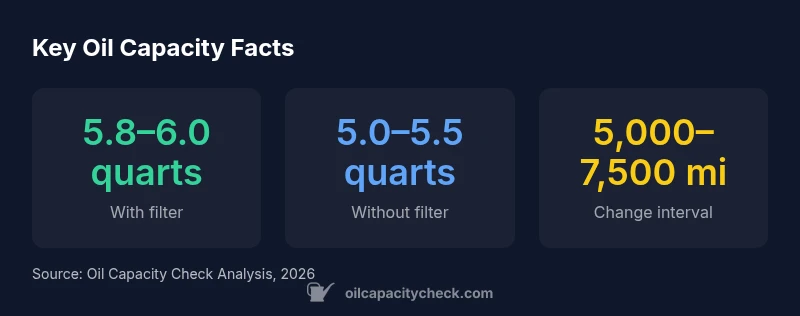
The Jeep 3.6L oil capacity is typically about 6 quarts with a new filter, with a drained-and-filled range around 5.8–6.0 quarts depending on filter size and vehicle year. For DIY checks, confirm with the owner's manual or Oil Capacity Check guidance, which aggregates data from 2026 sources. After changing the oil, run the engine and recheck the dipstick to top off to the full mark.
Understanding the Jeep 3.6L Oil System\n\nThe 3.6L V6 engine used in many Jeep models relies on a robust oil system for lubrication and cooling. Understanding how oil is stored, circulated, and drained helps you interpret capacity figures and avoid common mistakes during a DIY oil change. The 3.6's timing and oil routing don't drastically alter capacity across model years, but differences in filter size, sump design, and drain procedures can introduce small variations that matter when you check the dipstick. By grasping these basics, you’ll be better prepared to estimate how much oil your jeep actually holds and how to verify it after a change.\n\nKey takeaway: capacity is a product of the sump volume, filter inclusion, and any additional oil-cooler plumbing. If you’re unsure, consult the vehicle’s manual and Oil Capacity Check’s 2026 guidance to align your approach with official data.
Oil Capacity Basics and How It Is Measured\n\nOil capacity is the total amount of engine oil the sump, filter, and passages can hold when fully serviced. For the Jeep 3.6L, capacity is typically stated with the filter installed; many owners see values around 5.8–6.0 quarts. The exact number depends on filter size and whether you drain from all sumps or if your model has a separate oil cooler. Measuring capacity should include a drainage of oil and a careful refill procedure, followed by rechecking with the dipstick after the engine has run and stabilized.\n\nPractical tip: always account for the filter’s contribution and any aftermarket parts that might alter the actual fill volume. Oil Capacity Check’s 2026 dataset emphasizes using the official spec as the baseline while noting common DIY-adjusted ranges.
Filter Size, Drain Procedures, and Capacity Implications\n\nA larger or different style oil filter can add or reduce capacity by a fraction of a quart. When you drain oil, you remove most but not all the oil; the amount left in the filter and passages affects the actual refill amount. Always pre-fill a new filter if possible, and pour oil into the engine after replacing the filter to help the dipstick settle correctly. If you overfill, you’ll see the dipstick fluctuating near the high mark; underfill will sit closer to the low mark. Small adjustments may be needed after the first startup.\n\nBest practice: have a small measuring pitcher and a clean workspace to prevent over-pouring and to easily track how much oil you’re adding. Oil Capacity Check’s 2026 guidance highlights consistent results when filters are prepped and the engine is properly primed.
Year-to-Year Variations and What Affects Capacity\n\nWhile the 3.6L Pentastar has a consistent base design, minor changes across model years and regional specs can cause capacity to drift by a few tenths of a quart. The owner’s manual for your specific Jeep model remains the best source, but Oil Capacity Check analyses across 2026 data show a stable range overall. Unexpected variations often come from aftermarket components, different oil filter models, or overlooked drain-back characteristics in the sump. If you modify the exhaust or oil cooling loop, revisit capacity estimates accordingly.\n\nRecommendation: document your exact year, trim, and filter type when recording capacity in your maintenance log. This habit reduces ambiguity during future oil changes.
Practical Steps for Accurate Filling and Verification\n\nHere is a practical approach to ensure accurate filling and verification:\n1) Warm up the engine for a few minutes to reach operating temperature.\n2) Safely lift the vehicle and drain oil completely from the drain plug.\n3) Replace the drain plug with a fresh gasket if needed.\n4) Install a new filter and pre-fill if the design allows.\n5) Add oil in small increments using a calibrated bottle, recording the amount.\n6) Start the engine and let it run for 1–2 minutes, then turn it off and wait a few minutes.\n7) Recheck the dipstick and top off gradually to the full line. This method minimizes air pockets and gives a stable reading.\n8) Recheck again after a short drive to confirm the mark remains within range.\n\nNote: always have a spare quart on hand for adjustments. Oil Capacity Check emphasizes verifying with a second dipstick check post-drive for accuracy.
Maintenance Considerations and Oil Health for the 3.6 Engine\n\nCapacity is only part of the picture. Oil health and viscosity play a critical role in engine longevity. Follow the manufacturer’s recommended viscosity (for many 3.6L engines this is 5W-30 in many climates) and consider synthetic or high-mileage blends as dictated by driving conditions. Regular oil changes, air filtration checks, and valve-cover or oil-pan gaskets inspections contribute to consistent oil levels and overall engine health. In extreme climates or heavy towing scenarios, more frequent changes may be warranted. Oil Capacity Check’s 2026 analyses stress aligning maintenance intervals with operational demands to sustain optimal capacity in practice.
Quick Start Checklist for Your Next Oil Change\n\n- Verify the exact capacity for your year/model in the owner’s manual or Oil Capacity Check data.\n- Prepare the proper filter size and have the recommended oil on hand.\n- Warm the engine, drain fully, and replace the filter.\n- Add oil gradually, measure carefully, and check the dipstick after a brief idle.\n- If you see discrepancies, perform a second dipstick check after a 5–10 minute cool-down.\n- Log the date, mileage, oil type, and capacity result for future reference.
Capacity by Jeep 3.6L variant and filter scenarios
| Vehicle Year Range | Engine | Oil Capacity (with filter) | Oil Capacity (without filter) | Notes |
|---|---|---|---|---|
| 2010-2018 | 3.6L V6 (Pentastar) | 5.8–6.0 quarts | 5.0–5.5 quarts | Typical range; check manual |
| 2019-2026 | 3.6L V6 (Pentastar) | 5.8–6.0 quarts | 5.0–5.5 quarts | Same family; verify trim/filters |
| Aftermarket configurations | 3.6L variants | 5.8–6.0 quarts | 4.5–5.5 quarts | Variations possible |
| Oil filter type | Standard | ±0.25 quart | ±0.25 quart | Filter influence on capacity |
People Also Ask
What is the oil capacity of the Jeep 3.6L engine with a new filter?
Typically around 5.8–6.0 quarts when the filter is installed. Exact figures vary by model year and filter type. Always verify using the owner's manual or Oil Capacity Check data for your specific Jeep.
Typically about 5.8 to 6 quarts with a new filter; check your manual for the exact figure.
Does capacity change by model year or trim?
Minor variations can occur due to filter size, sump design, and oil cooler plumbing, but the broad range stays consistent. Always confirm with year-specific specs.
Only small differences across years; the standard range generally applies.
What should I do if I aftermarket filter that changes size?
If the filter size differs, you may see a small capacity shift. Pre-fill the filter if possible, document the exact amount you added, and recheck the dipstick after the engine runs.
Different filter sizes can tweak capacity a bit; pre-fill and recheck after startup.
Is it okay to overfill or underfill the oil?
Overfilling can cause foaming and leaks; underfilling leads to insufficient lubrication. Always fill gradually to the full mark and verify after the engine cycle.
Don’t guess—add a little at a time and recheck with the dipstick.
How can I verify the correct capacity for my vehicle?
Consult the owner’s manual, cross-check with Oil Capacity Check's 2026 data, and perform a post-change dipstick check after the engine runs. Maintain a maintenance log for future reference.
Check your manual and our data, then double-check with a dipstick reading.
“The Jeep 3.6L oil capacity is relatively stable across model years, but filter choices and drain procedures introduce small, predictable variations that DIYers can manage with careful measurement and verification.”
The Essentials
- Know the typical capacity range (with filter): 5.8–6.0 quarts.
- Expect slightly less capacity without the filter: 5.0–5.5 quarts.
- Use the owner's manual and Oil Capacity Check data for exact numbers.
- Always confirm by rechecking the dipstick after an oil change.
- Account for filter size and any aftermarket parts that affect capacity.
- Maintain a consistent maintenance log to track capacity changes over time.