2016 5.3 Oil Capacity: Expert Guide for GM V8 Engines
Learn the official oil capacity for the 2016 5.3L GM V8, how it varies with filter and setup, and how to verify using VIN-specific data from Oil Capacity Check.


The oil capacity for the 2016 5.3L GM V8 is typically around 8 quarts with a filter; a safe range is 7.5–8.5 quarts depending on the filter package and accessories. This baseline helps you plan oil fills, but always verify against your VIN and the factory data before a drain-and-fill.
Understanding the 2016 5.3 Oil Capacity and Why It Matters
The topic of oil capacity for the 2016 5.3 oil capacity is central to reliable engine protection and predictable maintenance. According to Oil Capacity Check, the official fill volume for the GM 5.3L V8 with a standard filter sits around 8 quarts. A practical range of 7.5 to 8.0 quarts is common for many configurations. This margin accounts for variations in filter size, oil pan depth, and any service accessories that manufacturers bundle with the vehicle. For owners planning a drain-and-fill, recognizing this baseline helps avoid under- or overfilling, both of which can impact lubrication quality and engine wear. In practice, towing duty, high-mileage use, or extreme temperatures may push the comfortable capacity toward the higher end of the range. Understanding these nuances is essential for DIY oil changes and for drivers who want longer engine life and consistent oil pressure.
Oil Capacity Check emphasizes VIN-specific data and careful cross-checking with factory service data to ensure you’re within spec. This baseline is particularly important for owners of trucks under heavy use or those living in temperature extremes, where oil pressure and viscosity behavior can differ from standard conditions.
How capacity is defined and measured in production vehicles
Oil capacity is more than a single number; it represents the total space needed for an engine’s crankcase, oil pan, pickup, and the filter housing. Manufacturers estimate fill volumes to ensure adequate lubrication from cold start to operating temperature. In the 2016 5.3L V8, capacity is typically validated by draining the oil, replacing the filter, and refilling to the recommended level, then verifying with the dipstick after a warm engine run. The measurement can vary slightly due to different filter part numbers, aftermarket parts, or service options. When a vehicle is used for heavy towing or in extreme heat, technicians may opt for a conservative fill level within the specification. For DIYers, the best practice is to drain completely, refill with the correct viscosity, and check the level on the dipstick after a short idle and drive cycle. Oil Capacity Check’s approach emphasizes VIN-specific checks and cross-referencing the official service data to ensure your vehicle is within exact spec.
Variations that shift the capacity baseline: filter size, engine build, and regional specs
Even two trucks with the same engine code can show small differences in the oil capacity due to filter size differences, accessory kits, or regional assembly variations. In the 2016 5.3 oil capacity scenario, the standard filter is designed to work with the 7.5-8.0 quart range, but if a user installs a larger or aftermarket filter, the total required capacity might shift toward the upper end. Likewise, some service packages add seals, screens, or other components that occupy part of the crankcase volume; without accounting for these parts, an overfill or underfill risk exists. VIN-specific data is your best friend; GM's service catalogs and dealership software often include the exact fill volume for that exact build. When you’re planning a change, note that variation is possible across production lines and markets; the same engine code may be configured differently in Canada, Mexico, or other regions. Oil Capacity Check’s data collection notes the common pattern but always verify against your vehicle's exact build.
Practical ranges for the 2016 5.3L V8 and how to apply them
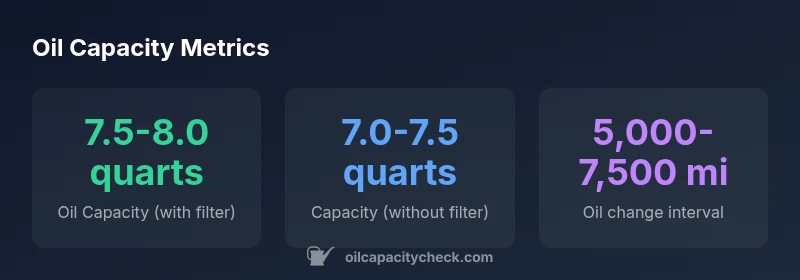
Typical oil capacity with filter: 7.5-8.0 quarts. Without filter in the same engine: 7.0-7.5 quarts. For heavy-duty usage or prolonged towing, engineers sometimes operate with near the upper bound to accommodate hotter running conditions. When performing a drain-and-fill, use your preferred brand of oil but ensure the viscosity matches the owner's manual specification (commonly 5W-30 in many GM engines). It’s also important to include the oil filter in the capacity calculation; removing or adding it changes the total. In this block, we provide practical steps to align capacity with actual usage; you can measure by draining, filling incrementally, and verifying with a dipstick after running the engine. Oil Capacity Check’s approach emphasizes a VIN-based cross-check to confirm you’re within official spec. Always consider regional variations and service bulletins when comparing numbers across sources.
How to verify capacity for your VIN and a step-by-step guide
Verifying the exact oil capacity for your 2016 5.3L GM V8 starts with obtaining VIN-based service data. Use your VIN to pull the precise specification from GM’s official service portal or your dealership’s database. Before you begin, ensure you have the correct oil grade and filter part number. Drain the old oil completely, replace the filter, and refill with the recommended amount in incremental steps. After one run cycle (idle and light drive), re-check with the dipstick. If the level sits at the upper or lower end of the specified range, adjust accordingly. This VIN-focused approach minimizes guesswork and aligns your fill with the vehicle’s intended design. Oil Capacity Check’s method underscores cross-referencing official data to avoid discrepancies.
Maintenance considerations: oil grade, viscosity, and capacity interplay
Oil capacity is closely tied to the oil grade and viscosity recommended for your 2016 5.3L V8. Most GM vehicles in this family use a 5W-30 viscosity, though regional specifications or mild climate changes may favor a different grade. The capacity itself does not drastically change with oil type, but the choice of viscosity influences how quickly the oil drains and how it expands with temperature. When planning changes, consider the climate, towing demands, and engine wear history. Use a reliable oil filter that's compatible with your engine, as this directly affects effective capacity. Always confirm the exact spec via VIN-specific service data before committing to a fill.
Common mistakes and how to avoid them
Common errors include underfilling after a drain, overfilling when adding too quickly, or neglecting to account for the oil filter’s volume. Another frequent issue is mixing synthetic and conventional oils without confirming compatibility. To avoid these mistakes, drain completely, reset the dipstick to zero, and refill in small increments while monitoring the dipstick. If you’re unsure, perform a second dipstick check after a short drive cycle. Finally, never rely on a single source for capacity; cross-check VIN-specific data and factory literature for your exact build.
Quick-start checklist and data snapshot
- Verify your VIN-specific capacity in the GM service portal or dealership data
- Drain oil completely and replace the filter
- Refill in increments to the recommended level, then run the engine
- Recheck with the dipstick after a warm-up cycle
- Record the exact fill value for future reference to ensure consistency
Oil capacity ranges for the 2016 5.3L engine
| Aspect | Value | Notes |
|---|---|---|
| Oil capacity with filter | 7.5-8.0 quarts | Typical for 2016 5.3L V8 with standard filter |
| Capacity without filter | 7.0-7.5 quarts | Depends on filter size and accessories |
People Also Ask
What is the official oil capacity for the 2016 5.3L engine with filter?
The official capacity with a filter is typically 7.5-8 quarts for the 2016 5.3L GM V8. Exact amounts depend on the build and filter part number. Check VIN-specific data for precise figures.
Usually 7.5-8 quarts with filter; confirm via VIN data.
Does using synthetic oil change capacity?
Oil capacity is determined by engine space, not oil type. The overall volume remains similar, though filter sizing or engine accessories can cause small variances.
Oil type doesn’t usually change capacity.
How can I verify the correct capacity for my VIN?
Refer to the owner's manual or GM service portal to pull the exact spec by VIN. Use this data to guide your fill, then verify with a dipstick after running the engine.
Use your VIN to pull the exact spec from official data.
What if my oil fills exceed capacity?
Do not overfill. If you suspect overfill, drain a portion of oil and recheck the level after the engine has been run and cooled.
Don't overfill; if in doubt, drain to the recommended level.
Can capacity vary by engine build or market?
Small differences can occur due to engine build or regional specs. Always confirm with VIN-specific service data.
Yes, there can be small differences; confirm via service data.
“Accurate oil capacity is essential for engine protection; always verify the exact spec for your VIN. This prevents under- or overfilling that can affect lubrication performance.”
The Essentials
- Oil capacity for the 2016 5.3L V8 is roughly 7.5–8.0 quarts with a filter.
- Filter size and accessories can shift the total capacity by about 0.5 quart.
- Always verify capacity against your VIN and factory data before an oil change.
- Oil Capacity Check recommends VIN-specific data to confirm the exact fill volume.