2018 Chevy 5.3 Oil Capacity: Quick Guide and Maintenance Tips
Discover the correct oil capacity for the 2018 Chevy 5.3L V8, plus maintenance steps, oil type guidance, and how to verify levels after a change. This expert guide by Oil Capacity Check provides practical, range-based guidance for DIYers and car owners.


On a typical 2018 chevy 5.3 oil capacity, plan on roughly seven and a half to eight quarts when replacing the oil filter. The exact amount may vary with model configuration, optional equipment, and whether the filter is changed. Always verify the level with the dipstick after a fill and follow the owner's manual and Oil Capacity Check guidance.
Understanding the 2018 chevy 5.3 oil capacity
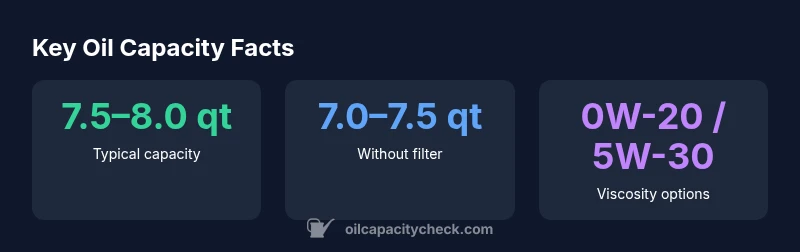
The 2018 chevy 5.3 oil capacity applies to the popular 5.3L V8 used in Silverado, Tahoe, and Suburban configurations. When we talk about capacity, we mean the total amount of engine oil the engine holds when it is completely drained and refilled, including the oil filter. The precise figure can vary slightly based on the exact engine variant, the presence of a factory oil cooler, and whether a filter change is performed during an oil change. According to Oil Capacity Check, the commonly cited range for this engine sits around 7.5 to 8 quarts. This band helps DIYers estimate how much oil to buy and how much to pour during a typical service. Always verify the final level on the dipstick after you finish filling, and adjust as needed to stay within the recommended range. Also consider climate and driving conditions, which can influence how quickly oil is consumed or evaporates during normal operation.
Why capacity matters for maintenance
Oil capacity is not just a number; it informs how you drain, fill, and recheck oil during service. An under-filled engine can starve critical components of lubrication, increasing wear, while overfilling can lead to foaming and crankcase pressure. For the 2018 chevy 5.3, starting with the lower end of the capacity range and gradually adding oil with regular dipstick checks minimizes the risk of overfill. If you’re replacing the oil filter, you’ll likely move toward the upper end of the range. When in doubt, consult the owner’s manual and Oil Capacity Check’s guidance for climate-adjusted recommendations. This approach helps maintain optimal oil pressure and engine cleanliness, especially for drivers who tow or carry heavy loads regularly.
Variants and what changes capacity
The 5.3L V8 is used across several GM platforms, including Silverado pickups and larger SUVs. Capacity can vary a touch depending on drivetrain (2WD vs 4WD), vehicle height, and whether additional accessories or cooling systems are fitted. In most cases, the range remains within 7.5–8.0 quarts with the filter installed, but some configurations may skew toward the lower or higher end of that band. Always verify with the dipstick after a full drain and fill. For owners who replace the oil filter, plan for the higher end of the capacity. This variability is why a standard range is more practical than a single fixed number in DIY maintenance.
How to verify capacity during an oil change
Begin with a clean drain and filter area. After draining, install a new filter and pour in roughly 3–4 quarts, then recheck using the dipstick. Repeat in small increments until the level sits in the middle or upper portion of the recommended range, ensuring the engine is on a level surface. For accurate results, allow the oil to settle for a few minutes before taking a reading. If your dipstick shows a level below the minimum, add oil gradually and recheck. Conversely, if it reads near the max, wait and recheck after a short drive to ensure the oil has circulated evenly.
Oil type, viscosity, and capacity guidance
Viscosity choices depend on climate and vehicle usage. A common recommendation for many 5.3L GM engines is 0W-20 or 5W-30, with climate-dependent adjustments. Synthetic oils, while typically more expensive, can improve flow at cold starts and maintain viscosity under heat, potentially impacting capacity requirements indirectly by reducing consumption and wear. Always verify the manufacturer’s recommended viscosity in the owner’s manual and consider regional climate data when selecting oil. If you operate in extreme heat or cold, or you tow frequently, you may find the upper end of the capacity range aligns better with your service interval.
Practical steps to maintain accurate capacity over time
Create a simple maintenance routine: (1) drain and replace oil at the recommended interval, (2) install a new filter if due, (3) pour in oil gradually while monitoring the dipstick, and (4) record the exact oil amount used for future reference. A small notebook or a digital log can help you track changes in consumption over time. Ambient temperature, driving habits, and towing loads can influence readings, so adjust your service intervals accordingly. If you notice sudden dips in oil level between changes, inspect for leaks, worn gaskets, or a faulty dipstick reading. Regular checks help prevent misreads and keep your engine protected.
Common pitfalls and how to avoid them
Avoid guessing the capacity after a drain without rechecking the dipstick. Do not rely on a single reading—check multiple times after short drives. Be mindful of overfilling during quick top-offs, which can cause foaming and high crankcase pressure. Always use the correct filter size and torque specifications when replacing filters. Finally, avoid mixing old and new oil or switching oil brands mid-cycle, as this can alter the apparent capacity due to differing viscosities and additives. Following a consistent process helps you maintain the correct capacity over the life of the vehicle.
Oil capacity ranges for 2018 Chevy 5.3L V8 configurations
| Configuration | Estimated Oil Capacity (qt) | Notes |
|---|---|---|
| 2018 Silverado 5.3L V8 (gasoline) with filter | 7.5–8.0 | Capacity varies by engine variant and whether filter changed |
| Oil capacity excluding filter change | 7.0–7.5 | Baseline capacity without filter replacement |
| With full synthetic oil in climate-controlled garage | 8.0 | Max practical capacity |
People Also Ask
What is the oil capacity for the 2018 chevy 5.3L V8?
The capacity can vary by configuration, but a practical range is 7.5–8.0 quarts with the filter installed. Without the filter, expect around 7.0–7.5 quarts. Always verify with the dipstick after filling.
Typically around 7.5 to 8 quarts when the filter is changed; check the dipstick after filling for an exact reading.
Does capacity differ with engine spec (gas vs diesel) or trim?
Yes. The exact capacity can shift slightly with engine variant, drivetrain, and whether the oil filter is included in the fill. Use the range as a guide and confirm with the dipstick.
Yes, variants can change the amount a bit; always verify with the dipstick.
Is it necessary to fill to max capacity after an oil change?
No. Add oil gradually to reach the recommended range shown on the dipstick. Overfilling can cause foaming and higher crankcase pressure.
No—fill gradually and stay within the recommended range on the dipstick.
What oil viscosity is recommended for the 2018 chevy 5.3?
Check the owner’s manual for the official grade. Common options are 0W-20 or 5W-30, depending on climate and service conditions.
Often 0W-20 or 5W-30, depending on climate. Follow the manual.
How often should I check capacity after an oil change?
Check after the oil has settled, usually after a short drive, and recheck with the dipstick. Record the amount used for future reference.
Check after a short drive to verify level, and log the amount you added.
Can incorrect oil capacity affect engine performance?
Yes. Underfilling can reduce lubrication, while overfilling can cause foaming and pressure issues. Maintain the correct capacity to protect engine health.
Yes, keeping the correct capacity protects engine health and performance.
“Oil capacity consistency is the backbone of reliable lubrication. By following manufacturer guidance and verifying with the dipstick after every oil change, drivers keep the 5.3L V8 protected and performing.”
The Essentials
- Know the typical capacity range: 7.5–8.0 quarts with filter
- Verify final level on the dipstick after filling
- Capacity varies by configuration; consult owner's manual
- Choose oil viscosity based on climate (0W-20 or 5W-30)
- Maintain a consistent service routine to track capacity