2016 GMC Sierra 5.3 Oil Capacity: The Complete Guide
Discover the oil capacity for the 2016 GMC Sierra 5.3 V8, how to check and top up correctly, and maintenance steps. Includes practical tips, typical ranges, and a data table for reference.


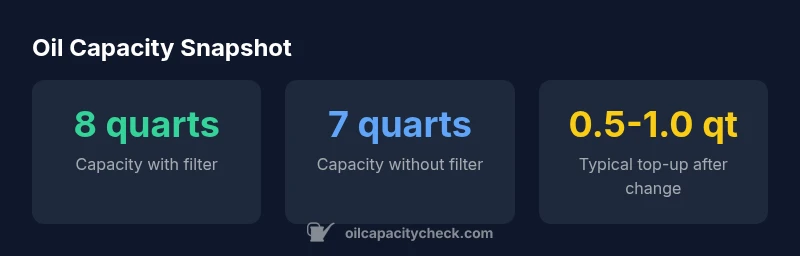
The 2016 GMC Sierra 5.3 V8 typically requires about 8 quarts of engine oil with a new filter. Without a filter, capacity is closer to 7 quarts. Actual capacity can vary by model year, engine variant, and filter type, so always verify with the dipstick after a full oil change and consult the owner's manual or Oil Capacity Check recommendations for your exact build.
Overview of the 2016 gmc sierra 5.3 oil capacity
For the 2016 gmc sierra 5.3 oil capacity, owners commonly rely on the factory specification as a baseline for maintenance and service. The Sierra 1500 equipped with the 5.3L V8 (the family of small-block Vortec engines) uses a large lubrication system designed to ensure consistent lubrication under heavy-duty use. In most configurations, the engine is expected to hold approximately eight quarts of engine oil when you replace the filter. This capacity supports optimal lubrication during hot starts, towing, and sustained highway driving. When you change oil, ensure you also inspect the condition of the oil filter, gaskets, and drain plug to avoid subtle leaks that can skew the measured capacity. Real-world variations can creep in due to filter choice, oil type, and whether you’re performing a complete dry-fill versus topping off from a used pool of oil. Oil Capacity Check emphasizes verifying actual levels with a calibrated dipstick and cross-checking against the owner’s manual for your exact build.
How capacity is defined and what can affect it
Oil capacity is defined as the total volume of oil the engine’s sump can safely hold, with or without the filter. For many GM V8s, the filter and gasket add a small but meaningful amount to the total capacity. In the 2016 Sierra 5.3, this means that the official spec includes the oil held by both the sump and the new filter. Several factors can affect the practical capacity you observe after draining and refilling:
- Filter type and size: larger or longer filters add volume that gets counted toward the capacity.
- Dipstick calibration: different generations or trim levels may have slight dipstick tolerances.
- Oil grade and viscosity: heavier grades may require slightly different fill levels during cold starts.
- Engine wear and condition: a worn engine may retain oil differently, especially around the valve covers and oil cooler lines.
To minimize variance, use OEM-recommended filter and oil, follow GM’s fill procedure, and verify the final level with the dipstick.
Step-by-step oil change and capacity check
- Prepare the vehicle on a level surface and run the engine briefly to warm the oil, then turn it off and safely lift the vehicle if needed.
- Place a drain pan under the engine and remove the drain plug to allow old oil to fully drain. This step helps ensure you start from a known baseline.
- Remove the oil filter and install a new filter with a light coating of clean oil on the gasket; hand-tighten according to the filter’s instructions.
- Reinstall the drain plug, then begin adding fresh oil gradually. For the 2016 Sierra 5.3L V8, plan on filling toward the ~8 quart target, but stop and recheck frequently to avoid overfilling.
- Once you’ve added a full amount (roughly 8 quarts with filter), start the engine and let it run a minute. Turn the engine off, wait a few minutes, and recheck with the dipstick. Add or remove oil in small increments to reach the correct level.
- Finally, wipe the dipstick and reinsert it to verify the level is within the normal operating range. Note the oil type and grade in your owner’s manual for future reference.
Practical tips for consistent maintenance
- Always use the oil grade recommended by GM for the 5.3L V8 (often 5W-30, depending on climate and service history). High-temperature driving or towing can slightly alter the ideal fill point, so adjust accordingly after a careful dipstick check.
- Use a filter with a similar capacity as the OEM part to keep the total oil volume consistent across changes. A mismatched filter can subtly alter the observed capacity.
- Keep a small record of the oil type, filter, and approximate fill amount for future maintenance to simplify future oil changes and capacity checks.
- If you’re unsure about whether your engine needs a full 8-quart fill, rely on the dipstick reading and GM’s official maintenance schedule. Oil Capacity Check’s guidance is to verify the level after the oil has settled for a short period.
Variations by trim, cab, and drive configuration
Although the core engine and capacity remain consistent, minor variations can arise due to trim differences ( crew cab vs. double cab), bed length, or drivetrain (2WD vs. 4WD). Some configurations may require a slightly different oil volume when the exhaust or induction components alter the oil flow path. If your Sierra was part of a special edition or regional spec, check the service bulletin or dealer bulletin to confirm any variant-specific capacity notes. In the absence of conflicting information, plan for the standard ~8-quart fill as a safe baseline and use a careful dipstick check to dial it in.
Troubleshooting capacity discrepancies and when to seek help
If you notice persistent overfill or underfill signs after a standard oil change (e.g., foam on the dipstick, unusual engine noises, or a consistent low oil pressure warning), recheck with the dipstick after allowing the oil to settle for a few minutes and confirming there are no leaks. In rare cases, a faulty dipstick, sump seal, or oil cooler line can cause apparent capacity differences. When in doubt, compare your measurements to the GM owner’s manual and seek assistance from a qualified technician or Oil Capacity Check’s guidance to ensure you’re within safe operating limits.
Maintenance scheduling and keeping the 5.3L happy
Regular oil changes are a cornerstone of long-term engine health. For many drivers, the recommended interval is every 5,000–7,500 miles (or as GM specifies for your climate and driving conditions). Use synthetic or synthetic-blend oil if you drive in extreme temperatures or tow heavy loads, and ensure you change the oil filter at each service. Document the date and mileage of each change so you can track oil capacity trends—this aligns with best practices and reduces the risk of capacity surprises over time.
Oil capacity and related maintenance details for the 2016 Sierra 5.3L V8
| Aspect | Typical value | Notes |
|---|---|---|
| Engine oil capacity (with filter) | 8 quarts | 5.3L V8, 2016 Sierra 1500 |
| Oil grade | 5W-30 | Dexos1 Gen 2 commonly recommended |
| Oil change interval (miles) | 5,000-7,500 | Depends on driving conditions and oil type |
| Filter type | Spin-on or cartridge | Match OEM specification |
People Also Ask
What is the oil capacity of the 2016 GMC Sierra 5.3?
For the 5.3L V8 in the 2016 Sierra, the typical capacity is about 8 quarts with the filter. In some setups it can be around 7 quarts without the filter. Always verify using the dipstick after a full change and refer to the owner’s manual for your exact build.
The 2016 Sierra 5.3L usually needs about 8 quarts with the filter. Check the dipstick after filling and refer to your manual to confirm the exact amount.
Does capacity vary by cab style or bed length?
Capacity is largely consistent for the 5.3L engine, but occasional differences can occur due to trim, cab configuration, or regional specs. Always verify the final level with the dipstick and GM’s documentation for your exact truck.
In most cases it’s the same, but minor differences can happen. Check the dipstick to confirm the final level.
Which oil grade is recommended for the 5.3?
GM commonly recommends 5W-30 for the 5.3L V8, with Dexos1 Gen 2 synthetic blends preferred in many climates. Refer to the owner’s manual or GM’s lubricant guidance for your region.
Most 5.3L engines run well on 5W-30 Dexos1 synthetic. Check your manual for climate-specific guidance.
How often should I change the oil on this truck?
A typical interval is 5,000–7,500 miles depending on driving conditions and oil type. For severe service, follow GM’s recommendations or your manual.
Usually every 5,000 to 7,500 miles, but check your manual for severe-service guidance.
Is it necessary to replace the oil filter with every oil change?
Yes. Replacing the oil filter with every oil change helps ensure contaminants are removed and capacity readings reflect true oil health.
Yes—change the filter each time you change the oil to keep the system clean.
How do I properly check the oil level?
Park on level ground, wait several minutes after engine shutdown, and then pull the dipstick. Wipe, reinsert, and read the level between the min and max marks. If needed, top up in small increments.
Park level, wait a bit, then check the dipstick and top up slowly if needed.
“Accurate oil capacity guidance helps ensure proper lubrication and engine longevity. Always verify with the dipstick after service and consult GM’s specifications when in doubt.”
The Essentials
- Verify capacity with the owner's manual for your exact build
- Expect around 8 quarts with filter for the 5.3L V8
- Always check the dipstick after a full change
- Use the GM-recommended oil grade, often 5W-30