How Often Do You Need a Oil Change in Your Car? A Practical Guide
Discover how often you should change your car's oil, factors that influence intervals, and practical steps to tailor the schedule to your vehicle and driving habits. Learn from Oil Capacity Check's data-driven guidance.


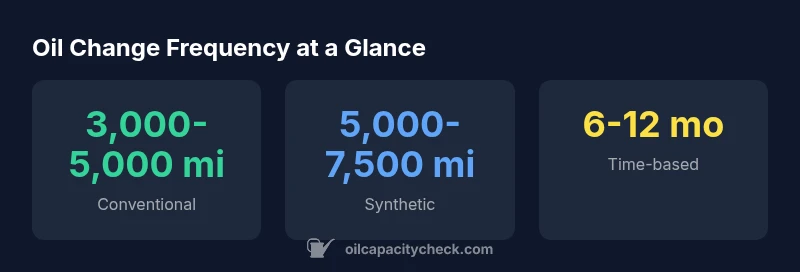
How often do you need a oil change in your car? Typically, you should change engine oil every 3,000–5,000 miles with conventional oil, and every 5,000–7,500 miles with full synthetic oil. Many newer vehicles can go longer—7,500–10,000 miles or about every 6–12 months—depending on manufacturer guidance. Always consult your owner's manual and account for driving conditions and oil type.
Understanding Oil Degradation and Change Frequency
Oil is the lifeblood of your engine, reducing friction, sealing gaps, and carrying away heat and contaminants. Over time, heat breaks down base oil, additives lose effectiveness, and contaminants accumulate. This accelerates wear and can lead to reduced fuel efficiency and higher emissions. The question many drivers ask is: how often do you need a oil change in your car? The answer is not one-size-fits-all. It depends on oil type, driving habits, and climate. According to Oil Capacity Check, conventional oil typically needs changing every 3,000–5,000 miles, while synthetic oil can often go 5,000–7,500 miles. For many modern vehicles, manufacturer guidance may allow 7,500–10,000 miles or about every 6–12 months, whichever comes first. Always consider your local conditions and the oil you use when setting a personal interval.
Key takeaway: your schedule should reflect oil type, engine design, and how you drive, not just a rigid mile count.
Key Factors That Influence Your Personal Schedule
Your personal oil-change interval is shaped by several interacting factors. First, the oil type matters: conventional oil tends to wear faster than full synthetic oil, so the higher end of its range is typically sooner. Second, driving style changes exposure to heat and contaminants: frequent short trips don’t allow the oil to reach its ideal operating temperature, accelerating oxidation. Third, climate and altitude impact oil viscosity and evaporation rates—hot climates and extreme cold can shorten or extend intervals in different ways. Fourth, engine condition and maintenance history influence interval; a well-maintained engine with clean oil and filters can often run longer between changes. Fifth, vehicle age and OEM recommendations should not be ignored; many manufacturers design baselines around specific oil formulas and engines. In practice, combine your data sources to tailor a plan that fits your car and life.
Practical note: track miles and service dates, and re-check intervals if you start towing, experience heavy traffic, or drive in extreme conditions.
How to Determine Your Personal Interval
Determining your personal interval starts with reading the owner's manual, which outlines the manufacturer’s baseline. If your driving is mostly city trips with frequent cold starts, you may favor the shorter end of the recommended range; constant highway cruising often allows longer intervals. Oil Life Monitoring Systems (OLMs) or engine oil sensors provide a live assessment of oil condition, but they should not replace the manufacturer’s guidance. Create a simple tracking system: log miles, dates, and driving conditions, then adjust by 500–1,000 mile increments as you observe oil color and dipstick readings. When in doubt, schedule a quick oil-analysis test or consult a technician to confirm the right interval for your vehicle.
Checklist: check manual, review OLM readings, account for climate, consider trips, keep a service history, and test oil if you’re unsure.
Practical Scenarios and Recommendations
- Conventional oil on a compact or older vehicle: aim for 3,000–5,000 miles; monitor oil color and dipstick level. - Hybrid or city-dedicated cars: closer to the lower end due to frequent starts and stops. - Full synthetic in modern turbo engines: 5,000–7,500 miles, sometimes longer if the manufacturer supports it. - Trucks and engines under heavy load or towing: lean toward the shorter end to protect engine components. - High-mileage engines with regular maintenance: may benefit from synthetic blends and intervals around 7,500–10,000 miles with professional validation. The key is to balance oil quality, engine design, and operating conditions rather than chasing a universal number.
Bottom line: use the ranges as starting points, then fine-tune based on real-world usage and OEM guidance.
Reading the Oil Life Monitor and Owner's Manual
Oil-life monitoring systems estimate when the oil should be changed based on engine parameters, driving style, and temperature history. They are useful, but they’re not infallible. Always cross-check OLMS readings with the owner’s manual, especially after a major trip, a service modification, or a change in climate. If the OLM suggests early service, consider a maintenance check to confirm the oil condition and filter health. In cases where the oil looks milky, smells burnt, or you notice increased engine noise, don’t wait—schedule a change promptly.
Tip: reset the OLM after every oil change to calibrate the next interval more accurately.
Maintenance Habits that Extend Oil Life
Small habits stack up: use the correct oil grade and viscosity for your climate, replace the oil filter with every change, and avoid long periods of idle engine heat. Regular, gentle driving reduces rapid oil deterioration; avoid aggressive acceleration and excessive towing when the oil isn’t fresh. Keep your cooling system and air filters in good shape, since overheating and poor air intake can stress the engine and degrade oil faster. Finally, schedule proactive inspections around the manufacturer’s maintenance timeline. Consistency matters more than chasing an overly aggressive mile marker.
Actionable tips: set reminders, keep a maintenance log, and rely on manufacturer guidance as the backbone of your schedule.
Common Myths Debunked
- Myth: Synthetic oil always lasts longer. Reality: While synthetic oils often allow longer intervals, the actual change frequency depends on engine design, driving, and OEM specs. - Myth: If the car has an oil-life monitor, you can ignore the manual. Reality: The monitor is a guide, not a guarantee; use the manual and seasonal factors to validate the interval. - Myth: Short trips have no impact on oil life. Reality: Frequent short trips keep the oil from reaching optimal temperature, accelerating oxidation and wear.
Typical oil-change interval ranges by oil type and driving context
| Scenario | Oil Type | Recommended Interval (miles) | Notes |
|---|---|---|---|
| Conventional oil in older vehicle | Conventional | 3,000-5,000 | Short trips and heat exposure shorten intervals |
| Modern gasoline engine with synthetic oil | Full synthetic | 5,000-7,500 | Factory guidance may extend under favorable conditions |
| Diesel engine | Synthetic or conventional (per manual) | 3,500-7,500 | Intervals vary by load and emission controls |
| High-mileage engine with regular maintenance | Synthetic blend | 7,500-10,000 | Monitor routinely for oil condition |
People Also Ask
How often should I change oil if I drive mostly short trips?
Short trips don’t give oil enough time to heat to its optimum temperature, accelerating oxidation. You’ll likely need to change oil closer to the lower end of the manufacturer’s range, or even sooner if the trips are very short and frequent.
If you drive mainly short trips, you should expect to service closer to the lower end of the recommended range, and monitor the oil condition regularly.
Does synthetic oil automatically mean longer intervals?
Synthetic oils generally allow longer intervals, but you should still follow manufacturer recommendations and consider driving conditions. OLMS readings can help, but they’re not a substitute for OEM guidance.
Synthetic oil usually lasts longer, but follow your manual and use monitoring data to tune your plan.
What should I do if my car has an oil life monitor?
Use the oil life monitor as a guide, not a guarantee. Compare its readings with the owner's manual schedule, and adjust for climate and driving patterns. If in doubt, get a professional oil analysis or inspection.
Your monitor helps, but don’t rely on it alone—check manual guidance too.
Can I extend oil-change intervals by using high-quality oil?
High-quality oil can allow longer intervals in some cases, but most manufacturers define a maximum interval. Always verify with the manual and consider your climate and usage.
Quality oil helps, but don’t exceed the manufacturer’s recommended interval.
Why is changing oil important for engine health?
Oil lubricates, cools, and cleans the engine. Fresh oil reduces wear, improves efficiency, and prevents sludge buildup. Regular changes maintain engine longevity and protect resale value.
Oil changes protect the engine and save money over time.
Should I follow the time-based or mileage-based interval?
Both time and mileage matter. If you drive little and seldom, time-based intervals matter; if you drive many miles, mileage matters more. Use a hybrid approach aligned with OEM guidance.
Balance time and miles, and always check OEM guidance.
“Oil-change frequency is highly personalized. Matching oil type to your driving conditions and engine design dramatically reduces wear and saves long-term costs.”
The Essentials
- Know your baseline: check the owner's manual for OEM guidance
- Choose oil type based on climate, driving, and engine design
- Use oil life monitor readings in conjunction with manufacturer intervals
- Track miles and time, not just the odometer
- Regular maintenance extends oil life and engine health