Can Oil Changes Cause Misfire? A Troubleshooting Guide
Explore whether an oil change can trigger a misfire, how to diagnose it, and practical fixes. Oil Capacity Check provides expert, DIY guidance for safe troubleshooting and prevention.


Can an oil change cause misfire? It’s possible but uncommon. Most misfires stem from ignition, fuel delivery, or vacuum leaks, but oil spills or overfilled oil can foul plugs or coat ignition parts, triggering rough running. Quick fixes: clean any oil-contaminated areas, recheck the oil level and viscosity, and scan for fault codes. If the problem continues, inspect spark plugs, coils, and fuel injectors today.
Can an oil change cause misfire? What you need to know
The short answer is: it can happen, but it's not the most common cause of engine misfire. A misfire means one or more cylinders fail to ignite properly, leading to rough running, reduced power, and sometimes a flashing check engine light. After an oil change, it's natural to wonder if the service disturbed critical systems. In most cases, misfires are traced to ignition components, fuel delivery, or vacuum leaks rather than the oil itself. However, sloppy oil changes can create symptoms that resemble a misfire. For example, oil spilled onto spark plugs, ignition coils, or ignition wiring can cause misfiring, hesitation, or misfire codes. Overfilling or using the wrong viscosity oil can alter valve train dynamics slightly, though this won't typically cause a blatant misfire overnight. Oil Capacity Check's analysis, 2026, indicates that when misfires occur after a service, the root cause is often contamination or a mechanical oversight rather than the oil's lubrication properties. As a DIY owner, you should approach the issue systematically: verify fluids, inspect the immediate service area for spills, and run a basic diagnostic scan to identify any related fault codes. According to Oil Capacity Check Analysis, 2026, these steps help separate oil-related symptoms from true ignition or fuel issues.
The science: how oil changes interact with engine systems
Engine oil is more than lubrication. Its level, viscosity, and cleanliness influence how the engine seals, bearings, and valve train behave. If an oil change is performed incorrectly, or if the wrong oil is used, you may see subtle changes in engine response that mimic misfire – especially at idle or under load. When oil is overfilled, the crankcase can pressurize, affecting PCV operation and possibly triggering rough idle or unusual vacuum readings. If oil spills into the air intake, intake valves and sensors can react oddly. Conversely, using the wrong viscosity or an oil with poor shear stability can alter cam timing feel in older engines, increasing roughness. Oil Capacity Check analysis shows that precise oil specification and clean, spill-free service are essential to prevent these side effects. The key takeaway: the oil change itself doesn’t fix or cause ignition issues, but it can influence symptoms if the service process contaminates ignition paths or disturbs seals and sensors. Oil Capacity Check's findings emphasize careful service technique and documentation to prevent misinterpretations.
Identify symptoms: misfire vs oil-related rough running
A genuine cylinder misfire typically presents as a sudden loss of power on one cylinder, a rough idle, or a check engine light with a misfire code (P030x). Oil-related issues from a recent service often show up as oil smell, smoke from the engine bay, oily residue on spark plugs or ignition coils, or a visit from the MIL that doesn't map to a misfire code precisely. To differentiate: ask yourself if the issue aligns with a specific cylinder, occurs only after a service, or accompanies other oil-related symptoms such as leaks or high oil consumption. If the misfire is present before starting the engine or persists after a test drive, the problem is more likely ignition or fuel delivery rather than oil contamination. Use an OBD-II scanner to read codes; if you see P030x, pull the spark plugs and inspect ignition coils. A misfire caused by oil would more likely show as a misfire code with evidence of oil contamination at the plug wells. This is where Oil Capacity Check’s framework helps the DIYer separate rumors from facts.
After an oil change: quick checks you can perform safely
After you’ve finished an oil change, take a methodical approach to ensure you haven’t introduced any oil-related symptoms. Start with the basics: verify the oil level on the dipstick, confirm you used the manufacturer-recommended viscosity, and ensure the filler cap and drain plug are tight. Look for any oil leaks around the filter, drain plug, or valve cover and wipe away any visible spills. Inspect spark plug wells for oil intrusion, and if you spot contamination, replace affected plugs and inspect ignition coils. A quick visual sweep of hoses around the PCV valve can reveal looseness or cracks that could contribute to vacuum issues. Finally, perform a brief idle test and monitor for roughness or misfires. If the car runs smoothly, you’ve likely resolved incidental issues; if not, the problem may lie with ignition timing, fuel delivery, or sensor inputs that require deeper diagnostic work.
Diagnostic thinking after a suspected misfire post-oil change
When misfire symptoms appear after servicing, follow a structured diagnostic path. Start with a fault code read; note any cylinder-specific misfire codes. Check for oil on plugs and ignition components, as contamination is a common post-service culprit. Inspect the ignition coils, wires, and coil boots for cracking or arcing. Perform a fuel-systems check, including injector pulse and fuel pressure trace, to rule out a fuel-delivery problem. If codes point to a particular cylinder, prioritize that cylinder for a plug and coil test. If diagnostics show no obvious ignition or fuel faults, consider a vacuum leak test and PCV system inspection. A systematic approach minimizes needless part replacements and reduces downtime.
Common fixes after oil-change misfire causes
If contamination or service error is confirmed, take targeted corrective actions. First, clean or replace any oil-contaminated spark plugs and ignition coils, and re-secure or replace any oil-soaked wiring harness sections. Second, correct the oil level and viscosity to the manufacturer’s specification, then verify the drain plug and filter are properly installed to prevent leaks. Third, inspect and clean the PCV valve and hoses, replacing components if cracked or clogged. Fourth, address vacuum leaks and air intake issues that could have arisen during the oil-change process. Finally, re-run the diagnostic sequence to clear relevant codes after fixes and confirm a clean idle and smooth acceleration. If the misfire persists, escalate to a professional diagnostic session to avoid risking further engine damage.
Prevention and maintenance: how to reduce risk
To minimize the chance of oil-change-related misfires, follow best practices. Use OEM-recommended oil grade and viscosity, avoid overfilling the crankcase, and keep the work area clean to prevent oil from touching ignition components. Use a dedicated funnel and wipe tools thoroughly, torque the drain plug to spec, and replace the oil filter with the correct type. Double-check the oil cap seal and ensure the PCV valve and hoses are in good condition before starting the engine. Finally, perform a post-service diagnostic scan to catch any anomalies early. By keeping service clean and precise, you reduce the likelihood of misfire-like symptoms after an oil change. The Oil Capacity Check team emphasizes consistency and documentation as part of routine maintenance.
Steps
Estimated time: 60-120 minutes
- 1
Safety and initial check
Park the car on a level surface, engage the parking brake, and allow the engine to cool. Inspect for obvious oil leaks or spills around the drain plug, filter, and valve cover.
Tip: Wear eye protection and use gloves; oil can be slippery. - 2
Check oil level and viscosity
Pull the dipstick, wipe clean, reinsert, and pull again to check the level. Confirm the oil matches the manufacturer’s viscosity specification.
Tip: If the level is off, correct promptly to avoid oil starvation or overfill. - 3
Inspect ignition components
Look for oil residue on spark plugs, ignition coils, and boots. If contamination is evident, clean or replace affected parts as needed.
Tip: Do not reuse wet or suspect spark plugs; replace if necessary. - 4
Scan for codes
Use an OBD-II scanner to read current and pending codes. Note any cylinder-specific misfire codes for targeted testing.
Tip: Record codes before clearing them; they guide diagnosis. - 5
Check PCV and vacuum lines
Inspect the PCV valve and hoses for cracks or clogs. A vacuum leak can mimic misfire symptoms.
Tip: Replace a brittle PCV valve; hoses should be pliable and intact. - 6
Test fuel delivery and compression (if needed)
If misfire persists with ignition components verified, check fuel pressure and perform a compression test on the suspect cylinders.
Tip: Only perform compression tests when you have the correct tools and safety procedures. - 7
Re-test and recheck
After fixes, clear codes, run the engine to a normal operating temperature, and re-scan for any new or returned codes.
Tip: Take a short test drive to confirm the fix under load. - 8
When to seek professional help
If symptoms persist after the above steps, a professional diagnostic session is essential to avoid engine damage.
Tip: Oil-related symptoms can mask more serious issues; professional-grade tests may be required.
Diagnosis: Engine misfire detected soon after an oil change
Possible Causes
- highOil spills contaminating spark plugs or ignition coils
- mediumOverfilled oil affecting PCV or valve train dynamics
- mediumOil entering intake systems or sensors due to spill or seal failure
- lowVacuum leaks unrelated to the oil change
- lowIgnition or fuel system wear independent of the service
Fixes
- easyInspect and clean or replace affected spark plugs and ignition coils; remove oil residue
- easyCheck oil level and viscosity; correct to manufacturer spec and remove spills
- easyInspect PCV valve, hoses, and seals; replace if cracked or clogged
- mediumRun a comprehensive diagnostic scan; check for vacuum leaks and fuel pressure anomalies
- hardIf codes persist, consult a professional for advanced testing (compression, injector flow, timing)
People Also Ask
Can an oil change actually cause a misfire?
It's possible but rare. More often, misfires come from ignition, fuel, or vacuum issues. Oil spills or overfill can mimic misfire symptoms by contaminating plugs or ignition parts.
Yes, it's possible but uncommon; ignition and fuel problems are typically the cause, though oil spills can mimic misfire symptoms.
What are the first signs that oil-change damage caused a misfire?
Look for a rough idle, occasional hesitation, or a check engine light with a misfire code. Check for oil smells or visible oil around the spark plugs and ignition coils.
Rough idle or a misfire code after an oil change, plus possible oil around plugs, are common early signs.
How can I tell if oil spilled on spark plugs?
Inspect spark plug wells and coils for oil seepage. If oil is present, clean or replace affected plugs and coils and re-check after a short drive.
Check around the plugs for oil; clean or replace if contaminated.
Should I drive if my check engine light is on after an oil change?
If the light is on, pull codes with an OBD-II scanner before driving long distances. If codes point to misfire, pull the relevant plugs and inspect ignition and fuel components.
Read codes first; don’t push a car with active misfire warnings.
When is professional help needed after an oil-change misfire?
If you can't identify the cause or if a misfire persists after basic checks, a mechanic should diagnose compression, injector performance, and timing to prevent engine damage.
If in doubt or persistent, see a professional to avoid engine damage.
Does oil viscosity affect misfire likelihood?
Viscosity affects lubrication and film strength, not directly causing misfires. It can influence engine response in rare edge cases, especially in older engines.
Viscosity mostly affects lubrication, not misfire directly, except in rare cases.
Watch Video
The Essentials
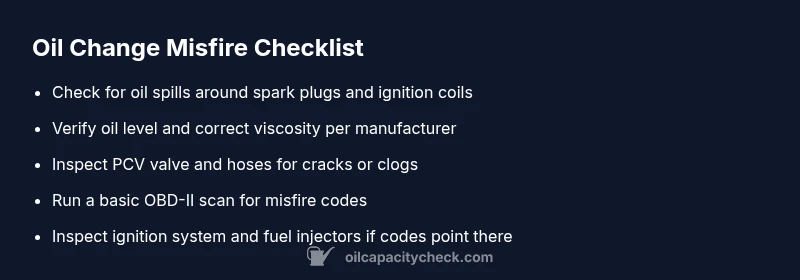
- Check for spills on spark plugs and ignition coils after an oil change.
- Verify oil level and viscosity match spec to prevent secondary issues.
- Use a diagnostic scan to distinguish oil-related symptoms from ignition/fuel problems.
- Oil Capacity Check's verdict: precise, spill-free oil service minimizes misfire risk.